
The middle of a term is where a class stops moving as one body. Two chapters of a mathematics syllabus put a student a long way from where the lesson now begins, and the gap rarely announces itself. The student still hands in work, still writes something in the notebook. It becomes visible at the next test, and by then the class has moved again.
The reflex in most schools is a sprint: extra classes in the evenings before the next test, a revision drive that pauses the syllabus, a note home about seriousness. Each costs more than it appears to, and the following weeks pay the bill.
A better plan starts by refusing the assumption underneath the reflex: that a student who is behind is behind by a single measurable amount. Most mid-term gaps are several gaps at once.
A mid-term gap is usually three different gaps
- A prerequisite gap. The next unit assumes something the student cannot yet do. A student who cannot divide fractions cannot begin ratio, and no amount of practice on ratio will repair that. This is the only kind that must be closed now.
- A fluency gap. The idea is understood but slow and error-prone under time. Ordinary practice closes this, usually with the normal course load.
- A coverage gap. Something was missed through illness, a transfer, or a stretch without a subject teacher, and nothing downstream depends on it yet. It can wait for a revision slot.
Recovery plans fail most often because they treat all three as one problem and spend their scarce hours on the third. A student kept back after school to redo a chapter nobody needs until February is not fixing what is blocking Monday.
The sprint borrows from the weeks after it
The first cost is time: an evening class before a test takes the hours the next unit needed, and the next unit does not shrink to accommodate it.
The second is shallow familiarity. A student carried through a chapter at speed learns to recognise it. Recognition reads as knowledge in the next class, the teacher sees a room of nodding heads and moves faster, and the class reaches the following topic less prepared than before the catch-up began.
The third is the lesson the student takes away: that the remedy for falling behind is a sprint. That is a strategy a school has to unteach later, and it is hardest to unteach in a board year.
Find the blocking gap with a short test that goes backwards
Take the next unit, not the one just finished, and list the two or three things it assumes. Write one or two items per assumption, answerable in a few lines, and run it in class in about fifteen minutes. Mark against skills rather than marks. Four out of ten on a diagnostic built this way tells you something specific; the same score on the last chapter test tells you only that something is wrong.
If the school already tags questions to topics and keeps the responses, the chain is quicker to follow: start from the topics the next unit depends on and work backwards until the evidence stops. Topic-level assessment analytics covers how to keep that mapping honest, including the step most schools skip, which is checking the item before trusting the result. Use items that cannot be answered by guessing, and ask for a shown step.
Teach the prerequisite inside the unit that needs it
The standard remedy is a parallel remedial section, and it usually makes things worse: two versions of the subject, a remedial class that drifts into a second syllabus, and a main class that keeps assuming what the student still lacks.
The alternative is smaller: five minutes at the start of the next unit, taught to the whole class, naming the prerequisite out loud. “This chapter needs you to divide fractions, so here is the case that trips people up.” That closes the gap for those who have it, repairs the shaky version for those who half have it, and labels nobody.
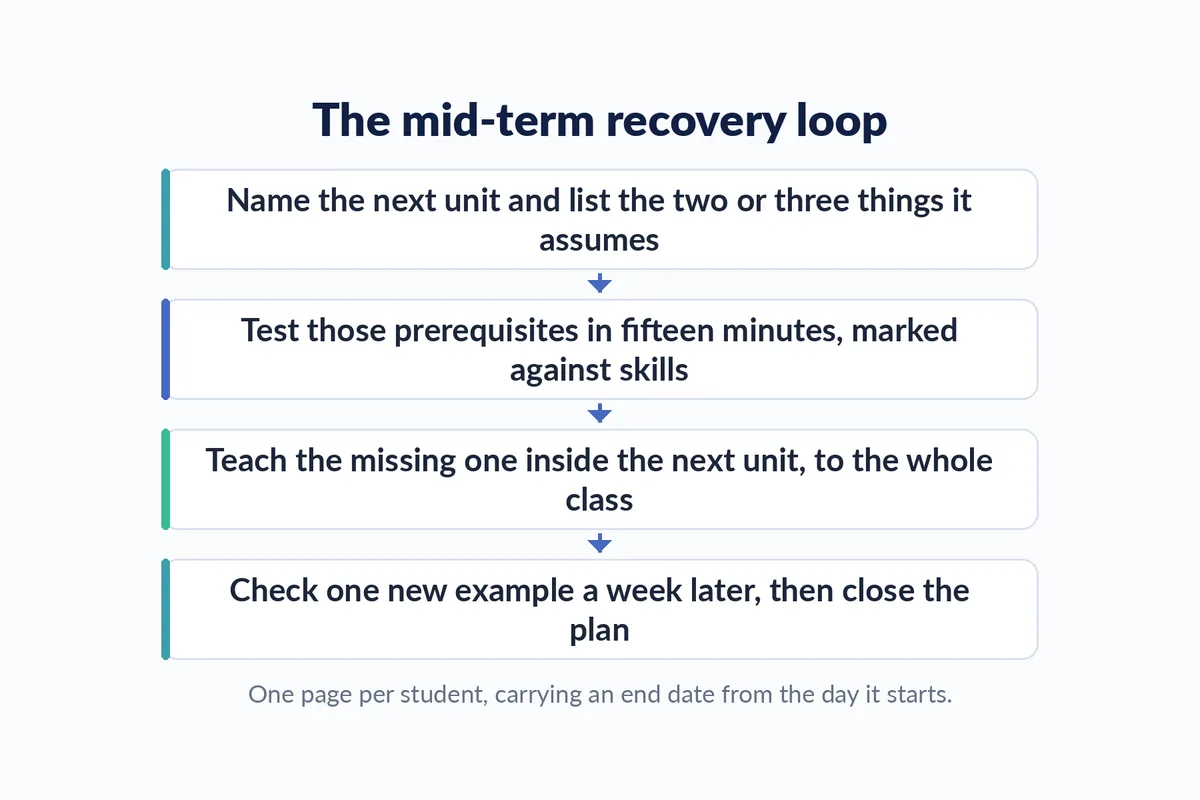
The loop is deliberately short: the diagnosis decides what gets taught, and one check a week later decides whether the plan continues.
Give recovery a slot, not an extra evening
The workable version is dull and small: twenty-five minutes, four days a week, in a slot the timetable already has, such as the block before first period or the library period. Supervised, with one written task a day and a finish line the student can see.
A weekly ninety-minute evening class sounds more serious, but it arrives with a transport arrangement, a safety question, a family that has to agree, and a teacher who is also tired. The daily block compounds, and it does not depend on anyone’s evening.
It also has to come out of somewhere: cut homework volume rather than homework, one practice set rather than the test. What must not happen is a second assessment on top of the first, added so the plan can be measured.
Decide who delivers it, by name
Four options work in real schools: the subject teacher’s weekly clinic period, best for conceptual gaps because the person teaching the next unit is the person diagnosing the last one; a peer tutor from the same class who has just cleared the same gap, strong on procedure and weak on concepts without a printed problem set; a supervised study slot with a prepared pack, as good as the pack; or the remedial teacher, if there is one, working to the class teacher’s page rather than to a separate syllabus.
Whatever the choice, one adult owns the plan. Shared ownership of a recovery plan means nobody checks it.

A peer tutor working through an example with a classmate, which is the cheapest recovery slot most schools already have if the problem set is printed.
Check that it worked, not that it was attended
Attendance is the easiest number to collect and the least useful: a student can sit through every session and still not be able to start the current unit’s work.
The check that matters is one item, on a different example, about a week after the teaching: can the student now begin what the class is doing, unaided? If the gap is closed, close the plan and say so out loud, because a plan never declared finished quietly becomes a permanent label. If it is not closed, change the diagnosis rather than adding hours, since more of the same teaching usually means the prerequisite was misidentified.
Keep the record to five fields, the gap, the slot, the person, the check date and the outcome, rather than a dashboard nobody opens. The same fields kept in an assessment module mean the next teacher inherits the history.
Tell the family one specific thing
“Your child is behind in mathematics” is a verdict, and a family can do nothing with it. A sentence naming one skill, one commitment and one request can be acted on the same evening: “Ananya cannot yet divide fractions, and the next chapter needs it. She will spend twenty minutes a day on it with me for three weeks. At home, the thing that helps is asking her to explain the step out loud.”
That message also protects the school, because a family told about the specific gap does not hear of it for the first time in the report card. Talking to Your Child About a Bad Result is worth sending with the first message rather than after the next test.
When the same gap appears across a class
Individual plans stop being the right instrument when a third of the class is missing the same prerequisite. That is a sequencing problem, and the fix belongs in the scheme of work rather than in forty recovery plans that exhaust teachers while hiding the cause.
What a school needs at mid-term
A school that handles the middle of a term well is not the one that runs the hardest catch-up week. It can answer four questions for any student who has fallen behind: which prerequisite is blocking them, who is teaching it, when, and how the school will know it worked.
Those four answers fit on one page, and the page fits in a normal term. That is the whole recovery plan, and unlike the sprint, it does not have to be paid for twice. A Study Timetable You Will Actually Follow After Week One is the version a student can run alone once the school has named the gap.