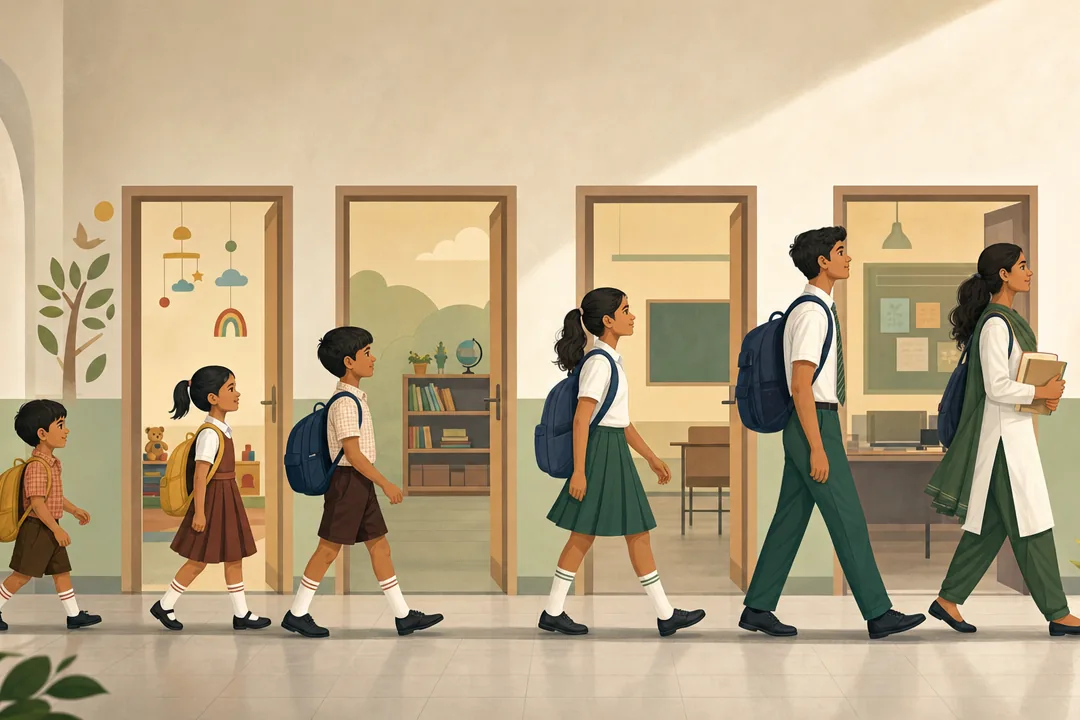
India operates one of the largest and most complex education systems in the world. With over 1.5 million schools, 260 million enrolled students, and dozens of education boards across 28 states and 8 union territories, the system is anything but uniform. For anyone building school management software, working in EdTech, or simply trying to understand how Indian schools function, grasping the different formats, boards, and structural models is essential.
This post breaks down the Indian schooling system: how it is organized, what the major boards are, how the traditional 10+2 model works, and what the National Education Policy (NEP) 2020 is changing.
The Traditional Structure: The 10+2 System
Since the National Policy on Education of 1986, Indian schools have followed a 10+2 structure, splitting school education into two broad phases:
- 10 years of general education (Classes 1 through 10), covering primary, upper primary, and secondary stages
- 2 years of senior secondary / higher secondary education (Classes 11 and 12), where students specialize in a stream
How the 10 Years Break Down
| Stage | Classes | Typical Ages | Focus |
|---|---|---|---|
| Primary | 1 to 5 | 6-11 | Foundational literacy, numeracy, languages, environmental studies |
| Upper Primary / Middle | 6 to 8 | 11-14 | Introduction to sciences, mathematics, social studies, languages |
| Secondary | 9 to 10 | 14-16 | Board-level academics, preparation for Class 10 board exams |
The +2 Phase: Stream Selection
After Class 10, students choose one of three traditional streams for their senior secondary education (Classes 11 and 12):
- Science – Physics, Chemistry, Mathematics, Biology, Computer Science
- Commerce – Accountancy, Business Studies, Economics, Mathematics
- Arts / Humanities – History, Political Science, Geography, Sociology, Psychology, Languages
This stream choice has historically been rigid. A student in the Science stream could not take a Humanities elective, and vice versa. NEP 2020 aims to change this, as we will discuss later.
Board Examinations
Two high-stakes board examinations define the 10+2 system:
- Class 10 boards – The first nationally recognized exam. Results determine stream eligibility and school admission for Classes 11-12.
- Class 12 boards – The culminating school exam. Scores are used for college admissions, competitive entrance exams (JEE, NEET, CUET), and scholarship applications.
These exams are conducted by the education board the school is affiliated with, and this is where the system gets fragmented.
Education Boards: The Governing Bodies
India does not have a single national curriculum or examination body. Schools affiliate with one of several boards, each with its own curriculum, textbooks, exam patterns, and grading systems. The choice of board is one of the most consequential decisions a school makes.
CBSE – Central Board of Secondary Education
- Established: 1929 (reconstituted in 1962)
- Affiliations: Over 29,000 schools across India and 28 countries
- Governing body: Ministry of Education, Government of India
- Curriculum: Based on NCERT (National Council of Educational Research and Training) textbooks
CBSE is the most widely adopted board in India. All Kendriya Vidyalayas (central government schools), Jawahar Navodaya Vidyalayas, and the majority of private English-medium schools are CBSE-affiliated.
Key characteristics:
- Standardized national curriculum across all states
- Emphasis on Science and Mathematics
- Medium of instruction: English or Hindi
- Exams designed to align with national competitive exams (JEE Main, NEET)
- Continuous and Comprehensive Evaluation (CCE) was used from 2010-2017; currently uses traditional exam-based assessment
- Grading uses a positional system (grades based on relative performance within the cohort)
CBSE is the preferred choice for families that relocate frequently across states (military families, government employees, corporate transferees) because the curriculum remains consistent nationwide.
ICSE / ISC – Council for the Indian School Certificate Examinations (CISCE)
- Established: 1958
- Affiliations: Approximately 2,700 schools
- Exams: ICSE (Class 10) and ISC (Class 12)
The CISCE board, commonly referred to as ICSE, is known for its broader and more detailed curriculum compared to CBSE.
Key characteristics:
- Wider subject range with greater depth in English, literature, and the arts
- Internal assessment carries significant weight alongside external board exams
- More analytical and application-based question patterns
- Considered more rigorous in English language skills
- Smaller number of affiliated schools, mostly in urban areas
- Higher fee structures on average
ICSE schools are often chosen by parents who prioritize a well-rounded education with strong English proficiency. The curriculum is also considered better aligned with international standards for students planning to study abroad.
State Boards
- Number: Each of the 28 states and some union territories operate their own board
- Total affiliations: Hundreds of thousands of schools combined
- Examples: Maharashtra State Board (MSBSHSE), Tamil Nadu State Board, Karnataka SSLC, UP Board, West Bengal Board
State boards are the backbone of Indian school education by volume. The vast majority of Indian students – particularly in government and government-aided schools – study under their state board.
Key characteristics:
- Curriculum designed by the state, often in the regional language
- Medium of instruction is typically the state language (Tamil, Telugu, Marathi, Bengali, Kannada, etc.), with English-medium options in some states
- Quality and rigor vary significantly from state to state
- Exam patterns, grading systems, and pass percentages differ across boards
- Fees are generally the lowest of all board types
- Textbooks are state-published and subsidized
The variation between state boards is substantial. Kerala and Tamil Nadu are consistently among the highest-performing states in education indicators, while states like Bihar and Uttar Pradesh face challenges with infrastructure, teacher availability, and learning outcomes.
IB – International Baccalaureate
- Headquarters: Geneva, Switzerland
- India presence: Approximately 200+ schools
- Programmes: PYP (Primary Years), MYP (Middle Years), DP (Diploma Programme), CP (Career-related Programme)
The IB Diploma Programme (for ages 16-19) is the most well-known offering in India.
Key characteristics:
- Inquiry-based, student-centered pedagogy
- Emphasis on critical thinking, research, and global citizenship
- Six subject groups with mandatory components: Theory of Knowledge (TOK), Extended Essay (EE), Creativity-Activity-Service (CAS)
- Internal assessments moderated by IB examiners worldwide
- Recognized by universities globally
- Among the most expensive schooling options in India (annual fees can exceed INR 10-15 lakhs)
IB schools in India cater primarily to the upper economic segment and families planning for international university admissions.
Cambridge (IGCSE / A-Levels)
- Governing body: Cambridge Assessment International Education (CAIE)
- India presence: 500+ schools
- Exams: IGCSE (Class 10 equivalent), AS & A-Levels (Class 11-12 equivalent)
Key characteristics:
- Flexible subject choices with no fixed streams
- Modular exam structure (exams can be taken at different sittings)
- Internationally recognized qualifications
- Strong emphasis on subject depth over breadth
- Popular among schools that position themselves for international university admissions
NIOS – National Institute of Open Schooling
- Established: 1989
- Enrollment: Over 4 million students
- Purpose: Provides open and distance learning for those who cannot attend regular school
NIOS is the world’s largest open schooling system. It serves students who dropped out of formal schooling, working adults, and those in remote areas without access to regular schools.
Key characteristics:
- Flexible timing – students can take exams when ready
- Offers Secondary (Class 10) and Senior Secondary (Class 12) certifications
- Vocational education courses available
- On-demand examination system
- Recognized by the Government of India and accepted by most universities
NEP 2020: The Structural Overhaul
On 29 July 2020, the Indian government approved the National Education Policy 2020, replacing the 34-year-old 1986 policy. It is the most significant reform to Indian education in decades.
From 10+2 to 5+3+3+4
The most visible change is the restructuring of the schooling years from the 10+2 model to a 5+3+3+4 model, which covers ages 3 to 18:
| Stage | Years | Ages | Classes | Focus |
|---|---|---|---|---|
| Foundational | 5 | 3-8 | Pre-school (3 years) + Classes 1-2 | Play-based and activity-based learning. Foundational literacy and numeracy. |
| Preparatory | 3 | 8-11 | Classes 3-5 | Gradual introduction of subjects: reading, writing, mathematics, sciences, arts, physical education. |
| Middle | 3 | 11-14 | Classes 6-8 | Abstract concepts in mathematics, sciences, social sciences, arts, and humanities. Introduction to coding from Class 6. |
| Secondary | 4 | 14-18 | Classes 9-12 | Multidisciplinary study with depth and critical thinking. No rigid stream separation. |
Key Changes Under NEP 2020
1. Pre-school education is now part of the formal system. Previously, pre-school (ages 3-6) was unregulated and not part of the formal schooling structure. NEP 2020 brings three years of pre-school under the school system, increasing the total formal schooling span from 12 to 15 years.
2. No more rigid streams. The traditional Science / Commerce / Arts divide in Classes 11-12 is being dissolved. Students can mix subjects across disciplines. A student can study Physics alongside Psychology, or Accountancy with Fine Arts.
3. Mother tongue as medium of instruction until at least Class 5. NEP 2020 recommends that the medium of instruction be the student’s mother tongue or regional language until Class 5, and preferably until Class 8. This is a guideline, not a mandate, and states decide the implementation.
4. Reduced board exam frequency and format. Instead of annual exams, formal assessments will occur in Classes 2, 5, and 8. Board exams in Classes 10 and 12 will continue but will be redesigned to test conceptual understanding rather than rote memorization. A new body, PARAKH (Performance Assessment, Review and Analysis of Knowledge for Holistic Development), will set assessment standards.
5. Vocational education from Class 6. Students will be introduced to vocational skills and internships starting from Class 6, including coding, arts, crafts, and local trades. The goal is to remove the stigma around vocational education and integrate it into mainstream schooling.
6. Holistic report cards. Report cards will go beyond academic scores to include information about the student’s skills, attitudes, and competencies.
7. Three-language formula. Students will study three languages, with at least two being native Indian languages. No specific language is imposed – the choice is left to states and schools.
Implementation Status
NEP 2020 is being implemented in phases, with states moving at different speeds:
- Karnataka was the first state to issue an implementation order (August 2021)
- Madhya Pradesh, Uttar Pradesh, Assam, and Telangana have announced phased rollouts
- Kerala joined the implementation in October 2025 through the PM SHRI project
- The National Curriculum Framework for foundational stage (ages 3-8) was released in October 2022
- CBSE announced it will conduct two board examinations per year starting from the 2025-26 academic year
However, implementation remains uneven. Many states are still working through curriculum redesign, teacher retraining, and infrastructure upgrades needed to support the new structure.
Types of Schools in India
Beyond boards, Indian schools are classified by their funding and governance model:
Government Schools
- Run and funded entirely by the state or central government
- Free or nominal fees
- Typically affiliated with the state board
- Medium of instruction is usually the regional language
- Account for roughly 70% of all schools
- Face challenges with infrastructure, teacher vacancies, and learning outcomes
Government-Aided Private Schools
- Privately managed but receive government funding
- Must follow government regulations on fees, reservations, and curriculum
- A significant portion of the teaching staff salaries may be paid by the government
- Common in states like Kerala, Maharashtra, and West Bengal
Private Unaided Schools
- Entirely privately funded and managed
- Must be registered as non-profit organizations to obtain board affiliation
- Set their own fee structures (subject to some state-level regulation)
- Typically affiliated with CBSE, ICSE, IB, or Cambridge
- Account for roughly 30% of all schools but the share is growing
- Generally perceived to have better infrastructure and learning outcomes
Kendriya Vidyalayas (KVs)
- Central government schools under the Ministry of Education
- Established primarily for children of transferable government employees
- CBSE-affiliated with a uniform national curriculum
- Over 1,250 schools across India
Jawahar Navodaya Vidyalayas (JNVs)
- Residential schools for talented students from rural areas
- One per district, fully funded by the central government
- Admission through a competitive entrance test
- CBSE-affiliated
- Over 660 schools across India
Challenges in the Indian Schooling System
The Urban-Rural Divide
The quality gap between urban and rural schools remains stark. While 96% of rural children aged 6-14 are enrolled in school (per ASER reports), learning outcomes are concerning. Many students in Class 5 cannot read a Class 2-level text or perform basic subtraction.
Teacher Shortages and Absenteeism
Studies indicate that nearly 25% of government school teachers are absent on any given day. Many schools operate with a single teacher handling multiple grades. NEP 2020 recommends a pupil-teacher ratio of under 30:1, with 25:1 in disadvantaged areas, but achieving this will require significant recruitment.
Rote Learning vs. Conceptual Understanding
The Indian exam system has historically rewarded memorization over understanding. Board exam questions often test recall rather than application. NEP 2020’s redesigned assessments aim to address this, but changing decades of pedagogical culture will take time.
The Coaching Industry
India’s parallel education economy – the coaching industry – is estimated at over $50 billion. Students preparing for competitive exams like JEE (engineering) and NEET (medical) often attend coaching classes alongside regular school, sometimes prioritizing coaching over school entirely. Cities like Kota in Rajasthan have become synonymous with this phenomenon, hosting hundreds of coaching institutes and hundreds of thousands of students.
Digital Divide
COVID-19 exposed the digital divide sharply. When schools moved online, students in rural areas with limited internet access and no devices were left behind. While initiatives like DIKSHA (a national digital education platform) and PM eVidya have been launched, equitable digital access remains a work in progress.
What This Means for School Management Software
The fragmented nature of Indian schooling – multiple boards, varied state regulations, different grading systems, diverse languages – creates unique challenges for EdTech platforms and school management systems:
Multi-board support is non-negotiable. A platform must handle CBSE’s grading system, ICSE’s internal assessment weightage, state board variations, and IB’s point-based scoring within the same product.
NEP 2020 compliance is now a feature. Schools transitioning to the 5+3+3+4 structure need software that can model the new stages, support multidisciplinary subject combinations, and generate holistic report cards.
Regional language support matters. With mother-tongue instruction being emphasized through Class 5-8, platforms must support content and interfaces in multiple Indian languages, not just English and Hindi.
Attendance and learning outcome tracking must go beyond simple present/absent records to support the continuous assessment models that NEP 2020 promotes.
Vocational education modules – previously a niche requirement – are becoming mainstream as schools integrate vocational learning from Class 6.
Conclusion
The Indian schooling system is in the middle of its most significant transformation since independence. The move from a rigid 10+2 structure to the flexible 5+3+3+4 framework under NEP 2020 signals a fundamental shift in how education is conceived – from rote-driven, exam-centric learning toward holistic, competency-based development.
For educators, administrators, parents, and technology builders, understanding the current landscape – the boards, the structures, the challenges, and the direction of reform – is the starting point for building anything meaningful in Indian education.
The system is complex. It is also evolving faster than it has in decades.
This post is part of a series on education systems worldwide. At Scholva, we build school management software that supports multiple boards and adapts to evolving policy frameworks. If you are managing a school and navigating these changes, we would like to hear from you.