
Every year, somewhere between a hard test and a difficult conversation at home, a decision gets made: extra classes. The reasoning is usually sound and incomplete. Something is not working, so something is added, and the addition is rarely examined afterwards.
You are the one who lives with it: you sit in those classes, you carry those worksheets, and you lose or gain those evenings. If a parent handed you this, the question is the same, but the honest answer has to come from the person sitting the paper.
The answer is rarely nothing and almost never everything. It depends which of three quite different things is missing.
Three things people call extra help
Tuition is a second pass at the school syllabus, slower, usually by a teacher or a senior student in a small room with a whiteboard.
Coaching is preparation for a specific examination or admission route. It has its own syllabus, test series and pace, and it is not trying to replace your school.
Self-study is your own work with the textbook, past papers and the feedback you already have. It costs nothing, and it is the only one of the three that builds the ability to learn without being taught.
Each fixes a different failure: tuition a gap in explanation, coaching a gap in exam-specific practice, self-study a gap in retention and independence. Choosing the wrong one is why so many families pay for a year of classes and get a year of attendance.
What extra help genuinely fixes
- A gap you can name. Not “maths is weak” but “I lose marks on three-mark questions because I write the answer and skip the reason”. A named gap is teachable. A mood is not.
- Structure you would not build for yourself. Fixed hours, a chapter sequence, a person who expects the work on a particular day.
- Exam technique. Timing, presentation, the order you attempt questions in, how much to write for two marks. Good coaching is strong here because that is what it is for.
- Momentum after a bad term, when a subject has started to feel like evidence against you.
If you cannot name the gap, classes turn into attendance. You go, you feel better about the subject, the marks do not move, and nobody asks why.
What extra help cannot fix
- Work you do not do. No class survives a student who watches attentively for two hours and studies for none.
- A foundation hole from two years ago. A Class 10 batch has a syllabus to finish; it will not rebuild Class 8 fractions.
- The hour you spend switched off. If you stop following in your own classroom, a smaller room with a second teacher tends to repeat it.
- Fear of being seen not knowing. A new class can be a fresh start. It can also add four more sets of notes you are afraid to admit you do not understand.
Read your own evidence before deciding
Most such decisions are made from a feeling after a result. Yours can come from a page of evidence instead, in about twenty minutes.
Take your last three test papers, and beside every mark lost write one of four words. Then count them, because the biggest column is the only thing worth fixing first:
- Did not know: the idea was never understood. You need teaching, in person and unpaced. More test papers will not help.
- Knew but forgot: it was understood and then lost. You need revision you control, spread across weeks, which no class can do for you.
- Knew but ran out of time: the method was there and the clock beat it. You need timed practice and technique, which is coaching’s actual speciality.
- Knew but misread: the work was fine and the question was not read carefully. You need practice under real pressure and the habit of reading each question twice.
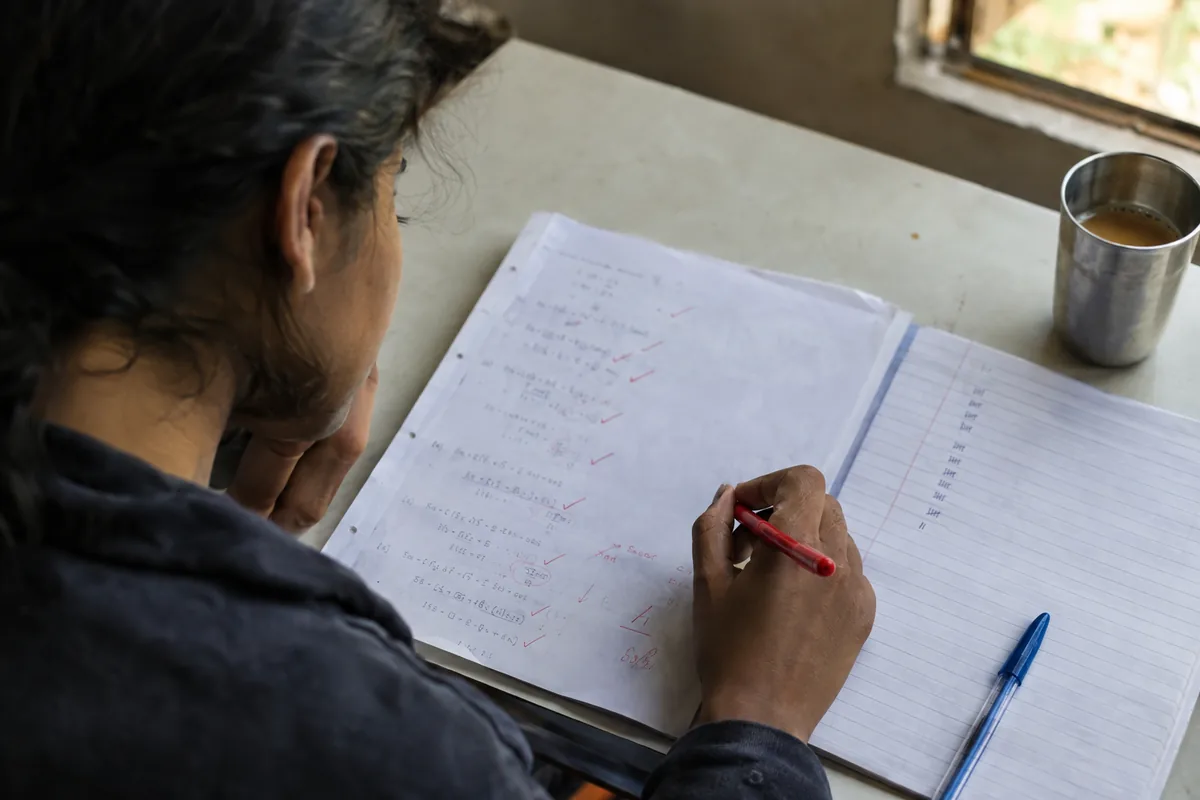
Sorting every mark lost on one paper into four columns is the whole diagnosis, because each column points at a different fix.
Where help starts replacing independence
Four habits show the arrangement has flipped from supporting your work to standing in for it.
- Notes you did not write. If you revise from someone else’s summaries, you are revising a stranger’s understanding of the chapter.
- Solutions you follow rather than produce. Reading a worked example feels like knowing something. The feeling ends at the first question that changes one number.
- A timetable you did not set. When someone else decides what you study each evening, you never learn to decide, and planning your own week is most of what higher study asks.
- Chapters you never attempt before they are taught. Attempting one cold shows what you do not understand, which makes the class sharper.
Then test it. Take one chapter you have studied, sit an unseen paper on it with no notes and no phone, and mark it yourself. If you cannot get most of it alone, more classes will not change the number; something about how you study has to change instead.
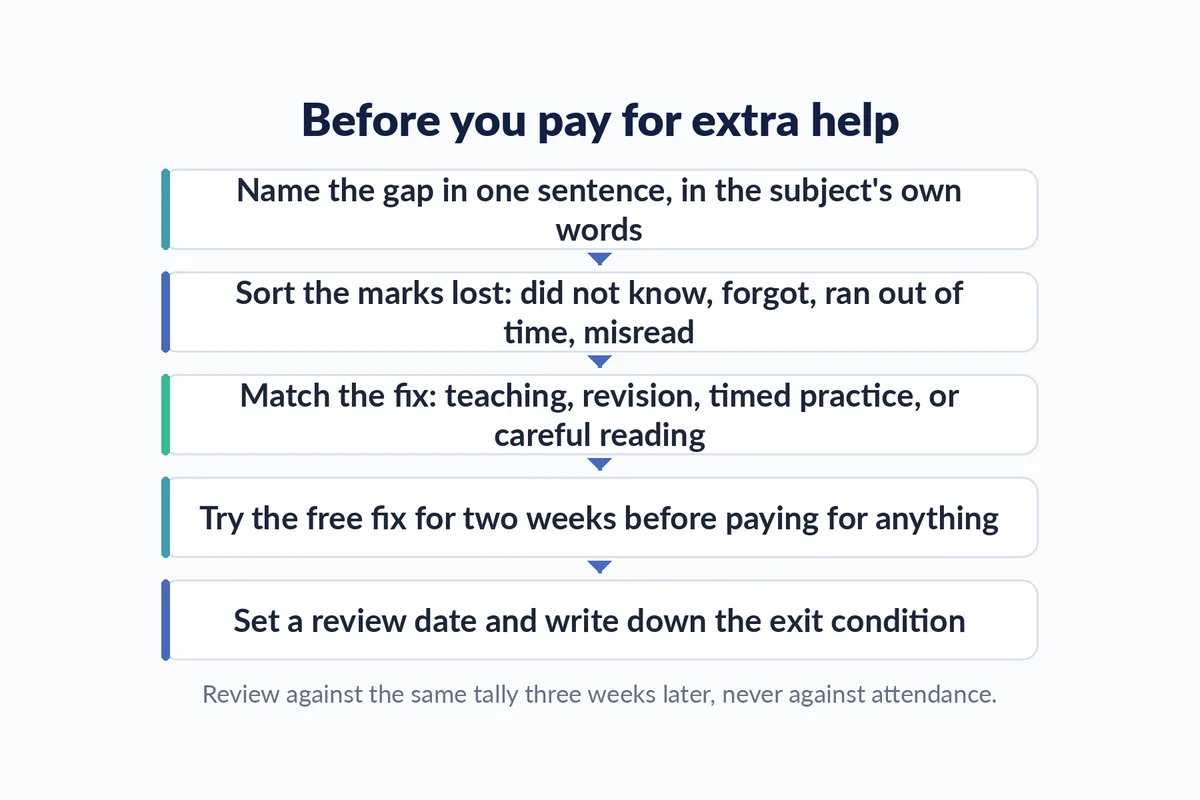
The order matters: find the gap before choosing the fix, and decide in advance what would make you stop paying for it.
A decision checklist
- Name the gap in one sentence, in the subject’s own words: “I cannot do questions where two chapters are combined.” If the sentence will not come, spend a week on your papers before spending money.
- Match the fix to the error. Tuition for explanation, coaching for the examination’s own format, self-study for retention and practice.
- Try the free version first, for two weeks. Your teacher’s doubt hour, the textbook’s end-of-chapter questions, the board’s published sample papers, one classmate who actually works.
- Check what you would give up. Extra classes take the evening hours revision would have used. If the class leaves no time to attempt questions alone, it is replacing your study rather than supporting it.
- Set a review date and an exit condition now. Three weeks and one test, with the stopping rule written down while stopping is still easy.
- Say out loud what the money is buying. If a parent is paying, agree what should be different at the review date. An unspoken expectation turns into guilt, and guilt is the main reason a bad arrangement runs for a year.
If the answer is coaching for an entrance examination
Coaching is not remedial teaching and not a substitute for school. Its value sits in the format: the paper’s pattern, the marking, the time pressure, and the syllabus parts your board does not cover.
Check three things before joining: does the batch follow the examination’s current information bulletin rather than last year’s, do your own attempted papers come back with comments, and is the test series included in the fee or sold separately. The tests are usually the part that does the work.
If you already know the material and lose marks on speed, a stack of past papers and a clock will do the same job.
If the money is not there
A paid class is one form of structure, not the only one. Your school teacher’s doubt hour costs nothing, and most teachers will name a day if you ask once. Board sample papers are published, and end-of-chapter questions are already in the book you own.
What you lose without a paid class is accountability, and that is replaceable: a fixed time, a fixed place, and one person who will ask you on Friday whether it happened.
Decide, then review it
Three weeks, one test in the subject, and the same four-column tally you wrote before. If the dominant column has moved, the arrangement is working. If the same column is still on top, the arrangement is wrong, however good the attendance.
The point of help is to need less of it
Extra help is worth paying for when it closes a gap you named, teaches you a method you keep, and eventually becomes unnecessary. Judge it by that last part. A class that leaves you unable to sit an unseen paper alone after a term has not supported your study; it has become the reason you cannot study without it.
If you are working out what went wrong in a paper before deciding anything, Reading Your Own Marks: How to Work Out What Actually Went Wrong is the next useful thing to read.