
The transport contract is usually renewed the way a shop lease is renewed. Someone compares last year’s rate with this year’s, negotiates a little, and signs before the first week of the new session, when the buses are already on the road.
That is the wrong order of work. The contract decides who is responsible when a bus is late, a driver is replaced, a child is dropped at the wrong stop, or an inspector stops a vehicle at the gate. Renewal is the one moment when a school can change those answers without an argument.
So treat renewal as a risk review that happens to end in a price.
Compliance papers must be valid on the renewal date, not on inspection day
The common failure is a document that was valid when the operator sent it in June and expires in November. By then the contract is signed and the school owns the problem.
What the file should hold for every vehicle on the route: registration certificate, fitness certificate, permit, insurance, and the emission certificate. For every driver: a licence of the correct class, the badge or authorisation the state requires for a transport driver, and the police verification the school asked for when the person was first engaged. For the arrangement as a whole: the operator’s registration and the tax documents your accounts team needs.
Check expiry dates against the term of the contract, not against today. A fitness certificate that runs out in February is a February problem, and the contract should say what happens then: the vehicle comes off the route until the paper is renewed, and any replacement must pass this file. “The operator will sort it out” is not a clause.
Most states notify their own conditions for school buses under their motor vehicle rules, and those conditions change. Current as of October 2026, the habit that holds is reading this year’s notification from your state transport department rather than reusing last year’s summary, and writing the requirement into the contract with a date on it. If the state requires an attendant on every bus, the contract is where that stops being a good intention.
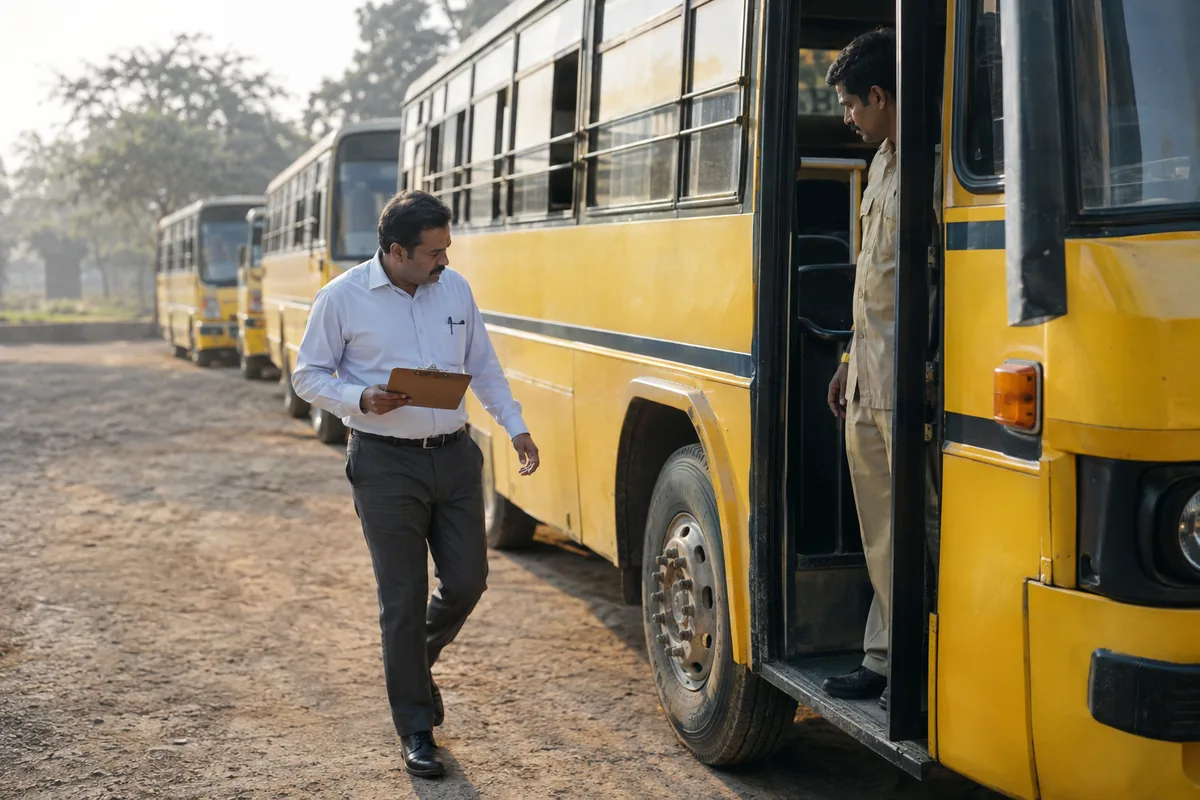
The file is only as good as the vehicle standing in the yard: papers current on the day of signature, and a physical check of the bus they describe.
The same rule applies to people. Name the driver and the attendant in the contract, and agree in writing that any substitution needs the school’s approval and a fresh document set first. Transport staff turn over faster than vehicles do, and a renewal silent on substitution quietly allows it.
Read the incident record before you read the invoice
Ask for the year’s incident log: late arrivals, breakdowns, route deviations, parent complaints, accidents and near misses, and every change of driver or vehicle. If the operator keeps no log, that is the first finding of the review, because a school cannot manage what nobody records.
Read five or six together rather than one. For each, ask what happened, who was told, how long it took to resolve, and what changed afterwards. Three answers repeat across most fleets: the delay was known before the route started and reached the school late; the school found out from a parent; and the same stop appears more than once.
That is enough to write two clauses: what counts as an incident the school must hear about the same morning, and what the operator reports at the next renewal, in a format the school sets.
Keep the log with the contract. It is the only evidence a management committee has when a parent asks whether the problem was known beforehand.
GPS data is evidence, not a dashboard
Live tracking earns its place at renewal only if the history was kept. Most schools can show a parent where a bus is this minute and cannot say how the route behaved across the term.
The useful review looks at patterns rather than a single bad morning: how often each route arrived after its scheduled time, which stop is late most often, where the vehicle waits longest, whether speed alerts were raised and what followed them, and whether the boarding list matched the children who travelled. A system that raises alerts nobody answers is a record of ignored alerts.
Two clauses belong here. The first says who owns the tracking and boarding data. The second says what the school receives when the arrangement ends: a complete export of routes, stops, boarding records and incident notes, in a format the school can open without the operator’s software. A school that cannot take its history to a new operator is negotiating the next renewal with nothing.
Escalation paths that survive a bad morning
A parent whose bus has not arrived will call someone, and the worst possible answer is that they call the driver. A driver on a phone at the wheel is the risk every school says it forbids and every contract leaves open.
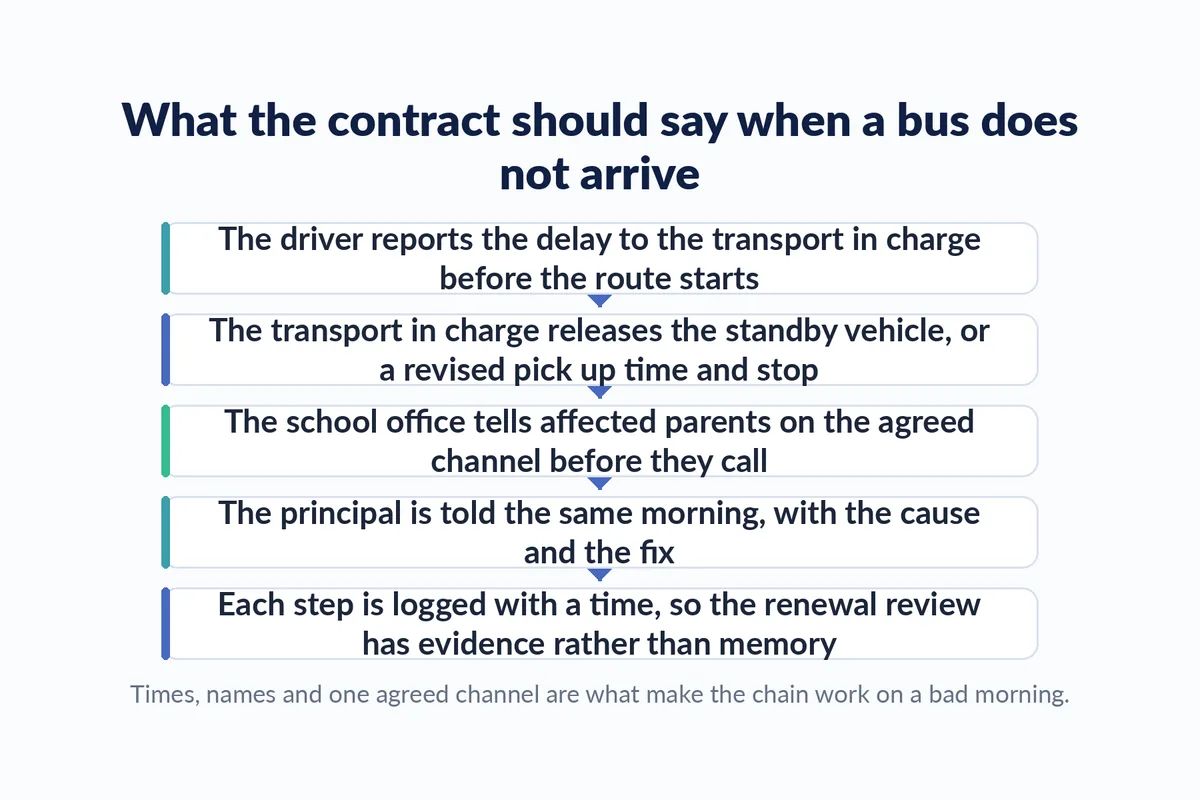
Writing the chain down with time limits is what stops a late bus turning into a queue of parents calling the driver.
The contract should name the chain and its time limits, because a chain without times is a chain nobody follows. Who the parent calls, which number is answered during the run, what the transport in charge does when a vehicle will not start, when the standby vehicle is released, and who tells parents before the gate opens. The principal hears the same morning, with the cause and the fix.
Two cases deserve their own line. The handover: which adult takes responsibility at the gate or the stop, and what the driver does if nobody is there to receive a child. And a child who does not board, or boards and is not on the list at the end of the run. Both need a written sequence, because both are where a school is asked to explain itself.
Clauses to rewrite rather than renew
Some clauses are worth more than the rate. Vehicle substitution, and the standard a substitute has to meet. Driver change, and the approval step. A rate revision formula, so an increase can be checked against something other than goodwill. Termination and notice, including what happens mid-term. Insurance, stating plainly what the operator’s policy covers and what the school’s own covers, checked with the insurer rather than agreed across a table. And a data clause covering tracking records, boarding lists and the export at exit.
Where the state notification requires a drill, an attendant or a first aid kit, give it a date in the contract.
Who signs, and what stays in the file
One folder, dated, is the whole deliverable: the current contract, the document set with expiry dates marked, the incident log, the GPS review note, the revised clauses, and the approval from the principal or the management committee. Keep last year’s beside it; the difference between the two is the argument for the changes.
This is where ordinary record keeping pays off. Vehicle records, driver documents and expiry dates belong in one place, as a school tracks its equipment, the discipline described in digitising school inventory and asset tracking.
A checklist to finish before you sign
- Every vehicle’s registration, fitness, permit, insurance and emission certificate valid for the whole contract term.
- Every driver’s licence, badge and verification current, with a named substitute approved in writing.
- The named driver and attendant in the contract, and an approval step for any change.
- The year’s incident log read, with two clauses written from it.
- GPS and boarding history reviewed by route and by stop, not by memory.
- Data ownership and an export at exit written into the contract.
- The parent escalation number, the standby vehicle rule and the principal notification stated with time limits.
- The handover rule and the missing child sequence written out.
- Rate revision as a formula, and termination terms agreed before anyone discusses the number.
- The dated folder, with the previous year’s file beside it.
None of this needs a new system. Scholva holds staff, vehicle and document records with expiry dates alongside student records, so a transport renewal can be reviewed against the system rather than a folder of photocopies. Request a demonstration to see how that works for your school.
Related reading: School bus tracking, a safety and operations guide and a practical guide to school transport route optimisation.