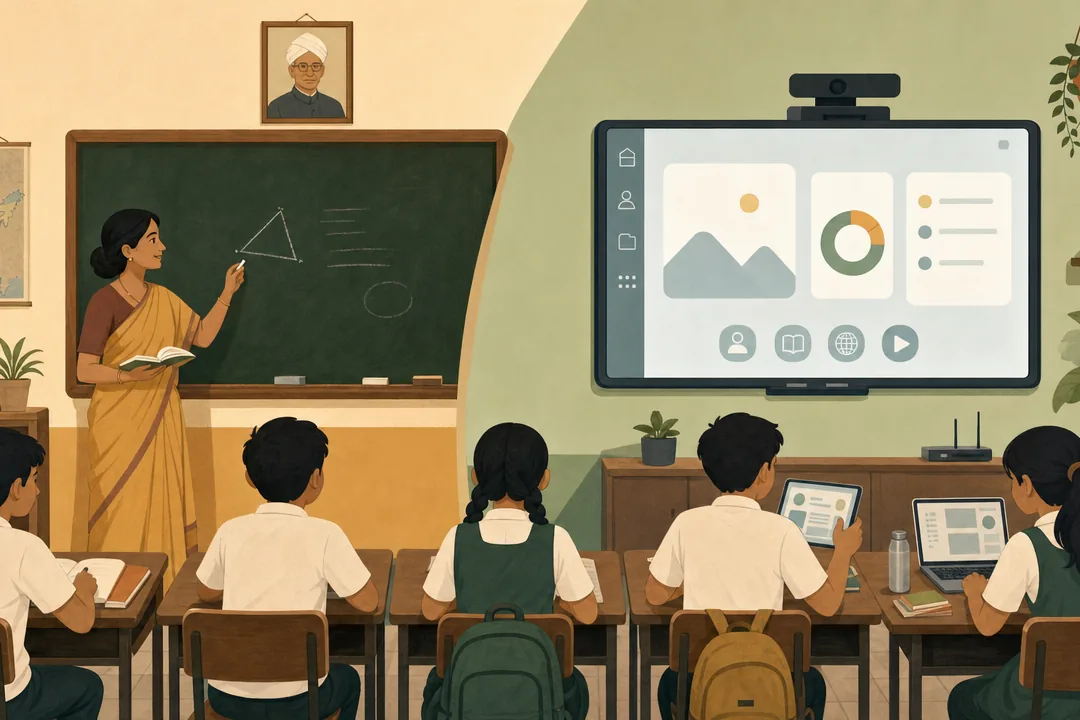
A decade ago, the typical Indian classroom looked the same as it had for fifty years: a blackboard, chalk, a textbook, and a teacher lecturing to rows of students. Today, that picture is changing – unevenly, but unmistakably.
India’s education technology landscape has been reshaped by three forces converging at once: a national policy mandate (NEP 2020) that explicitly calls for technology integration, a pandemic that forced 260 million students online overnight, and an EdTech market that peaked at $6 billion in 2022 before its correction.
The result is a system in transition. Some schools now operate entirely cloud-based administration and hybrid classrooms. Others still lack reliable electricity. Understanding where technology fits in Indian education – what is working, what is not, and what comes next – matters for anyone building, running, or studying in an Indian school.
The Starting Point: Where Indian Schools Were
Before COVID-19, technology adoption in Indian schools was limited and fragmented:
- Government schools (which educate roughly 70% of Indian students) had minimal technology infrastructure. A 2019 UDISE+ report showed that only 38% of government schools had functional computers, and just 22% had internet connectivity.
- Private schools had better infrastructure on average, but adoption was concentrated in urban areas and premium institutions. Smart boards and computer labs existed, but were often underutilized or treated as add-ons rather than core teaching tools.
- Teacher readiness was a fundamental barrier. Most teachers had received no formal training in using technology for instruction. A study by the Azim Premji Foundation found that only 10% of teachers in government schools felt “comfortable” using digital tools for teaching.
- Student access was heavily skewed by geography and income. Urban students in upper-income households had personal devices and internet access. Rural students, particularly in states like Bihar, Jharkhand, Chhattisgarh, and Uttar Pradesh, had neither.
Technology was an aspiration, not a reality, for most Indian schools.
The COVID-19 Inflection Point
When schools closed in March 2020 and remained shut for extended periods (some Indian states kept schools closed for over 18 months), the digital divide became an education emergency.
What happened
- Urban private schools shifted to Zoom/Google Meet within weeks. Students with devices and internet access continued learning with minimal disruption.
- Government schools and rural areas faced a different reality. Students relied on WhatsApp groups for assignments, television broadcasts (through PM eVidya and SWAYAM Prabha), and radio lessons. Many simply stopped learning.
- ASER (Annual Status of Education Report) 2021 documented the damage: the proportion of Class 3 students in rural India who could read a Class 2-level text dropped from 27% in 2018 to 20% in 2021. Basic arithmetic skills showed similar declines.
- Enrollment in government schools actually increased during the pandemic, as families facing economic hardship moved children out of private schools. Government school enrollment rose from 64.3% in 2018 to 70.3% in 2022 (ASER 2022).
The pandemic proved two things simultaneously: that technology could keep education running when nothing else could, and that without equitable access, it widened the gap between the haves and have-nots.
Government Initiatives: Building Digital Infrastructure
The Indian government has launched several national-scale technology initiatives for education. Some pre-date the pandemic; others were accelerated by it.
DIKSHA (Digital Infrastructure for Knowledge Sharing)
Launched in 2017 by the Ministry of Education, DIKSHA is a national platform for school education built on open-source technology (Sunbird, developed by the EkStep Foundation).
What it offers:
- Curriculum-aligned digital content (textbooks, videos, interactive resources) in multiple languages
- QR-coded textbooks: Students can scan QR codes in NCERT and state board textbooks to access related digital content
- Teacher training modules
- Assessment tools for students and teachers
Scale: As of 2024, DIKSHA has registered over 140 million learning sessions and supports content in 36 Indian languages. Every state and union territory has onboarded content to the platform.
Limitations: Usage is heavily dependent on smartphone access and internet connectivity. In states with low digital penetration, DIKSHA adoption remains limited to urban and semi-urban areas.
PM eVidya and SWAYAM Prabha
Launched in May 2020 as part of the Atmanirbhar Bharat initiative, PM eVidya is an umbrella programme for digital education:
- SWAYAM Prabha: 34 DTH television channels broadcasting educational content for Classes 1-12 and higher education, 24 hours a day. This was designed to reach students without internet access.
- SWAYAM (Study Webs of Active-Learning for Young Aspiring Minds): An online platform offering courses from Class 9 to post-graduation, developed by MHRD/MoE with content from NCERT, IITs, IIMs, and central universities.
- NDEAR (National Digital Education Architecture): A proposed open architecture for building interoperable digital education systems across the country.
PM SHRI Schools
Announced in 2022, PM SHRI (PM Schools for Rising India) is a centrally sponsored scheme to upgrade approximately 14,500 schools across India into model schools that demonstrate NEP 2020 implementation. Technology integration is a core component:
- Smart classrooms with digital boards
- Digital libraries
- ICT labs with internet connectivity
- Green and sustainable infrastructure
As of 2025, over 6,000 schools have been selected and are at various stages of upgradation.
National Education Technology Forum (NETF)
Proposed under NEP 2020, NETF is envisioned as an autonomous body to facilitate the exchange of ideas on technology usage in education. It is intended to:
- Provide strategic guidance on technology adoption
- Research and evaluate emerging EdTech tools
- Build a platform for technology providers, educators, and policymakers to collaborate
NETF is still in the process of being formally constituted.
Technology in the Classroom: What Schools Are Actually Using
Beyond government platforms, schools across India are adopting technology at different layers of their operations.
Digital Classrooms and Smart Boards
Interactive flat panels and smart boards have become the most visible technology investment in Indian schools. Companies like SMART Technologies, BenQ, ViewSonic, and Indian brands like Extramarks and Tata ClassEdge supply these devices.
How they are used:
- Displaying multimedia content (videos, animations, simulations) during lessons
- Interactive exercises where students participate using touchscreens or response devices
- Annotating and recording lessons for later review
Adoption: Widespread in urban private schools and CBSE/ICSE-affiliated institutions. Limited in government schools except where state or central funding (like PM SHRI) has intervened.
Challenge: A smart board in a classroom does not automatically improve learning. Without teacher training and curriculum-aligned content, it becomes an expensive projector.
Learning Management Systems (LMS)
LMS platforms allow schools to manage and deliver digital curriculum, track student progress, and facilitate communication between teachers, students, and parents.
Commonly used platforms in India:
- Google Classroom: The most widely adopted free LMS, particularly during and after the pandemic
- Microsoft Teams for Education: Popular in schools with Microsoft 365 subscriptions
- Moodle: Open-source, used by some CBSE and state board schools
- Proprietary platforms: Extramarks, LEAD School, Byju’s (for institutional partnerships)
What LMS enables:
- Assignment distribution and submission
- Automated quizzing and grading
- Attendance and participation tracking
- Parent communication portals
- Video lesson repositories
Adoption reality: Most urban private schools use some form of LMS. Government schools have been slower to adopt due to infrastructure and training gaps. Post-pandemic, many schools that adopted LMS during lockdowns have reverted to paper-based processes.
School Management Systems (School ERP)
While LMS focuses on teaching and learning, School Management Systems (also called School ERP) handle the operational side:
- Student information management: Enrollment, demographics, academic history
- Attendance tracking: Digital attendance with biometric or app-based systems
- Fee management: Invoicing, payment collection, reminders, receipt generation
- Timetable and scheduling: Automated timetable generation and conflict resolution
- Report cards and grading: Multi-board grading system support (CBSE, ICSE, state boards, IB)
- Transport management: Route planning, vehicle tracking, parent notifications
- Communication: SMS/WhatsApp notifications, parent-teacher portals
- HR and payroll: Staff management, salary processing, leave tracking
Why this matters: For a school administrator, the management system is the technology they interact with daily. An effective school management platform reduces administrative overhead, improves accuracy, and frees up staff time for education-focused work.
Market landscape: The Indian school ERP market includes players like Fedena, Skolaro, MyClassboard, Teachmint, LEAD School, and newer entrants like Scholva. The market is growing as even mid-tier schools recognize that paper-based administration does not scale.
Online Assessment and Adaptive Learning
Post-NEP 2020, there is growing interest in formative assessment tools that go beyond end-of-year exams:
- Competency-based assessments aligned with NEP’s emphasis on testing understanding rather than recall
- Adaptive learning platforms that adjust difficulty based on student performance
- AI-assisted evaluation for essay-type and descriptive answers (still nascent in Indian schools)
Platforms like Embibe, Toppr (now part of Byju’s), and government tools like SAFAL (Structured Assessment for Analyzing Learning) under CBSE are moving in this direction.
The EdTech Market: Boom, Bust, and What Survived
India’s EdTech sector experienced a dramatic arc between 2020 and 2025.
The Boom (2020-2021)
- Byju’s became the world’s most valuable EdTech company at $22 billion
- Unacademy, Vedantu, PhysicsWallah, Toppr all raised hundreds of millions in funding
- Direct-to-consumer tutoring apps and tablet-based learning products proliferated
- Enrollment in online learning surged as schools closed
The Correction (2022-2025)
- Byju’s faced severe financial difficulties, governance issues, and regulatory scrutiny. Its valuation was written down to near zero by some investors.
- Multiple EdTech startups shut down or consolidated
- The market shifted from consumer-facing tutoring to B2B (business-to-business) models – selling to schools and institutions rather than directly to parents
- Sustainable, revenue-generating EdTech companies (like PhysicsWallah, which went public) outperformed those reliant on venture funding
What Survived and Why
The EdTech products that have shown staying power share common traits:
- They solve a real operational problem (school management, fee collection, attendance) rather than promising vague “learning outcomes”
- They work within existing school structures rather than trying to replace teachers
- They support multiple boards and languages, acknowledging India’s fragmented education system
- They are affordable for the mass market, not just premium urban schools
- They integrate with government platforms (DIKSHA, UDISE+, state portals) where compliance reporting is required
NEP 2020 and Technology: The Policy Mandate
NEP 2020 is explicit about the role of technology in education. Key provisions include:
Technology Integration
- Schools are expected to integrate technology into teaching and assessment, not as a separate “computer class” but across all subjects
- Digital literacy and coding are to be introduced from Class 6
- The curriculum should leverage open educational resources and digital content
Assessment Reform
- The new assessment body PARAKH is expected to develop technology-enabled assessment tools
- Report cards should be holistic, capturing skills and competencies beyond academic scores – a capability that requires digital systems
Teacher Training
- The National Professional Standards for Teachers include ICT competency
- Teacher education programmes (B.Ed.) are being revised to include digital pedagogy
- In-service teacher training through DIKSHA and state platforms
Infrastructure
- The policy targets internet connectivity in all schools
- PM SHRI schools serve as pilot implementations for technology-enabled education
- NDEAR (National Digital Education Architecture) aims to create interoperability across education technology systems
The Reality Gap
While the policy is ambitious, implementation faces real constraints:
- Only 53% of Indian schools had electricity in 2022 (UDISE+). Internet connectivity was below 30% for government schools.
- Teacher training has not kept pace with technology deployment. Many teachers received smart boards but no training on how to integrate them into lessons.
- Content quality varies widely. Not all digital content available on platforms like DIKSHA meets the pedagogical standards the policy envisions.
- State-level implementation varies dramatically. Karnataka and Kerala are ahead; Bihar and Jharkhand lag significantly.
The Digital Divide: India’s Core Challenge
Any discussion of technology in Indian education must confront the digital divide. It is not just a gap – it is a chasm.
By Geography
- Urban schools: 85%+ have internet access and computing devices
- Rural schools: Less than 25% have functional internet connectivity
- Some states (Rajasthan, Madhya Pradesh, Uttar Pradesh) have entire districts where no school has internet access
By Income
- Students from households earning above INR 5 lakhs/year have near-universal access to smartphones and internet
- Students from households below INR 2 lakhs/year rely on shared devices, limited data plans, or no digital access at all
- The cost of a basic smartphone (INR 5,000-8,000) remains prohibitive for many families
By Gender
- Girls in rural areas are disproportionately affected. When a household has one smartphone, it is typically used by male family members. Girls have less screen time, less access to digital learning resources, and higher dropout rates from online education.
What Is Being Done
- BharatNet: A government project to connect all 250,000 gram panchayats with broadband. As of 2025, approximately 200,000 panchayats have been connected, though last-mile connectivity to schools remains inconsistent.
- One Nation One Subscription: A government initiative providing free access to academic journals and research databases for all educational institutions.
- State-level initiatives: Kerala’s KITE (Kerala Infrastructure and Technology for Education) programme has achieved near-universal digital access in government schools. Rajasthan launched a programme to provide tablets to students. Odisha’s “Mo School” initiative uses technology for school development.
Bridging this divide is not just a technology problem – it requires infrastructure investment, policy commitment, and community engagement. Technology alone cannot solve an access problem.
What Comes Next: Trends Shaping the Future
AI in Education
Artificial intelligence is entering Indian education slowly but with significant potential:
- Personalized learning: AI tutors that adapt to individual student pace and learning style (still early-stage in Indian schools, but platforms like Embibe and Khan Academy are piloting)
- Automated assessment: AI-assisted grading for descriptive answers, reducing teacher workload
- Predictive analytics: Identifying at-risk students before they drop out, based on attendance, performance, and engagement patterns
- Content generation: AI tools for creating lesson plans, worksheets, and assessments in multiple languages
The risk: AI tools require data, and Indian schools lack the digital infrastructure to generate and manage student data at scale. Privacy and data protection (under the Digital Personal Data Protection Act, 2023) add regulatory complexity.
Vernacular and Multilingual Technology
NEP 2020’s emphasis on mother-tongue instruction through Class 5-8 creates demand for technology that works in Indian languages – not just Hindi and English, but Tamil, Telugu, Kannada, Malayalam, Bengali, Marathi, Gujarati, Odia, Assamese, and others.
This is a harder problem than it appears. Most EdTech content is English-first. Building quality educational content, assessment tools, and school management interfaces in 22+ scheduled languages requires significant investment.
Hybrid and Blended Learning
The post-pandemic school is neither fully physical nor fully digital. The emerging model is blended:
- In-person instruction for core teaching, labs, and social development
- Digital resources for revision, practice, and extended learning
- Recorded lessons and asynchronous content for student-paced study
- Digital assessment for formative evaluation
Schools that invested in LMS infrastructure during COVID are better positioned to operate in this hybrid model.
Open Educational Resources (OER)
NEP 2020 promotes the use of open educational resources – freely available, openly licensed content that schools can use, adapt, and share. DIKSHA is built on this principle. The growth of OER could reduce schools’ dependence on expensive proprietary content providers.
Practical Recommendations for Schools
For Government and Budget Schools
- Start with the basics: Ensure electricity, a functional computer lab, and internet connectivity before investing in smart boards or tablets.
- Leverage DIKSHA and free platforms: Google Classroom, DIKSHA, and state-provided content are free and available. Training teachers to use them effectively yields better results than buying hardware.
- Focus on teacher training: A trained teacher with a basic smartphone is more effective than an untrained teacher with a smart board.
For Mid-Tier Private Schools
- Adopt a school management system: Fee collection, attendance, report cards, and communication should be digitized. The administrative time savings alone justify the investment.
- Invest in an LMS: Even a basic LMS (Google Classroom or Moodle) provides structure for assignments, assessments, and parent communication.
- Align technology with board requirements: Ensure your digital tools support your board’s grading system, report card format, and compliance needs.
For Premium and International Schools
- Integrate technology into pedagogy, not just administration. Smart boards and 1:1 device programmes should come with corresponding changes in teaching methodology.
- Invest in data analytics. Use student performance data to personalize learning paths and identify students who need intervention.
- Prepare for NEP 2020 compliance. Holistic report cards, competency-based assessments, and multidisciplinary subject tracking require purpose-built digital systems.
Conclusion
Technology is not a silver bullet for Indian education. It will not fix teacher shortages, close the urban-rural divide, or replace the foundational work of good pedagogy. But deployed thoughtfully – with teacher training, equitable access, and alignment to curriculum goals – it is a powerful enabler.
India is moving from chalk to cloud. The pace is uneven, the challenges are real, and the digital divide remains the system’s most urgent problem to solve. But the direction is clear: the future of Indian schooling is digital, and the schools that embrace this transition thoughtfully will serve their students better.
The question is not whether to adopt technology, but how to do it in a way that works for every student – not just those with a smartphone and a broadband connection.
Scholva is a school management platform built for the complexity of Indian education. We support multiple boards, regional languages, NEP 2020 holistic report cards, and the operational workflows that keep schools running. If technology adoption is on your roadmap, we would like to be part of the conversation.