A disappointing result usually arrives in an ordinary way. A test paper comes home folded at the bottom of a bag. A portal updates on a Tuesday evening. A teacher mentions it at the gate. The mark itself is settled in a minute. What follows it can run for months.
Most parents prepare carefully for the exam and hardly at all for the conversation after it. That conversation is where a bad mark either becomes information a child can use or becomes a story about what kind of student they are.
This is about that first conversation: what helps, what backfires, and some words you can borrow.
Why the first conversation carries so much weight
A child already knows the result is bad. By the time they reach you they have had hours to think about what it means about them, and what it will mean at home.
So the first conversation rarely changes the mark. It changes whether the child brings the next bad result to you early, while there is still time to fix it, or hides it until a report card makes hiding impossible. That second pattern costs terms of progress, and it is built out of a handful of conversations.
What backfires, even when it feels responsible
Four responses are natural, and all four close the conversation.
Immediate problem solving. The paper is barely on the table before a revision plan appears. The instinct is generous, but it skips the part where the child tells you what happened, and it teaches them that the fastest way through the conversation is to agree and leave.
Comparison. A cousin, an older sibling, a classmate, your own school record. It answers a question nobody asked and gives the child something to defend instead of something to think about.
Reassurance that dismisses. “It does not matter” or “one test means nothing” sounds kind and lands as “your effort is not worth discussing”. If the child is upset, the upset is the first thing to acknowledge.
Effort as a verdict. “You just need to work harder” is sometimes true and almost never useful on the first evening. It turns a fixable problem in one topic into a judgement about character, and character is much harder to change.
Start with their account, not yours
The most useful opening line hands the paper back to them: “What did you make of it?”
That question is deliberately open. It lets a child who already knows what went wrong say so first, and it surfaces the cases you would otherwise miss: the one who understood the topic but ran out of time, the one who misread the question.
Then ask one more question before offering anything: “Which part felt worst?” Not to dwell, but because the answer tells you whether the problem is the subject, the exam conditions, the teacher, or the child’s own expectation of themselves. Those need very different responses.
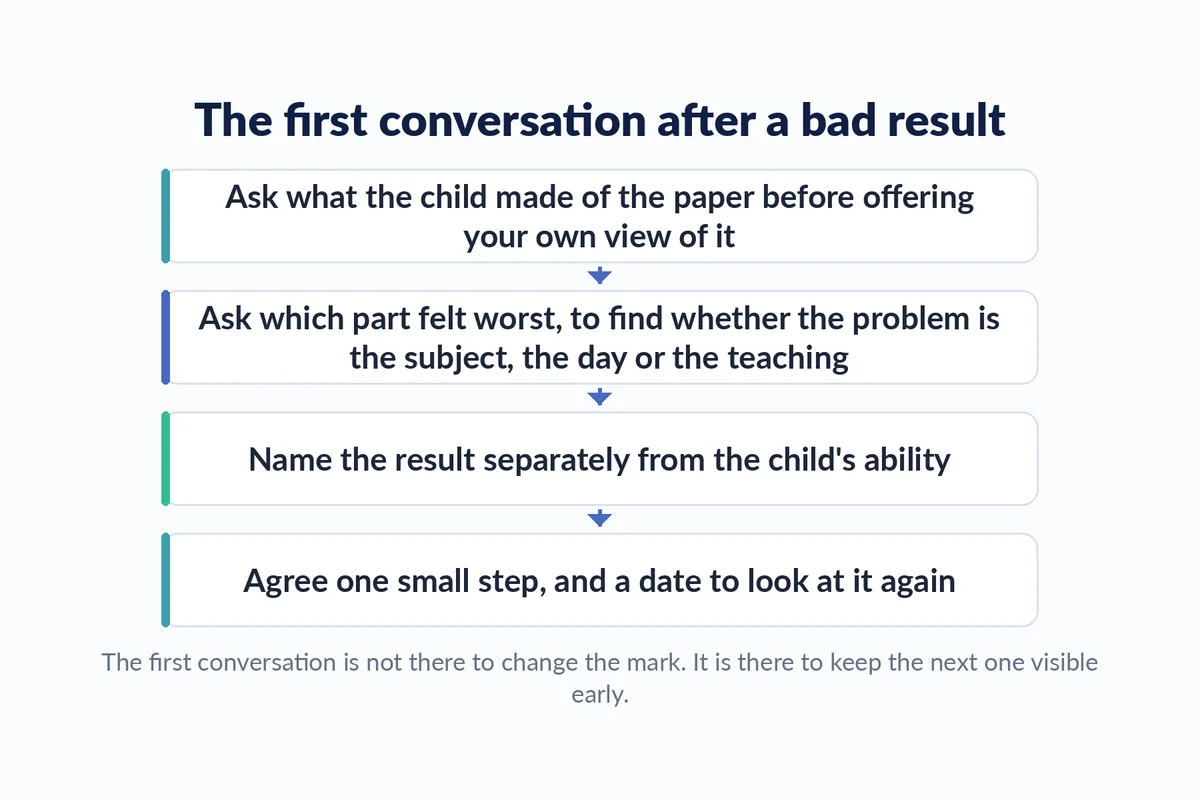
Four moves in order: hear the child’s own account, find which part hurt, separate the mark from ability, then agree one step with a review date.
Separate the result from the person
Children turn a mark into an identity quickly. “I am bad at maths” is a conclusion a ten-year-old can reach from two tests, and once it settles it does more damage than either test.
The sentence that helps is specific and true: “You did badly on this test” rather than “you are bad at this subject”, followed by the part that keeps it movable: “This tells us about this chapter, not about what you can do by March.”
That framing is not morale boosting, it is accurate. One assessment samples a particular set of questions on a particular day. Treat the mark as a reading rather than a sentence, and the child is more likely to do the same.
Three conversations you will actually have
The child who is already upset. Acknowledge first, solve later. “That is a horrible feeling, and I am not going to pretend it is nothing.” Sit with it for a few minutes before any discussion of what to do. Then: “Do you want to tell me what happened, or would you rather look at it tomorrow?” Handing back the timing is often what makes the conversation possible at all.
The child who shrugs. Shrugging is usually protection, not indifference. Do not argue with it; ask something hard to shrug at. “If you had one more week before that test, what would you have done differently?” A child who can answer that is not indifferent, they are discouraged.
The child who is angry, at the teacher or the paper. Let them finish, then ask what part of the complaint they think is fair. Some of it usually is, and acknowledging that part is what allows the rest to be examined. If the complaint is about marking or a missing answer, check the paper against the school’s answer key before deciding anything.
Agree one next step, not a new regime
The temptation after a bad result is a full rebuild: new timetable, no phone, tuition three times a week. Regimes built in one evening collapse within a fortnight, and their collapse teaches the child that the problem was never solvable.
One step is enough for the first week. Pick it together and make it small enough to check: redo the questions marked wrong and take them to the teacher, or do one past paper under timed conditions before the next test.

The step agreed at home is usually smaller than the rebuild planned on the first evening, which is what makes it checkable a week later.
Agree when you will look at it again. A step with a review date is a plan; one without is a hope.
The second conversation, a week later
The follow-up matters as much as the first conversation and usually does not happen. A week later, ask about the step, not the mark: “Did you get the corrections checked?” Keep it short, and keep the tone the same as the first conversation, which was calm.
If the step worked, say so plainly and stop there. If it did not, ask why, and expect a practical answer: the teacher was unavailable, the corrections were harder than expected, the child was not sure what “checked” meant. Adjust the step rather than concluding that the child cannot be relied on.
When the mark is not really about the mark
Some patterns need more than a conversation at home. If the same subject has slipped across two or three assessments, the question is where the understanding broke, and that is a question for the subject teacher. If results are uneven across the board but the child is working steadily, look at attendance, sleep, or a load of activities that has quietly become too much.
If a child who used to cope now avoids the subject, refuses to show papers, or dreads school mornings, treat that as the finding rather than the mark. Nothing in a conversation at home fixes a problem that is happening in a classroom.
What to take to the school
Parents often arrive at a parent-teacher meeting with the mark and leave with a general impression. It works better to arrive with three questions: which topics were weak in this paper, what the teacher sees in class that the paper does not show, and what they would do first if this were their child.
The second question matters more than it sounds. A paper is one sample; the teacher has watched the child for a term, and their answer often explains a result more accurately than the answer sheet does. What Parents Should Ask at a Parent-Teacher Meeting has a fuller version of that conversation.
Reading the report card before the meeting rather than at it also helps. How to Read Your Child’s Report Card Without Panicking walks through what each part of it is actually telling you.
What the first conversation is for
You are not trying to make the child feel better about a bad mark, and you are not trying to make them feel worse. You are trying to keep the paper useful: a readable signal about one topic, on one day, that can still be acted on.
Get that right and the conversation takes ten minutes. The next one is easier, because the child already knows that bringing you a bad result is survivable, and that habit is what keeps small problems small.