
A school report card answers a narrow question: how did this child perform in these subjects this term. A semester result at a university looks like the same kind of document and is not. It is a set of statements about course offerings, credit values, grade points, attempts, and one particular scheme of examination in force that year.
Most institutions meet that difference in the week results are published. The software was built for a class of thirty students sitting the same six subjects, and it now has to serve a programme where two students in the same semester study five different courses at different credit weights, under regulations that may have changed since they were admitted.
A report card is a per-term statement, a credit record is a per-programme one
A K-12 report card is easy to define. For each subject it carries the maximum marks, the marks obtained, a grade, a pass or fail outcome, and an aggregate and division. Every value is final the moment the card is issued. The card describes a term, and the term is closed.
A credit-based record is built from a different atom. The unit is not the subject but the course as it was offered in a semester: a course code, its credit value, the semester of offering, the regulation the student was admitted under, the grade awarded, and the attempt number. The student’s standing is derived from those units: credits earned against credits attempted, a semester grade point average, a cumulative average, and the set of courses still to be cleared.
The UGC’s Choice Based Credit System framework is what made this the norm rather than the exception, and the Curriculum and Credit Framework for Undergraduate Programmes published after NEP 2020 extends it with credit-bearing skill and value-added components. Both are published by the UGC and checkable against the current text; as of October 2026 the direction has not reversed.
What matters for a records system is not the framework but two consequences of it. First, the same semester contains students on different course baskets, so a result cannot be stored as a row of subjects in a fixed order. Second, credits are portable. Under the multiple entry and exit design, a student may leave with a certificate or a diploma after part of a programme and return later, and credits already earned have to be recognisable on re-entry. A record that stores only percentages and divisions cannot be reassembled into credits.
Where the school-shaped record stops coping
The failures are specific, and they appear in the same order at most institutions.
A subject is not a course offering. In a school system a subject exists independently of when it is taught. In a credit system the same course is offered in different semesters, by different teachers, sometimes with a changed syllabus or credit value after a regulation revision. If the record points at a subject name, a result from 2021 and a result from 2025 become the same thing, and the transcript can no longer say which syllabus applied.
One mark per subject is not one result per attempt. A student may fail a course, clear it in a supplementary examination, attempt an improvement paper, or clear it through revaluation. The record needs every attempt with its outcome, and a stated rule about which attempt stands. Universities differ on that rule: some take the latest attempt, some the best, some cap the grade on a cleared backlog.
A result is not always final. Results are routinely published as provisional, pending revaluation or moderation. A school system has no concept of a value that is officially true today and officially different next month, and it will helpfully overwrite the old one.
Progression is not promotion. A school promotes a child to the next class. A university decides whether a student may register for the next semester on the basis of credits earned, and that rule is usually written per programme, with a different threshold for a professional course than for an arts programme.

Each bundle on an examination section table is the evidence behind one attempt, which is why a result has to stay traceable to it long after the grade is published.
The word backlog hides four different states
The same condition is called an arrear, a supplementary, a reappear, a carry-over or a paper to keep terms, depending on the university, and often on the programme within it. Behind those words sit four situations that a registrar treats differently:
- A course failed and not yet re-attempted.
- A course failed with a re-attempt scheduled or under way.
- A course passed but awaiting publication after revaluation.
- A course never registered for, which the scheme requires.
The first three look similar on a screen. The fourth is not a result at all but a gap in registration. A system that stores a backlog as a flag cannot answer “how many active backlogs does this student carry” for an eligibility decision, and cannot answer it consistently a month later, because the flag records none of the four.
Recomputation is the real test
Ask any vendor what happens when a revaluation changes one mark, and the answer separates a records system from a marksheet printer. A single revised grade has to move through everything derived from it.
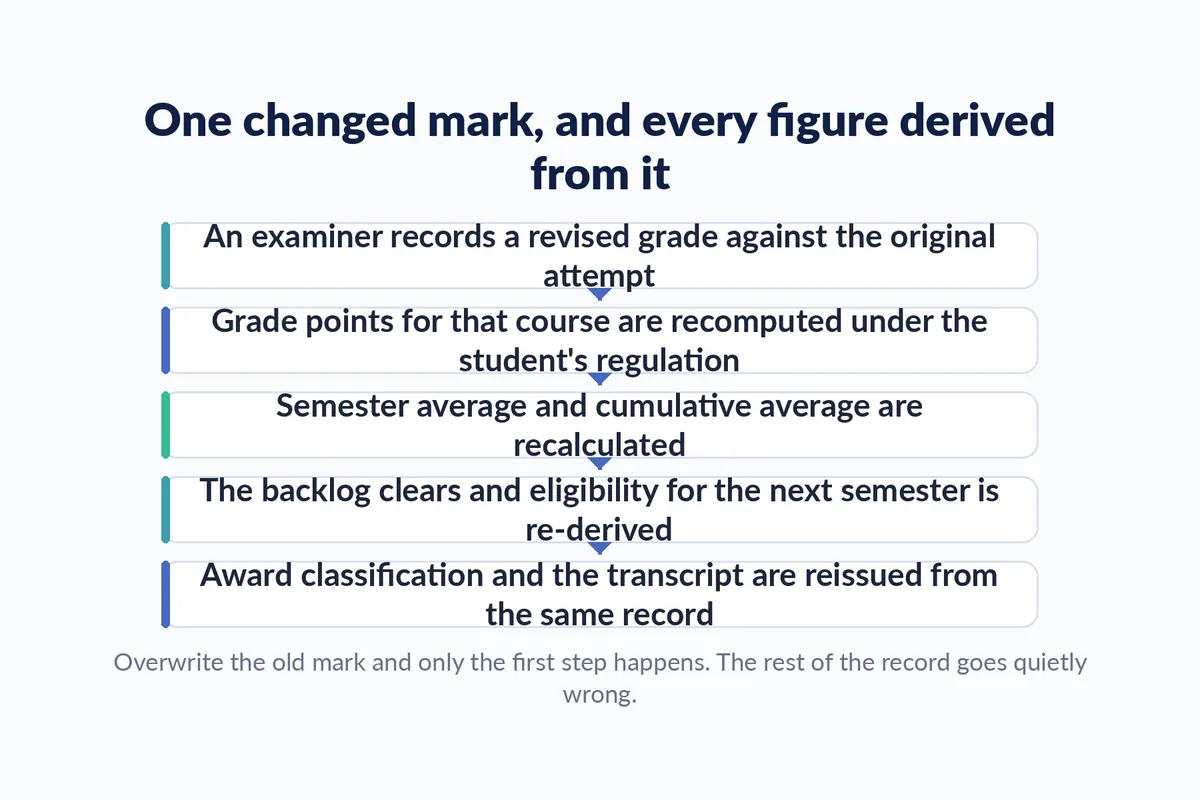
A revaluation changes one grade, but it has to move through five linked figures, which is why the record needs versions rather than an edited value.
The awkward part is the last step. Award classification is computed from the cumulative average, which is computed from semester averages, which are computed from course grades. Change a grade in the second semester of a four year programme and the classification printed on a provisional certificate changes with it. A system that stores the computed average as a field and recalculates only on demand will eventually hold two numbers that disagree, and nobody will know which one the board approved.
Rules that differ by programme must be data
The other structural gap is the assumption that the rules are constant. Two cohorts in the same department can sit under different regulations, a professional programme can set a higher pass mark and a narrower grading scale than an arts programme, and a revaluation can raise a grade in one scheme and be capped in another.
If those differences live in code, every revision becomes a change request and the institution spends a term waiting. Written as an effective-dated rule set attached to the programme, they let the examination section open a new scheme for the incoming batch without touching the record of anyone already enrolled.
A workable rule set answers a short list of questions per programme: the credit value of each course, the minimum for a pass, the grading scale and grade points, the attempt policy, the threshold for progression to the next semester, the effect of a revaluation, and the bands used for award classification. Effective dates on each version mean a student admitted in 2024 is never judged by a rule written in 2027.
What to write down before configuration
- The scheme of examination for each programme, with the date it applies from.
- The unit of record: course offering, not subject name.
- The attempt policy, stated in one sentence, per programme.
- The definition of an active backlog and the credit threshold for progression.
- Whether a published result is provisional or final, and who may change that status.
- Which derived values recalculate automatically, and what document is reissued when they do.
Institutions that settle these six points before configuration find that results day is a publishing task rather than a repair task. Those that leave them to the software find out in the second semester, when the first revaluation arrives and the transcript, the eligibility list and the award classification start telling different stories about the same student.
Semesters, credits, arrears and revaluation are not four modules. They are one record seen at four moments, and the record has to be built so that a change at any moment propagates honestly. Scholva runs admissions, examinations, credit accumulation and award records in one system, with programme-specific grading rules held as effective-dated configuration rather than custom code, so an examination section can publish a result, revise it after revaluation, and have every derived figure follow. See how it works.
Related reading: One ERP across a multi-campus university: what actually has to be shared and Digital certificates and marksheets: what institutions should retain.