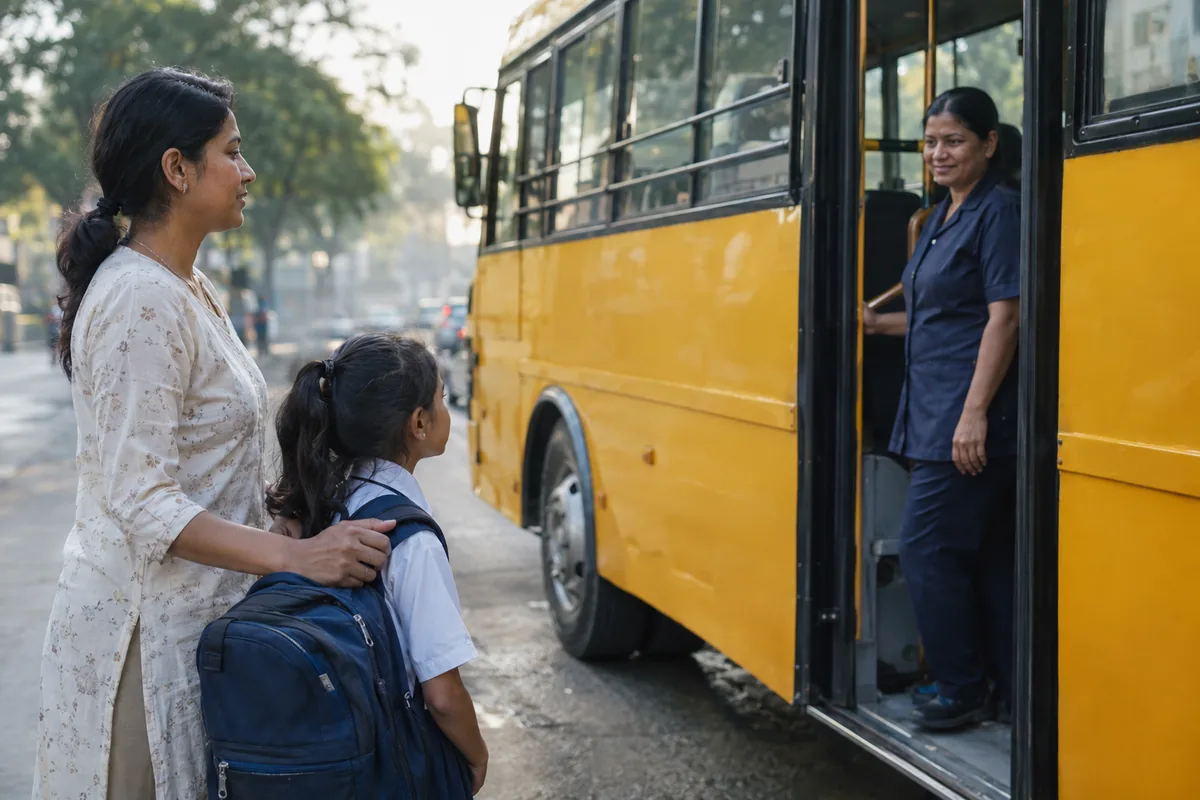
Most parents ask their school one question about transport: is the bus safe? The answer is usually yes, and it is usually honest. It is also not something you can verify. What you can verify is narrower and more useful: who is responsible for your child from the moment the door closes until the door opens again, and what record exists if something goes wrong.
This is not a reason to distrust your school. It is a short list of things a well-run transport operation can answer in a minute, and that many schools tighten up only after a complaint. Asking is normal, and how the school answers tells you a good deal on its own.
What verified actually means
A transport arrangement has five links: the driver, the vehicle, the adult who supervises the children, the route and timing, and the way the school responds when something goes wrong. A gap in any one of them matters, and the gaps are rarely a secret: usually they are just unasked questions.
Two of the five you can check yourself; the rest you can ask the school about and test with one written question.
Start with the people
Who is driving
Ask which licence class the driver holds. A licence that covers a private car is not the same as one that covers the heavy passenger vehicle your child travels in, and the school should be able to say plainly which class its drivers hold. Transport vehicles also carry conditions of their own: a medical fitness certificate, a police verification, and the operator’s own checks on driving history and training.
Rules for school vehicles are set by each state, so ask which conditions apply where you live and which ones the school has added on top. If a driver is not the regular one, the school should be able to name the substitute before the bus reaches your stop.
Who is on the bus with them
An attendant, sometimes called an ayah, is the adult who helps children on and off the bus, keeps the boarding record, and deals with the child who is unwell, upset, or standing at the wrong stop. Many states require an attendant on school buses carrying younger children, and some require a woman attendant where girls travel. Because the requirement is set state by state, and state rules change, the useful question is direct: does an attendant travel on this route, and what is she responsible for at my stop?
If the driver is also the attendant, ask why: on a small route with older students that can be a deliberate choice, but the school should be able to say who supervises your child while the driver is at the wheel.
Then the vehicle
A school bus is a commercial vehicle, and commercial vehicles carry documents a private car does not: a fitness certificate confirming the vehicle is roadworthy, a permit for the service it runs, valid insurance, and a pollution certificate. These are issued and periodically renewed through the regional transport office.
You do not need to inspect papers at the roadside. Ask instead how the school keeps them current: who holds the vehicle file, how often the dates are reviewed, and what happens when one lapses.
The physical checks are easier to see. Emergency exits that open, a first aid box that has not expired, a fire extinguisher with a current refill date, working indicators and horn, and a bus that is not carrying more children than it has seats for. Ask what the daily pre-trip check covers and who signs it off.
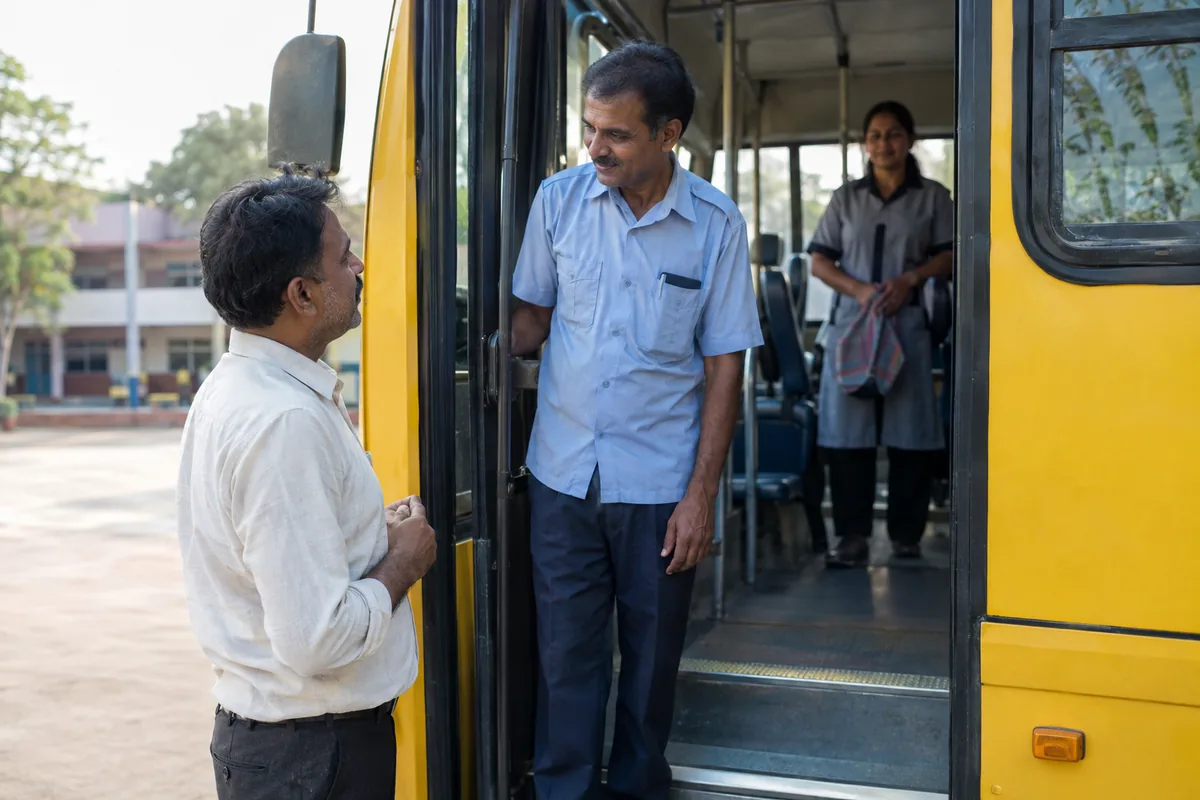
The two adults worth being able to name: the driver who holds the transport licence, and the attendant who supervises children on board.
State rules usually set a lower speed limit for school vehicles than for ordinary traffic. Ask what limit applies in your state, what the school has told its drivers, and how it checks. A warning painted on the back of the bus fades and proves nothing about the driving.
Route, timing and the handover
Ask for the route sheet for your stop: the stop point, the pick-up and drop-off window, the bus and driver assigned, and the name of the transport in-charge. The window matters more than an exact minute. A bus that is “usually around 7:20” with no notice when it runs late leaves a child waiting alone at a roadside and a parent unsure whether to wait or to leave.
Ask about the handover rule in both directions. Who waits with your child in the morning? What does the school do if nobody is at the stop when the bus arrives in the afternoon? Most schools have a written rule: “wait at the stop”, “return the child to the school office”, or “call the guardian and wait”. Any of those can be reasonable; not knowing which one applies is not.
Boarding records are what make the rule enforceable. Ask who records a boarding or drop-off event, what an “expected but did not board” exception looks like, and how quickly it reaches the school office. If your child is expected on the bus and does not board, you should hear about it the same morning.
What to escalate, and how
Most transport concerns are settled by the person on the ground. An unsafe stop, a door that will not close, a route that keeps running late: raise it the same day with the transport in-charge, and give the route, the bus, the time and what happened.
Escalate when the answer does not come, when the same problem repeats, or when the concern is about the vehicle, the permit or the driver’s documents. Those are the school’s responsibility to hold and the transport department’s to check. A dated written note to the principal is a different thing from a message in a class group: it creates a record that can be acted on.
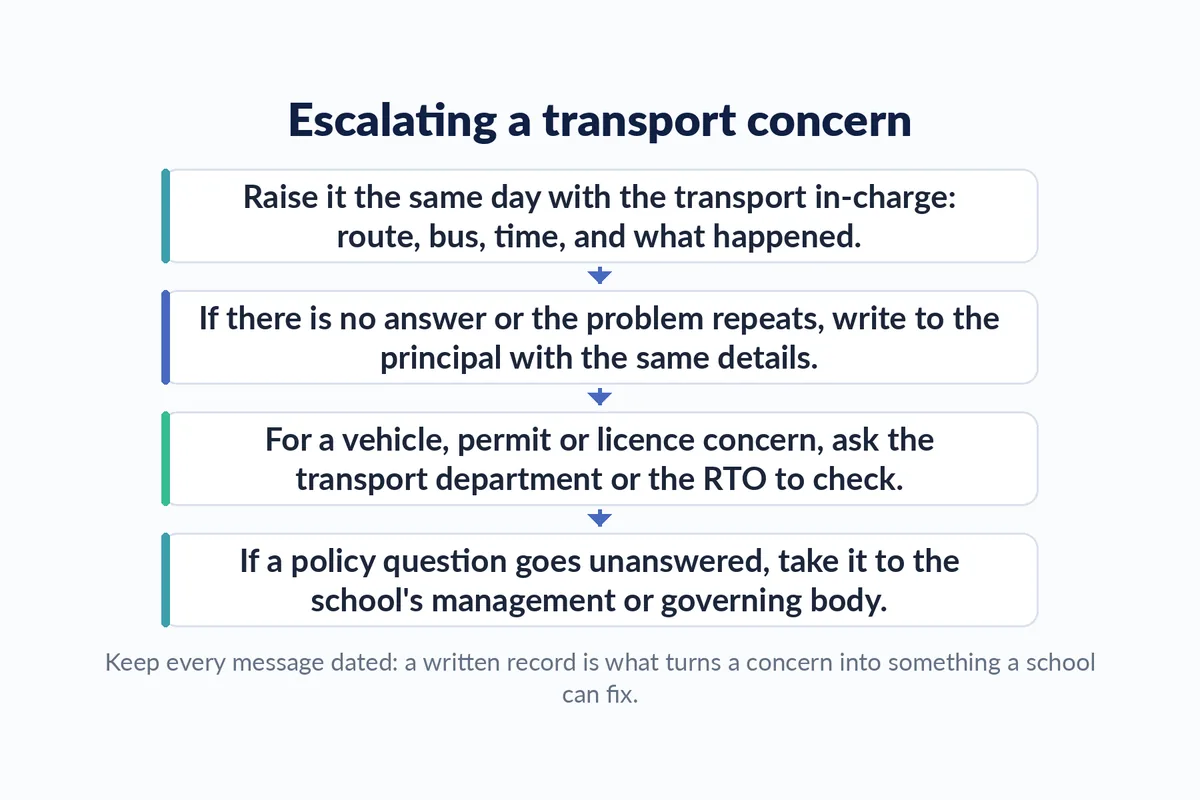
The order matters: most concerns end at the first step, and the later steps work only when the earlier ones are on record.
For the condition of a vehicle, the validity of a permit, or who is at the wheel, the state transport department and the regional transport office are the authorities that check it. For conduct on the road, the traffic police. For a policy question that never gets answered, the school’s management or governing body.
Red flags worth a same-day conversation
- A substitute vehicle or driver arrives and nobody told you beforehand.
- The bus carries more children than it has seats, on your route, on an ordinary day.
- The driver is the only adult on board a bus full of young children.
- Repeated lateness with no notice through an official channel.
- A written question goes unanswered for more than a week.
- Nobody can tell you who is supervising the bus today.
None of these on its own proves an unsafe school. Each is a signal that a question is worth asking today.
A checklist you can use this week
- Ask for the route sheet for your stop, with the assigned driver, attendant and vehicle.
- Ask which licence class the driver holds and how the school verifies it.
- Ask whether an attendant travels on the route and what she is responsible for.
- Ask when the vehicle’s fitness certificate, permit and insurance were last reviewed.
- Confirm the drop-off rule for the days when no guardian is at the stop.
- Find out which channel carries delay notices and who answers it.
- Stand at your stop in daylight, at the real pick-up time, and look at what a child has to cross.
- Save the transport in-charge’s number and the school office number in your phone.
- Put any concern in writing with the date, the time, the route and the bus.
The point of asking
Transport is one of the few parts of schooling where the parent is not present, which is why a short, specific question is worth more than general reassurance. Schools that keep routes, vehicles, drivers and boarding events in one place can answer these questions from the record rather than from memory. Scholva’s school transport module connects the route sheet, the assigned staff and the daily boarding record, so a question about yesterday morning has an answer.
Related reading: School Bus Tracking: A Safety and Operations Guide and A Practical Guide to School Transport Route Optimisation.