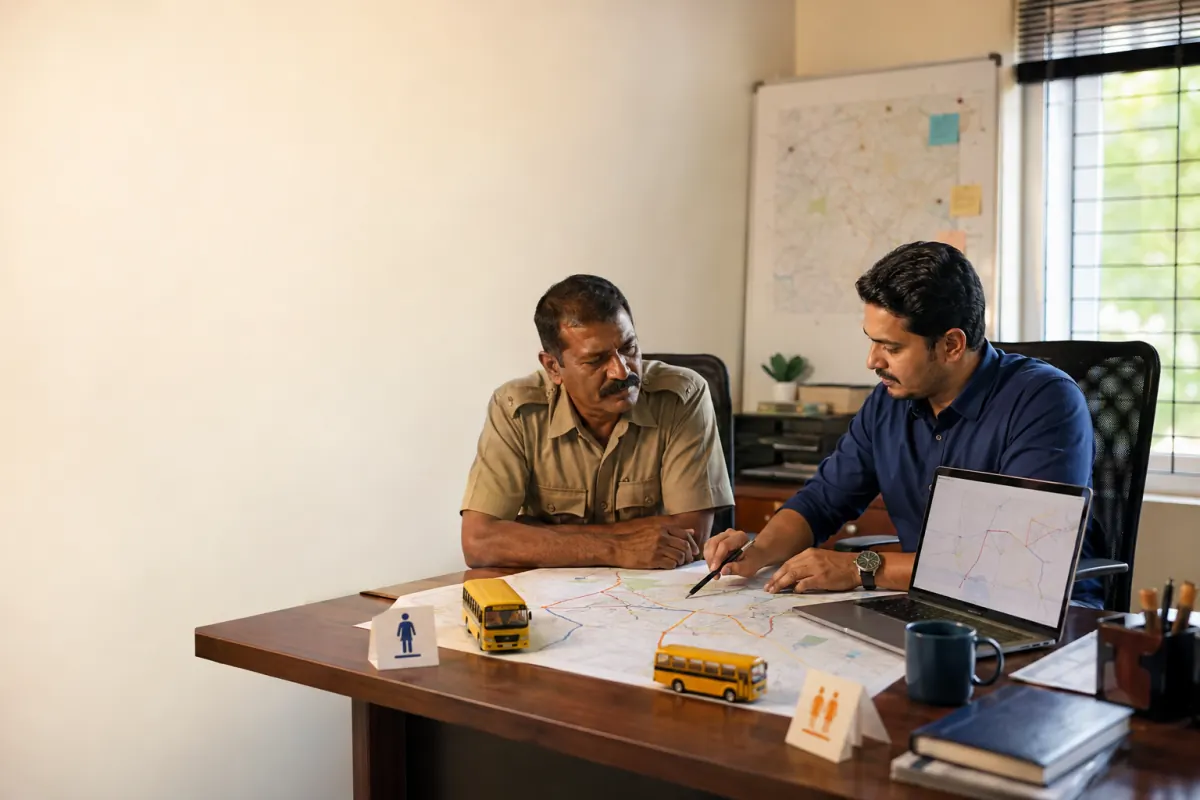
The shortest line on a map is rarely the best school bus route. Routes must balance student demand, safe pickup points, vehicle capacity, realistic road conditions, arrival windows, staff availability, and family experience. A change that saves distance may add a risky crossing or make the first child’s journey unreasonably long.
Route optimisation is therefore a review loop, not a one-time calculation.
It works best when transport staff, drivers, families, and school leaders contribute evidence at the right stage.
Work through six stages
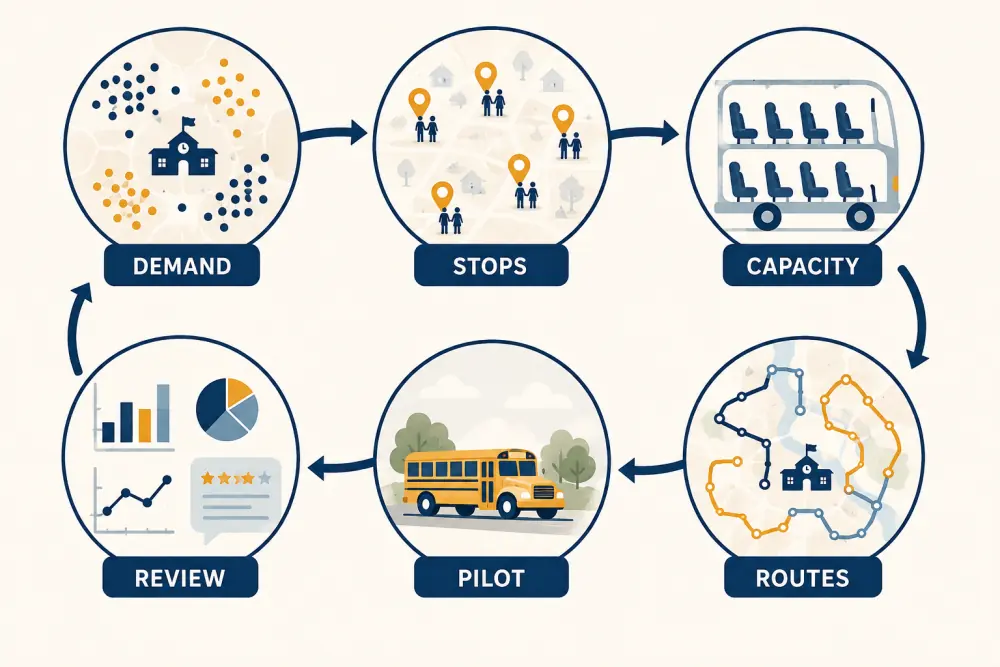
- Map current and expected demand.
- Evaluate safe, accessible stop options.
- Confirm vehicle and attendant capacity.
- compare route scenarios and constraints.
- Pilot selected changes in real conditions.
- Review performance and repeat when demand changes.
Start with dependable demand data
Use current student addresses or approved pickup areas, grade or age needs, service requests, and campus arrival requirements. Protect precise location data and restrict exports. For early planning, aggregated zones may be sufficient.
Account for siblings, alternating schedules, temporary arrangements, students joining or leaving, and demand that is not yet confirmed. Do not optimise around an outdated roster.
Choose stops through a safety review
Consider visibility, lighting, road width, traffic direction, legal stopping conditions, pedestrian access, waiting space, weather exposure, and whether younger learners need an adult handover. Local staff and drivers often know constraints that a map does not show.
Consolidating stops can reduce journey time, but only if the walking route remains appropriate. Document who approves new stops and how families request a review.
Model capacity honestly
Use authorised seating capacity and the school’s staffing policy. Include wheelchair or accessibility needs, equipment, attendants, and route-specific requirements. Avoid planning every vehicle at theoretical maximum if normal changes would immediately create an exception.
Track expected and actual occupancy so future adjustments use evidence.
Compare route scenarios
Assess distance, predicted journey time, number of stops, earliest pickup, latest arrival, vehicle capacity, operational cost, and robustness to congestion. Give safety and policy constraints priority over a small efficiency gain.
A school transport system can connect routes, vehicles, stops, students, and daily operations, while planners retain responsibility for local conditions and decisions.
Pilot in real conditions
Drive the proposed route at the actual time of day before launch. Check turns, stopping space, school-gate queues, seasonal road conditions, construction, and mobile connectivity. Trial with staff before placing students on a major change where practical.
Communicate the proposed stop, pickup window, effective date, and support contact to affected families. Avoid promising an exact minute when traffic makes a time window more honest.
Review daily exceptions
Monitor late starts, recurring delay points, missed stops, overcrowding, unplanned deviations, and family queries. Distinguish a one-off incident from a structural problem.
Use transport communication to keep families informed without turning every small variation into an alert.
Re-optimise at sensible points
Review before each academic session and when enrolment, campus timing, vehicle availability, or road conditions materially change. Keep the previous approved plan and effective dates so the school can understand why assignments changed.
Route-planning checklist
- Demand data is current and access-restricted.
- Stop options receive a local safety review.
- Capacity includes accessibility and staffing needs.
- Scenarios compare time, distance, reliability, and experience.
- Earliest pickup and total student journey are considered.
- Drivers and coordinators inspect proposed routes.
- Changes are piloted and communicated clearly.
- Live exceptions feed future planning.
- Temporary changes do not overwrite the master route.
- Review occurs when demand or conditions change.
Good optimisation makes routes safer to operate and easier to understand; it does not promise perfect journeys. Scholva can support route planning, assignments, live operations, and parent updates. Request a demonstration with anonymised stop zones.
Related reading: School bus tracking: a safety and operations guide and Early-warning signals school leaders should track.