Gamification can make progress visible and encourage participation. It can also narrow attention to points, embarrass students who start behind, or reward activity that has little connection to learning.
The difference is not the presence of badges. It is whether the design supports a worthwhile learning goal and respects student wellbeing.
Put the learning goal at the centre
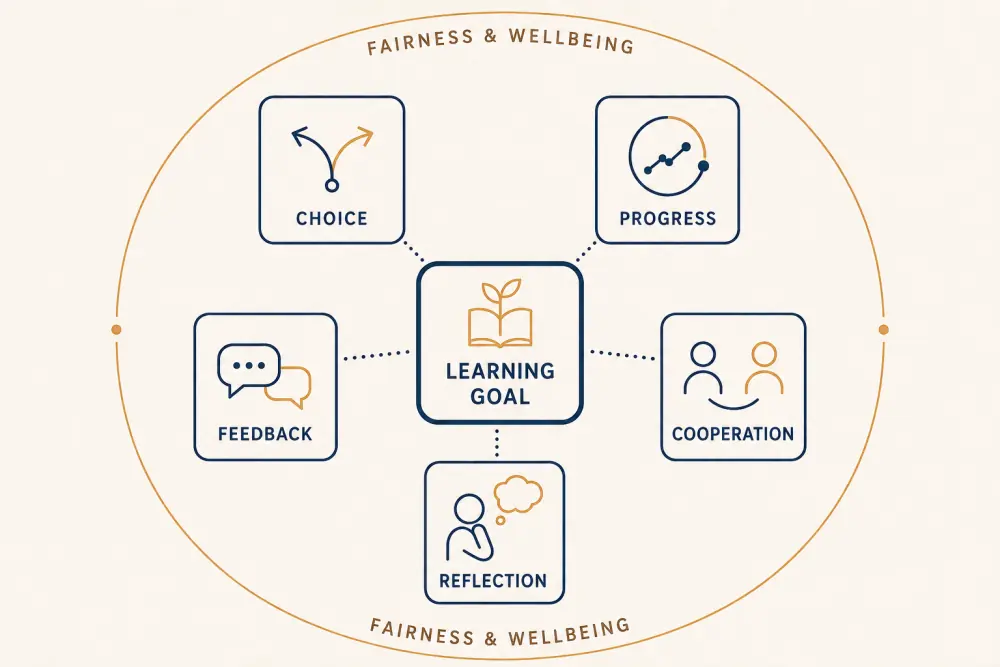
Begin with the change you want: more deliberate practice, regular reading, helpful peer feedback, or completion of a learning sequence. Then decide whether a game element makes that behaviour clearer or more satisfying.
If the activity would not be educationally useful without points, adding points will not fix it.
Design for progress, not status
Show students movement against their own goal: lessons completed, skills practised, a personal streak they can restore, or milestones reached. Avoid public rankings that repeatedly identify the same children as winners and losers.
Progress should reflect meaningful evidence. Logging in, clicking rapidly, or remaining online may be easy to count but weak indicators of learning. Combine completion with teacher feedback, reflection, or demonstrated understanding where appropriate.
Offer genuine choice
Students differ in confidence, access, interests, and pace. Offer several ways to participate or demonstrate progress. A learner might choose between practice sets, reading themes, collaborative challenges, or individual reflection.
Make participation accessible on shared devices and slower connections. Provide a non-gamified route when competition, animation, or reward mechanics create a barrier. An opt-out should not reduce access to teaching or essential information.
Use feedback quickly and carefully
The best feedback tells a learner what happened and what to try next. A badge can recognise a milestone, but it should not replace an explanation. Avoid rewards for speed when accuracy, reasoning, creativity, or care matter more.
Design recovery into streaks and challenges. Illness, disability, family responsibilities, and connectivity problems should not turn one missed day into a permanent disadvantage.
Prefer cooperation where it fits
Shared goals can encourage students to explain, help, and celebrate together. Structure them so one highly active learner cannot carry a group and one absence cannot make everyone fail. Reward the quality of collaboration rather than raw message volume.
Teachers should be able to see contribution patterns and intervene, but students do not need a public score for every interaction.
Protect fairness and privacy
Before launch, ask who benefits, who may be exposed, and what behaviour the system might accidentally encourage. Review differences by access, age, language, disability, and prior attainment. Treat patterns as prompts for investigation, not proof about motivation.
Use student identifiers only where staff genuinely need them. Do not display grades, behaviour events, attendance, or personal circumstances in a leaderboard. Apply the same role-based controls described in our school data-access guide.
Explain what is collected, why it is used, who can see it, and how long it is retained. Students should be able to understand the rules without reverse-engineering the interface.
Pilot before scaling
Run a short pilot with a representative group. Establish a baseline and examine participation, learning evidence, student feedback, teacher workload, and unintended behaviour. Ask students who disengaged, not only enthusiastic participants.
Watch for point chasing, guessing, peer pressure, account sharing, repeated easy tasks, and a decline in activity once rewards stop. Change or remove mechanics that create the wrong incentive.
Responsible design checklist
- State the learning purpose in one sentence.
- Reward meaningful practice or contribution, not clicks.
- Show personal progress instead of public rank.
- Provide choice, accessibility, recovery, and an alternative route.
- Pair rewards with useful feedback and reflection.
- Protect sensitive information and minimise collection.
- Pilot with diverse learners and teachers.
- Measure learning and wellbeing, not engagement alone.
- Stop mechanics that distort behaviour or increase pressure.
Technology can support the experience, but teachers remain responsible for the learning design. Scholva’s connected student workflows can help schools coordinate programmes without turning education into a scoreboard. Request a demonstration to discuss an appropriate approach.
Related reading: Positive student behaviour tracking and How connected software gives teachers more time.