
A board year has a shape everyone recognises. The syllabus gets longer, tests get more frequent, and somewhere in the middle the advice narrows to a single instruction: study more. Most students try to comply. Very few finish the year believing that more hours is what fixed it.
The students who come through a board year in reasonable shape are rarely the ones who studied the most. They are the ones whose work had a structure, who slept, and who kept a timetable they could sustain for five months instead of one they dropped in nine days. This is written to the student doing the revising, with a section for parents at the end.
Count one honest week first
Before changing anything, write down what one ordinary week actually contained. Not the week you intended, the week that happened. Record the hours that went to new content, to revision of content already covered, to practice done under time, and to everything else.
Most people find two things. The total is smaller than they assumed, and almost none of it is timed practice.
That matters because a board paper tests production under time, not recognition. Rereading a chapter a third time feels productive and is the weakest item on the list. One question answered with the book closed, then marked against the scheme, teaches more than an hour of highlighting.
Build a timetable you can keep
A revision timetable fails for one of two reasons. It has no room for a bad day, or it is written in units nobody can hold. “Physics, four hours” is both. “Chapter 6, problems 1 to 12, then check the answers” is a unit you can start, finish and measure.
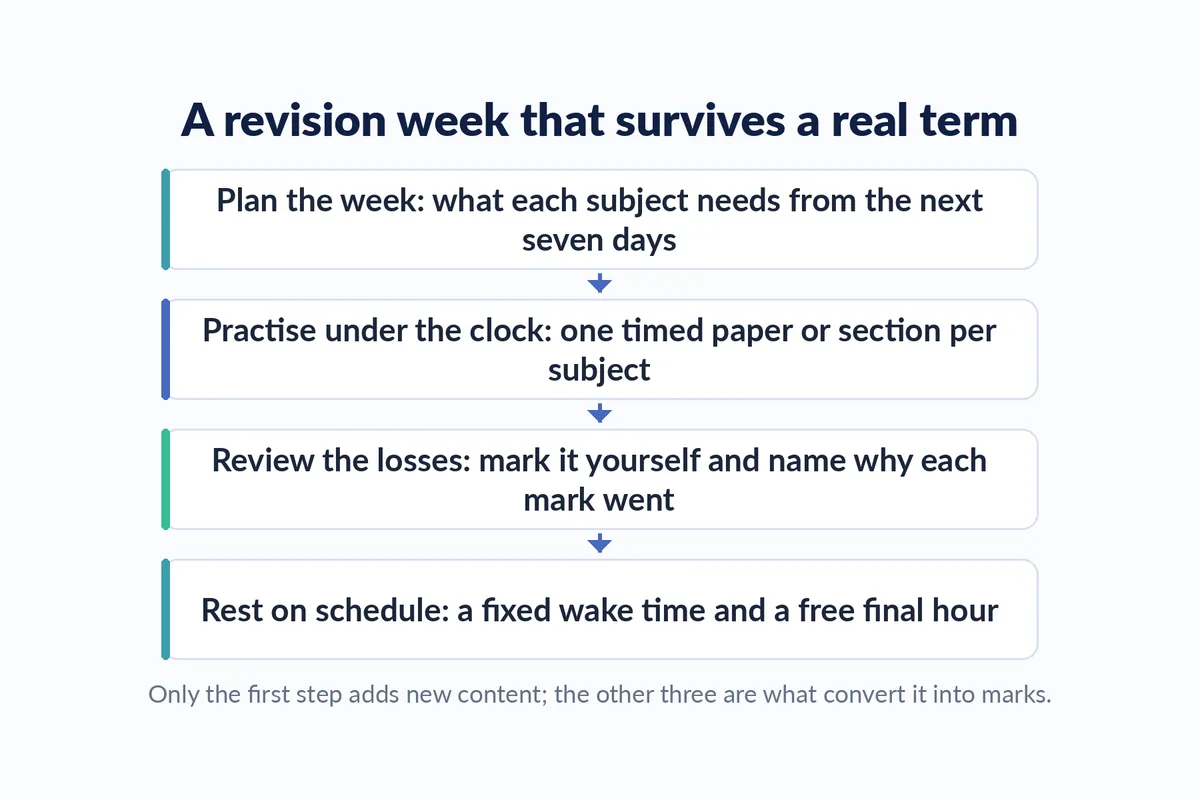
Four moving parts, arranged once a week: planning, timed practice, a review of lost marks, and rest that is scheduled rather than borrowed.
A week that survives real life has four moving parts, easier to arrange than a minute-by-minute grid.
Plan the week, not the day
On one evening a week, decide what each subject needs from the next seven days and write it down. Days go wrong, weeks rarely do. A daily plan that misses one evening feels broken. A weekly plan simply moves a block to Thursday.
Practise under the clock
At least one session a week per subject should be a real question paper, or a full section of one, done in the time the paper allows with nothing open beside you. That is the only honest rehearsal for the exam hall, and it is the first thing students drop when they feel behind.
Review what you lost
Every timed session gets a follow-up. Mark it yourself against the marking scheme and name why each mark went missing: not learned, learned but not applied, known and lost to carelessness, or lost to time. That is the difference between practising and repeating mistakes.
Leave the last hour free
Do not schedule up to bedtime. Keep that hour unassigned.
Sleep belongs in the timetable
Students treat sleep as the thing you spend when you are behind. It is closer to the opposite. A tired brain reads the same paragraph four times and keeps none of it, and a short-sleeping student makes the careless errors that look like not knowing the chapter.
Two habits do more than any app: a fixed wake time that anchors the rest of the day, and a screen cut-off half an hour before bed. Both get harder to keep in February, so set them now.
If you are regularly awake at two in the morning, that is not dedication: the timetable does not fit the syllabus, so cut something rather than shorten the night.
Know the difference between tired and empty
Not every flat day is burnout, and not every heavy week needs a counsellor. But some signals mean the current plan is the problem and should be changed rather than pushed through:
- You are sleeping less than usual and still feel unrested.
- You cannot start a chapter you have already read twice, and it is not one boring subject but all of them.
- You have stopped seeing friends, stopped moving, or stopped eating properly, without deciding to.
- School feels like somewhere you are avoiding rather than somewhere you go.
If several of those have been true for more than a couple of weeks, tell someone: a parent, a class teacher, a school counsellor. That is not an overreaction. It is the ordinary way a heavy year gets managed.
Use the school instead of working around it
Teachers set the internal assessments, and in many boards the internal component forms a real part of the final mark. The tests you sit through the year are not a distraction from board preparation. They are part of it.
Two questions are worth asking a subject teacher early in the year:
- What does the internal assessment mark actually consist of this year?
- If I score badly on this test, what should I do differently for the next one?
The answers change between cycles, so ask. A senior student’s account of how the paper worked two years ago is a lead, not a specification. Where your institution shows subject-wise marks rather than one total, use them: a total says something went wrong and never says what.
The last six weeks
Nothing changes in the final stretch except the proportions. Timed practice goes up, new content goes down, and revision should be active.
- Keep one page per subject: formulas, definitions, and the mistakes you have already made twice.
- Sit full papers at the same time of day as the real exam.
- Add no new books or sources in the last fortnight. Your own notes are the syllabus now.
- Read the date sheet and the permitted items list on your own board’s website, not from a forwarded message.
Rechecking and re-evaluation windows are set by the board and are short, so read your board’s instructions before results day.
For parents: support without pressure
The instinct in a board year is to check more often, and it usually backfires. A student who is already anxious hears the third question of the evening as a verdict on the day.

The check-in that helps in a board year is a conversation about the work, not a progress report on the syllabus.
What tends to help instead:
- Ask about the work, not the marks. “What did you get through today” invites a conversation. “Have you finished the syllabus” invites a report.
- Protect the routine you control: meals at predictable times, a quiet place to work, a reasonable bedtime, and a calmer house in the evening.
- Watch what predicts a difficult month, such as skipped meals, broken sleep and a student who has gone quiet, and raise it gently rather than adding a timetable.
- Keep the exam in proportion out loud. A board mark opens some doors and closes a few. Students take their cue on how serious a result is from the adults around them.
- If a teacher raises a concern, treat it as information, then ask what support would help.
If you are trying to work out whether a dip is ordinary or something more, Signs Your Child Is Struggling Before the Marks Show It covers that ground in detail.
Conclusion
Preparing for board exams without burning out is not about studying less or being more disciplined. It is about matching the work to the paper: timed practice instead of rereading, a weekly plan instead of a daily one, and sleep treated as part of the schedule rather than something to catch up on later.
Start with one week counted honestly, one timed paper per subject, and one fixed wake time. That usually shows which part of the plan is costing marks. If the year has been disrupted by illness, a change of school, or something happening at home, tell the school now rather than in February, because more can be arranged early. And for the same calendar seen from the school office, read Board Exam Season: A Countdown Checklist for School Operations.
Related reading: Reading Your Own Marks: How to Work Out What Actually Went Wrong and A Student’s Guide to Choosing a Stream After Class 10.