A family sitting across a desk from an admissions officer is usually handed one number: a placement percentage. It is printed in the brochure, repeated in the counselling session, and it is often the single figure that decides where a seventeen year old spends the next three or four years.
That number is rarely a lie, and almost never a measurement. It is a reconstruction, assembled in the fortnight before an accreditation visit or a prospectus deadline, from a placement officer’s spreadsheet, a training register, a mentor’s notebook and a messaging group nobody exported. The same effort is spent again eighteen months later, slightly differently, for a different form.
This article is about the machinery behind that figure, and about what a family can ask for at the counter, because both questions have the same answer. An institution that records placement, progression and student support while the year is running can answer you in a minute. One that rebuilds the data every cycle is estimating, politely.
Accreditation asks the questions parents ask
Two regulators matter for most Indian colleges, and neither is mysterious once the vocabulary is stripped away.
The National Assessment and Accreditation Council (NAAC) assesses an institution as a whole, across criteria that include the curriculum, teaching and evaluation, infrastructure, student support and progression, and governance. The one that speaks directly to a parent is student support and progression, where placement, higher study, competitive examinations, mentoring, scholarships and grievance handling are reported. NAAC has been revising its framework, so the criteria, weightages and grading scheme current as of October 2026 belong on naac.gov.in, not in an article, including this one.
The National Board of Accreditation (NBA) works differently: it accredits individual programmes rather than the institution, and its review turns on whether a programme can show that graduates actually attain the outcomes it claims. The evidence for that is not a brochure. It is assessment data, cohort progression, and a documented loop in which a problem found is acted on.
Neither regulator is asking for marketing material. Both are asking for the same underlying facts: what happened to each student, and what the institution did for the ones who struggled. A college that holds those facts answers a parent and a peer team from the same place.
One record, two cycles
The reason accreditation feels like a project rather than a report is that the data usually lives in four unrelated places, each owned by a different office, each rebuilt at the end of the cycle. Put the same facts on the student’s record while the year runs and both reports become an export.
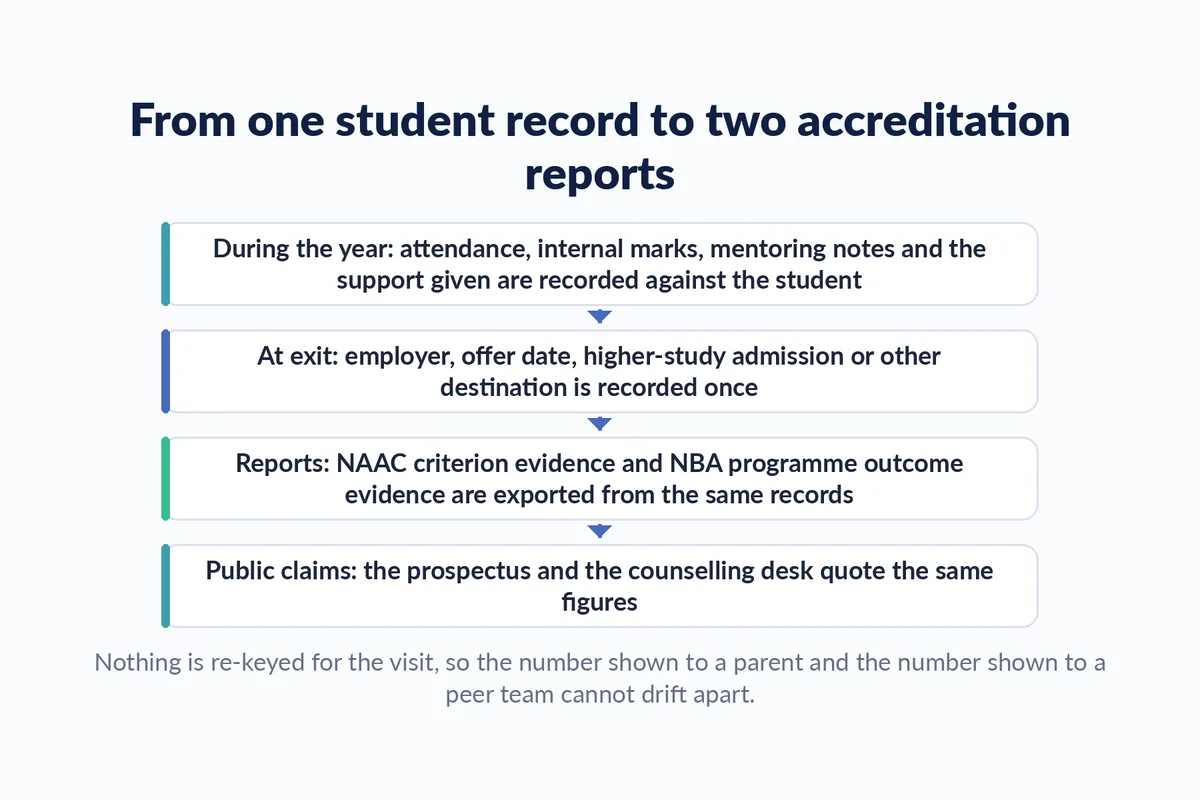
The same record feeds the accreditation submission and the number a family is given at the counter, which is why collecting it during the year is cheaper than rebuilding it twice.
The test of whether this is real is simple. Ask the placement officer and the head of department how many students from last year’s outgoing batch are employed, and see whether they reach for the same screen. If one opens a spreadsheet and the other a register, the institution has two versions of its own outcome data.
Why the number gets rebuilt every cycle
Four ordinary habits break the single record, and none of them looks like a mistake at the time.
The first is the placement cell running its own list. It is built to chase companies and collect offer letters, so it holds names, phone numbers and a status column, rarely connected to the academic record that knows which programme each student belongs to.
The second is training and mentoring recorded on paper. Attendance at a soft-skills batch, a mock interview, a remedial class, a mentor’s note about a student who stopped attending: all of it is evidence that support happened, and all of it sits in a register that nobody transcribes.
The third is the destination left blank. When a final-year student does not take a job, the register often says nothing. Higher study, a competitive examination, a family business, a gap year and an unrecorded outcome then become the same empty cell, and an empty cell is what later gets silently excluded from a percentage.
The fourth is the end-of-cycle scramble. A form arrives with a deadline and four people are asked for inputs. That reconciliation is not dishonest, but it is not auditable either, and the next cycle starts from the spreadsheet it produced rather than from the records.
Support that is never written down cannot be reported later, so the mock interview, the remedial class and the mentor conversation belong on the student’s record on the day they happen.
Four questions worth asking at the counter
Most families ask what the placement percentage is. It is a weak question: it invites a single figure with no denominator. These four are harder to answer without records.
- How many students were in the outgoing batch, and how many of them are counted in that figure? A percentage without its denominator hides everyone who did not respond, did not seek a job, or went on to study.
- What counts as placed here? An offer letter in hand, an offer accepted, a joining date passed, or a first salary received are four different states, and a record that distinguishes them is a record someone actually maintains.
- How are placements verified? The useful answer names a document and a date: an offer letter on file, an employer confirmation, a joining report. A number collected by asking students to reply to a message is a survey, not a placement record.
- What happened to the students who were not placed? This is the question accreditation asks under student support and progression, and the one a family should care about most, because it is about the middle and bottom of the batch rather than the top.
An institution with good records answers all four in the same conversation, and may offer to show you the summary. One that cannot answer the second question is not being evasive; it has probably never had to decide what “placed” means.
The paperwork you fill in twice
The same missing record shows up on the family’s side of the desk. A child’s admission form, scholarship application, bus pass, examination registration and hostel form each ask for the same details again, because the offices collecting them do not read one record. An institution that captures those details once, and reads them everywhere, gives a family fewer forms, fewer corrections, and fewer chances for a misspelt name to become a problem at the examination hall. The discipline that makes a placement figure defensible is the same one that makes a marksheet easy to reissue, which is the point made in what institutions should retain when certificates go digital.
What a well-run record looks like from outside
You will not be shown the database, and you should not ask to be. What you can look for is consistency under mild pressure. Ask the same question of two offices and see whether the answers match. Ask what happens to a student who fails two subjects in the first semester: whether the record shows a remedial plan, a mentor conversation, a parent contact, or nothing.
Consistency is the tell. A system that already holds attendance, internal assessment and mentoring notes makes those answers cheap, and an institution that has one tends to volunteer detail, because detail is free.
A short list before the first instalment
- Ask for the outgoing batch size alongside any placement figure, and ask what share of the batch is counted.
- Ask what “placed” means in their records, and whether offers and joinings are stored separately.
- Ask how destinations other than employment are recorded: higher study, competitive examinations, family business.
- Ask what support was given to students who were not placed, and who owns that follow-up.
- Ask how many times you will be asked to submit the same document during the year.
- Ask whether the programme your child is joining holds NBA accreditation, or only the institution holds NAAC. They are different claims.
Accreditation data has a reputation as paperwork with nothing to do with teaching. In practice it describes what happened to a batch of students, written by people who either kept the record or did not. Ask for it in its parts, before the fee is paid. For a longer view of how the same records support decisions across a campus, see building better decisions from everyday university data.