
A university with a parent campus, four affiliated colleges and two autonomous colleges does not have one student body. It has seven admissions processes, seven fee counters and seven examination sections, and it confers one degree that has to mean the same thing wherever it was earned.
Sooner or later someone proposes a single ERP for all of it, and the argument becomes one about software. It stalls there. The difficult question is which of these records is one record and which is genuinely many, and the answer has to be given per record. Answer it per campus, or per module, and the same three failures surface within a term.
One record or many
A record is one record when two campuses cannot both be right about it. A student’s enrolment number, the date an award was conferred, the fact that a fee receipt was issued: each has a single true value. Two versions are not a difference of local practice, they are an error waiting for a verification counter.
A record is many when the local context is the content. Attendance in a Tuesday lecture, an internal assessment mark, a room booking for a seminar: campus A’s answer is not a version of campus B’s, it is a different fact.
Three tiers follow from that test, and every record in the institution belongs to exactly one of them.
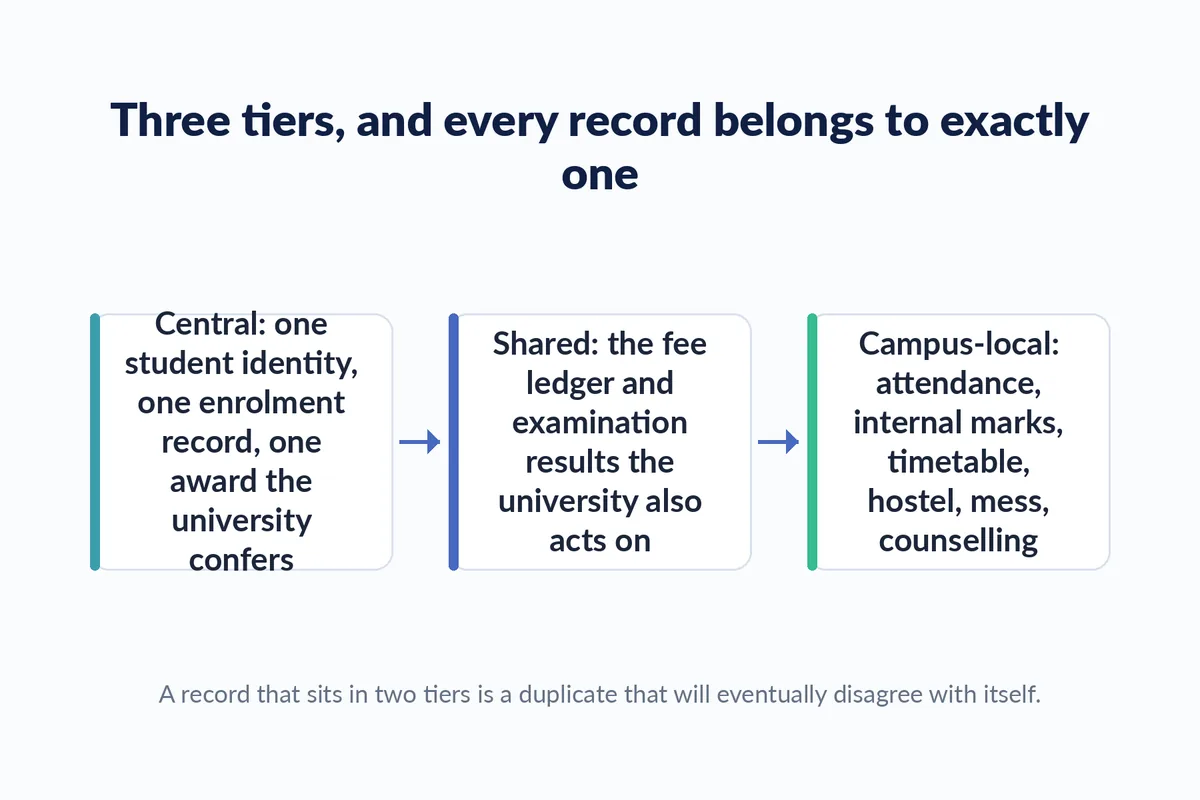
The tiers are settled record by record, which is why the same module can hold a shared record and a local one without contradiction.
What has to be shared
Student identity and enrolment
One person, one identifier, for the whole life of the relationship, including a transfer between colleges, a gap year, a re-admission and a second programme.
Most multi-campus systems get this wrong first, because each college already has an admission number its office uses daily, and that number is useful locally and useless centrally. A university needs an identifier it issues, that survives the student moving, and that every campus resolves to the same person.
Enrolment follows identity: which programme, which campus, which semester, from when. That record decides who may sit an examination, who counts for a funding claim, and who appears in the university’s own reporting.
Fees where the university touches the money
Fee records are shared where the university is party to the transaction: a fee structure it prescribes, a scholarship it funds, a receipt that must appear on a university statement. What matters is not that seven counters see one screen. It is that a payment is recorded once, in one ledger, so a reconciliation cannot give two answers about whether a student has paid.
Examination records and the award
Here the sharing is prescribed rather than chosen. Under the UGC framework for autonomous colleges, an autonomous college designs its own courses, conducts its own examinations and evaluates its own students, while the parent university awards the degree. Those guidelines are current as of 2026 and the text is checkable on the UGC site. The evaluation is local, the award is central. A system that stores the award only in the college that taught the student cannot answer a verification request ten years later.
Credit records now travel further than the degree does. Under NEP 2020 the Academic Bank of Credits is intended to hold credits earned across institutions. Connected to it or not, the design lesson is the same: the credit and the award have to outlive the campus relationship.

The evaluation belongs to the college, but the award it recommends has to exist in a record the university can still produce years later.
What has to stay local
The list is longer than most central teams expect, and keeping it local is not a concession to college pride. It is what lets a campus office correct a wrong entry without raising a ticket to the registrar.
- Attendance at class and subject level, including corrections made in the last week of a semester.
- Internal assessment and continuous evaluation marks, which belong to the teacher who set them.
- Timetable, room allocation and invigilation rosters, which change weekly and depend on a building.
- Hostel allocation, mess billing, and local transport run under campus contracts.
- Staff attendance, leave and payroll for staff the college employs.
- Counselling, disciplinary and wellbeing records, which should never be readable from a central console.
Centralising sensitive records does not make them safer, it widens the number of people who can reach them. A practical review of sensitive student records and who may access them applies unchanged across a university, with one addition: the campus holding the record should also hold the decision about who reads it.
When the line sits too far to the centre
Over-centralisation has a signature. It looks like a registrar’s office that becomes the only place a correction can be made, so a college with a wrong date of birth in an examination form waits three days. It looks like every college forced onto one academic calendar when affiliations and local holidays differ.
Three consequences follow. Campus staff keep a parallel spreadsheet because the system will not let them finish before the counter closes. That spreadsheet becomes the real record for anything urgent. The central team spends its time on corrections instead of reporting.
When it sits too far out
The opposite failure is quieter, because nothing breaks on the day it is configured. Each college keeps its own student master, the same person exists three times with three admission numbers, and credits are re-entered by hand from a photocopy of a marksheet after a transfer.
Then eligibility is calculated from local data that does not match the university’s enrolment list, and a student who attended everything is marked absent from the university roll. Then the university issues an award while the college issues a consolidated marksheet, and the two disagree about a grade. Nobody is lying. There is simply no authority of record.
Draw the line with a record by record review
The work is a short, unglamorous document that most institutions skip. For each major record, name four things.
- Who creates it.
- Who is the authority of record, meaning whose copy is correct when two copies disagree.
- Who else needs to read it, and at what scope.
- What happens when it is edited after someone has relied on it.
A record with one author, one authority, a defined read scope and a version history will behave whether it sits centrally or locally. A record with three authors and no stated authority will fail wherever you put it.
Two rules make the review hold. One write path per field, so a field is edited in one place and everywhere else receives it. And every shared record gets a named owner in the central office plus a counterpart on each campus, so a mismatch has a person to call.
The autonomous college is the real test
An autonomous college is where the two pressures meet most sharply. It has the academic freedom to run its own scheme of examination, and it still has to hand the university something it can act on: enrolment, results, credits, and a recommendation for the award.
That is not a conflict if the shared layer stops at what the university does with the information. Internal marks, question papers, moderation decisions and revaluation stay where the academic work happens. What travels is the outcome: this student, this programme, these credits, this result, recommended for this award.
What to settle before the first configuration
- Agree the identifier before the modules. A university issued student ID, resolved by every campus, prevents most later duplication.
- Write the authority of record for fees and examination data on one page, and have the registrar and college principals sign it.
- Keep attendance, internal marks and counselling outside the central store by default.
- Test the transfer case end to end with a real student record before go live.
None of this is really a product decision. It is a decision about where authority sits for each fact, and an ERP is only the place where that decision gets stored. Scholva runs admissions, enrolment, fees, examinations and academic records in one system, with role scoped access across campuses and an access history behind it, so a university and its colleges can work from one definition of a record without one office reading everything. See how it works.
Related reading: A complete management workflow for coaching institutes and Digital certificates and marksheets: what institutions should retain.