
Examinations bring together calendars, subjects, rooms, students, teachers, papers, marks, report formats, and parent communication. When each part is maintained in a different file, even a small change can produce conflicting versions.
Managing the examination cycle well means designing one controlled flow from planning to academic action.
Treat examinations as a lifecycle
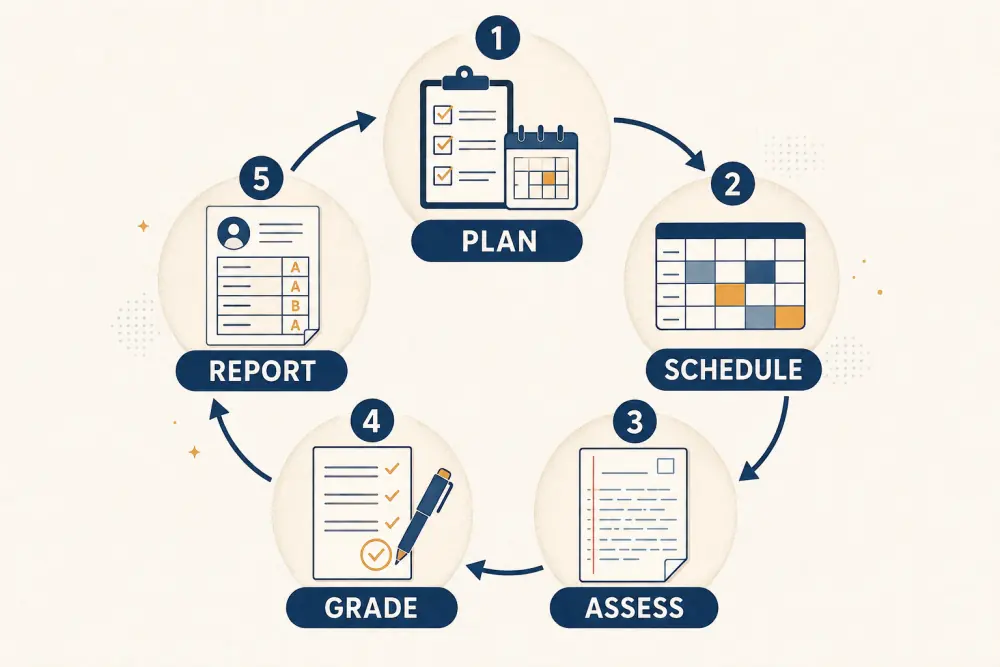
The five broad stages are connected:
- Plan: define the assessment, eligible students, subjects, weightage, rules, and owners.
- Schedule: assign dates, times, rooms, invigilators, and any accommodations.
- Assess: deliver the examination with controlled papers, rosters, and attendance.
- Grade: enter marks, moderate where required, and resolve exceptions.
- Report: publish approved results and use the evidence to plan support.
A change in one stage should be visible to the next. Rescheduling a subject, for example, must update the authoritative timetable and related communication - not only one spreadsheet.
Establish the assessment structure
Before scheduling, define the academic terms, assessment types, subjects, maximum marks, pass rules, grading scales, and contribution to final results. Record who may configure these rules and who approves them.
Keep the structure understandable. Excessive variations between sections make mark entry, moderation, and report cards harder to validate. When differences are educationally necessary, document them explicitly rather than hiding them in formulas known to one employee.
Build and validate the schedule
Use current class, subject, room, and staff information from academic operations. Check for student clashes, teacher or invigilator conflicts, room capacity, public holidays, practical requirements, and approved accommodations.
Publish a draft for internal review before sending it to families. Once approved, give the schedule a clear version and change process. Last-minute updates should identify what changed, who approved it, and which audiences need a new notice.
Control examination-day operations
Prepare student rosters, room allocations, invigilation duties, material requirements, and incident forms from the approved plan. Decide how absences, late arrivals, suspected malpractice, illness, and interrupted examinations will be recorded.
The coordinator should have one exception list rather than collecting messages from every room. This helps the team act consistently and preserves the information needed for later decisions.
Make mark entry verifiable
Set entry windows and permissions so teachers only access the appropriate assessments and groups. Validate values against maximum marks and provide explicit states for absent, exempt, withheld, or not assessed; do not represent every exception as zero.
Use a review step before results are final. Subject heads or authorised reviewers can identify missing entries, unusual distributions, totals that do not reconcile, or comments that need revision. A reliable assessment workflow should show what is draft, reviewed, approved, and published.
Separate calculation from approval
Software can calculate totals, grades, ranks, or promotion indicators according to configured rules. The institution remains responsible for verifying those rules and approving outcomes. Test the calculation with representative cases, including absences, optional subjects, transfers, and rounding boundaries.
Keep a record when approved marks are changed. Corrections should state a reason and follow an appropriate authorisation path.
Publish reports with context
Before releasing report cards, check learner identity, subject mapping, totals, grades, attendance where included, and teacher comments. Coordinate the publication time and support route so families know where to raise a genuine discrepancy.
Results are not the final step. Teachers and leaders should use subject, class, and topic patterns to identify reteaching, additional practice, enrichment, or learner support.
Review after every cycle
Within a week of publication, hold a short operational review. Capture timetable conflicts, paper or roster errors, late mark entry, moderation bottlenecks, correction volume, and recurring family questions. Assign improvements before the next cycle begins.
Examination-cycle checklist
- Assessment rules and owners are approved before scheduling.
- Student, subject, staff, and room data is current.
- Draft schedules are conflict-checked and versioned.
- Examination-day exceptions have defined records and responses.
- Mark-entry permissions and validation are tested.
- Absence and exemption states are distinct from zero.
- Moderation and final approval are visible.
- Report calculations are tested with edge cases.
- Families receive results through an official channel.
- The academic team reviews outcomes and process lessons.
Scholva connects examination planning, mark entry, reporting, and academic information so the cycle is easier to control and improve. Request a demonstration with your current assessment structure.
Related reading: Online assessments can reduce grading workload and Generate report cards without spreadsheet errors.