
Fee collection becomes stressful when the school, finance team, and families are working from different information. Parents may not know which instalment is due, receipts may arrive late, and staff may spend hours sending individual messages or matching payments to students.
The goal is not to send more reminders. It is to create a predictable process in which the right family receives the right information at the right time.
Start with fee-plan clarity
Define fee categories, due dates, instalments, concessions, late-fee rules, and refund policies before configuring software. Use names families can understand and staff can apply consistently. If “term fee,” “tuition fee,” and “academic fee” refer to the same charge in different files, reporting will remain unreliable.
Assign responsibility for approving concessions, correcting an allocation, waiving a charge, and issuing a refund. These decisions should not depend on whoever happens to notice the issue first.
Design the whole collection cycle
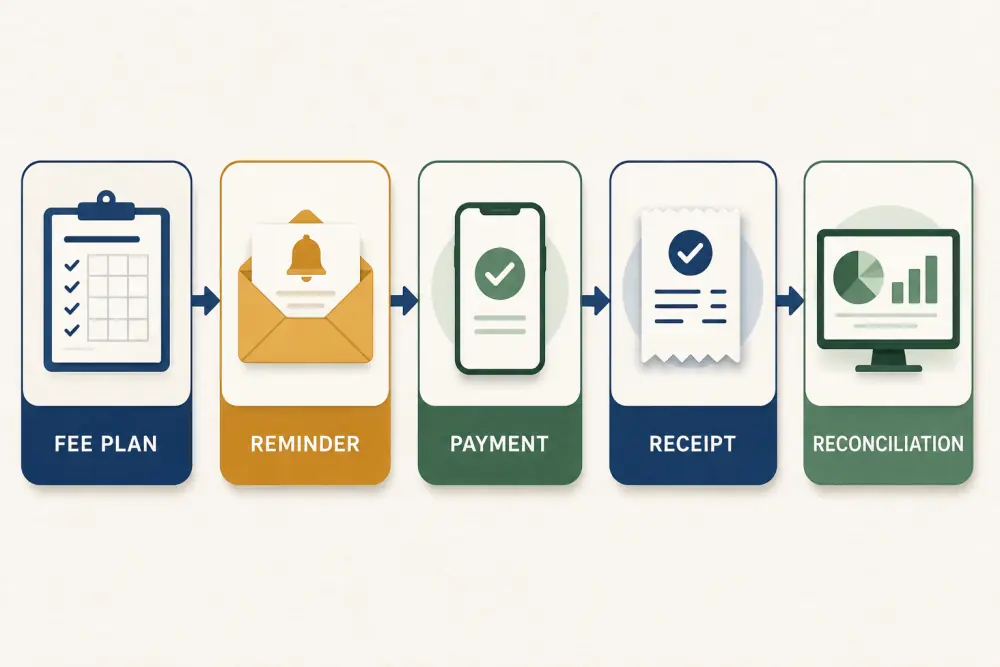
A dependable school fees workflow connects five stages:
- Assign the correct fee plan to the student.
- Notify the family before the due date with a clear breakdown.
- Accept and identify the payment through approved channels.
- Issue a receipt against the correct charge.
- Reconcile the transaction and surface genuine exceptions.
When these stages are separate, staff may remind a parent who has already paid or record one transaction twice. Connecting them makes communication both more accurate and more respectful.
Segment reminders instead of broadcasting
Use reminders for specific states: upcoming, due today, overdue, partially paid, or payment received but awaiting confirmation. Families with no outstanding amount should not receive collection messages.
Keep the message factual. Include the student context, amount or instalment, due date, approved payment route, and contact point for a genuine query. Avoid exposing financial details in large messaging groups or asking staff to use personal accounts.
Timing matters as much as wording. A small sequence - advance notice, due-date reminder, and overdue follow-up - usually feels more manageable than frequent unscheduled messages.
Give families a self-service view
A parent portal should make the current fee position easy to understand. Parents need to distinguish total annual fees from the amount due now, see previous payments and receipts, and find the school’s approved payment instructions.
Self-service reduces routine calls, but it must reflect finance records accurately. If the portal and office ledger disagree, parents will understandably return to phone calls and screenshots.
Reconcile every day
Collection is incomplete until the payment is matched to the student, fee item, amount, and date. Establish a daily routine for automatic matches, unmatched transactions, partial payments, duplicates, reversals, and offline payments.
Give one role responsibility for the exception queue and use an approval step for corrections. Do not silently edit completed transactions. A clear audit history protects the family as well as the institution.
Handle financial difficulty with care
Automation should never remove judgement from sensitive conversations. Give authorised staff a private process for instalment changes, hardship requests, concessions, or disputes. General teachers and unrelated staff should not see more financial information than their role requires.
Separate routine reminders from escalation. A system can identify an overdue state, but the school should define when a person reviews context before further action.
Track useful operational measures
Monitor collection by due date, not only the total amount received. Also review unmatched payments, time to issue receipts, unresolved parent queries, corrections after posting, and reminder delivery failures.
These measures reveal process quality. A high collection total can still hide significant manual work or a poor parent experience.
A practical 30-day improvement plan
- Week 1: clean fee categories, due dates, student allocations, and guardian contacts.
- Week 2: configure templates and test upcoming, due, paid, and overdue states.
- Week 3: pilot portal visibility and payment reconciliation with one grade or fee cycle.
- Week 4: review exceptions, parent questions, and staff workload before expanding.
Fee collection works best when clarity replaces chasing. Scholva connects fee plans, parent visibility, receipts, and reconciliation so staff can focus their attention on exceptions that genuinely need a conversation. Request a demonstration to walk through your current fee cycle.
Related reading: Design flexible school fee structures and Automatic payment reconciliation for school accounting.