
A day scholar’s family deals with one office. A residential campus is different: once your child lives on it, four people hold a record of her. The warden knows whether she was in the dormitory at ten at night, the accountant raises the mess bill, the transport desk runs the weekend bus, and the academic office holds her marks. Each record has a good reason, and each is kept somewhere else.
The question is whether they are reading the same child. When they are, the mess bill matches the nights she ate on campus and the room charge stops the month she left. When they are not, the family becomes the reconciliation department, and nobody tells you.
One student, five registers
Admission captures the details once: the name as it appears on the board certificate, the guardian phone numbers, and the identity number the campus uses on every list. Every later office either works from that record or invents its own.
Hostel allotment says which room your child is in, which warden is responsible, and the date the allotment began. A room change is an event with a date, not an edit that overwrites the old value, because the accountant needs to know where one room ends and the other begins.
Night attendance is not the attendance the academic office keeps. Class attendance answers whether she was in a lecture; night attendance answers whether she was on campus when the warden closed the register. The two are marked by different people, at different hours, from different lists.
The mess ledger is the least standardised charge on any campus: some institutions bill a flat monthly amount, some bill per day present, some bill per meal scanned at a counter. Whichever model is used, the bill should be traceable to it. If nobody can explain how a month’s amount was arrived at, it is a decision rather than a calculation.
The transport roster is not the school bus run. It is the weekend bus to town, the station run at the start and end of term, and the list of guardians permitted to collect a student.
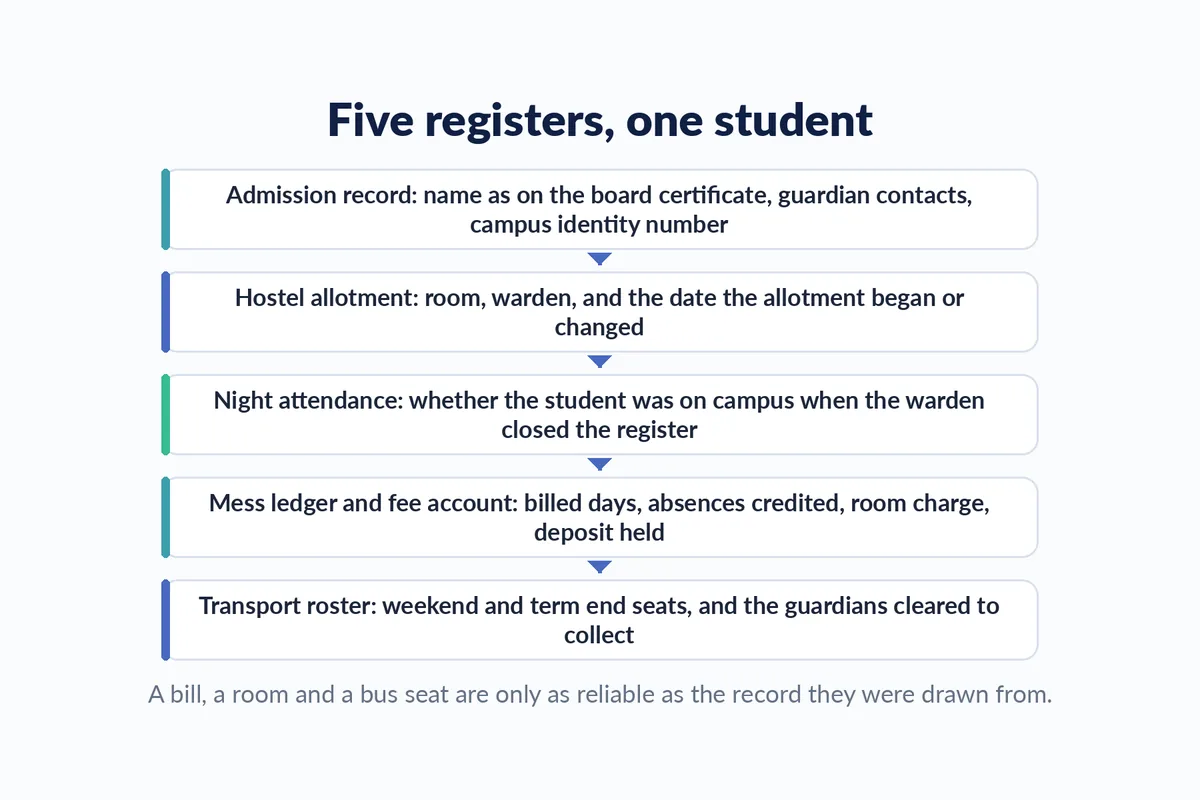
The five records a residential campus keeps about one student, which have to agree before a mess bill, a room charge or a bus seat can be trusted.
The mess bill is the record a parent can audit
The mess bill is the one number a parent can audit, because it has a period attached. Ask for the billing model in writing before the first term, and ask about the rule rather than the amount.
- On a flat monthly charge, an absence does not reduce the bill. Hear that from the hostel office before term rather than after a week at home with fever.
- On a per-day charge, ask which record the billed days come from, and whether a medical absence reaches the mess office at all.
- On a per-meal charge, ask how a missed scan is handled, because a card that fails at the counter is usually recorded as a meal not eaten.
Then read one bill against your own memory of the month. Were those the guest meals you actually had? An office that can put the days behind the amount is the same office that can correct it without an argument.
Night attendance is not class attendance
The register that closes at night is the one parents rely on most and see least. Three questions tell you whether it is a record or a ritual.
Who marks it, and when? A warden who walks the corridor at a fixed hour and marks each room is doing something different from a student who signs a sheet at the desk. Both can be legitimate; only one produces a time.
What happens when a name is missing? It should start a defined sequence: a second look at the room, a call to the student, a call to the guardian, and a log entry with a time against each step.
And what does it show in the morning? A register that only marks absence is weaker than one that marks presence, because an absence has to be inferred from a blank, and a blank has several causes.

Night attendance is taken by a person walking a corridor at a fixed hour, which is why the record needs a time against it and a defined next step when a name is missing.
Late returns belong in the same record, with a time against them. And the gate pass should carry the identity number the hostel and the fee counter use, so a permission given at the gate is visible to the warden expecting her back.
Rooms, deposits, and the charge that follows a move
The room is the part of a residential year that changes silently. A student moves to another block because a friend is there, and the change happens in a corridor conversation the fee account never hears about.
Two habits prevent the argument that follows. A room change is recorded with a date and a reason when it happens, and the charge is raised against the allotment in force that month, so a mid-month move produces two lines rather than one contested amount.
Ask how the refundable deposit is handled at exit, and what may be deducted from it. Damage charges are legitimate, but they should be itemised against an inspection a warden signed, not returned as one unexplained figure.
Transport on a residential campus: seats, routes and the gate
Transport here is occasional rather than daily, which is why it goes wrong. A weekend bus needs a list, and it has to be the list the gate works from, because whoever collects a student at the end of term should already be someone the campus cleared in September.
Three things make that reliable once the records are joined: a roster built from the hostel list rather than typed from a message group, so a student who moved blocks is still on the bus; a gate pass naming the guardian and vehicle, drawn from the cleared guardians on the admission record; and a rule that a student who is not on the roster does not board.
If your child travels with campus transport, the questions worth asking about school transport safety apply just as well to a college shuttle, and the same logic about who is allowed through a gate appears in paper visitor registers versus digital gate passes.
Where the versions of your child come apart
None of this fails dramatically. It fails in an ordinary week. A student goes home on Friday with a gate pass the warden approved, the mess ledger still bills her for the weekend, and the transport roster still expects her on the Sunday return bus.
That is a records problem arriving as an argument about money. The fix is not more diligence from the warden. It is one student record that all three offices read and write to, with dates on every change. The same principle sits behind one academic view of admissions, attendance, fees, exams, transport and communication, applied to a campus where the student never goes home at four o’clock.
What to ask before the first term
Ask these of the hostel office rather than the admissions desk, while you are still comparing institutions.
- Is there one student record, or a hostel register, a mess ledger and a transport list kept separately?
- How is the mess billed, and what reduces the bill: absence, medical leave, a mess cut applied in advance?
- Who marks night attendance, at what hour, and what happens when a name is missing?
- What is the deposit, what may be deducted from it, and how is a deduction documented before it is taken?
- Can I see one place with the mess bill, the hostel charges, the nights she was marked present and the bus seats she holds?
If the answer to the last question is a portal showing all of it for one student, the earlier answers are probably consistent. If it is four phone numbers, they probably are not.
A residential year is a records problem
The warden, the accountant and the transport manager are not adversaries. They are three people doing difficult jobs with partial information, and the parent who calls about a mess bill is usually the first to notice the records disagree.
You cannot audit a campus from home, and you should not try. But you can ask, once, whether the same student appears the same way in every office that houses, bills or moves her. An institution that answers yes has solved a harder problem than the one you are asking.