
Spreadsheet report cards often depend on copied marks, hidden formulas, manual grade lookups, and one person who knows which file is current. The process may work for years - until a row shifts, a formula misses a learner, or an outdated version is published.
Reliable report cards come from a controlled workflow with visible checks and approvals.
Separate the five stages
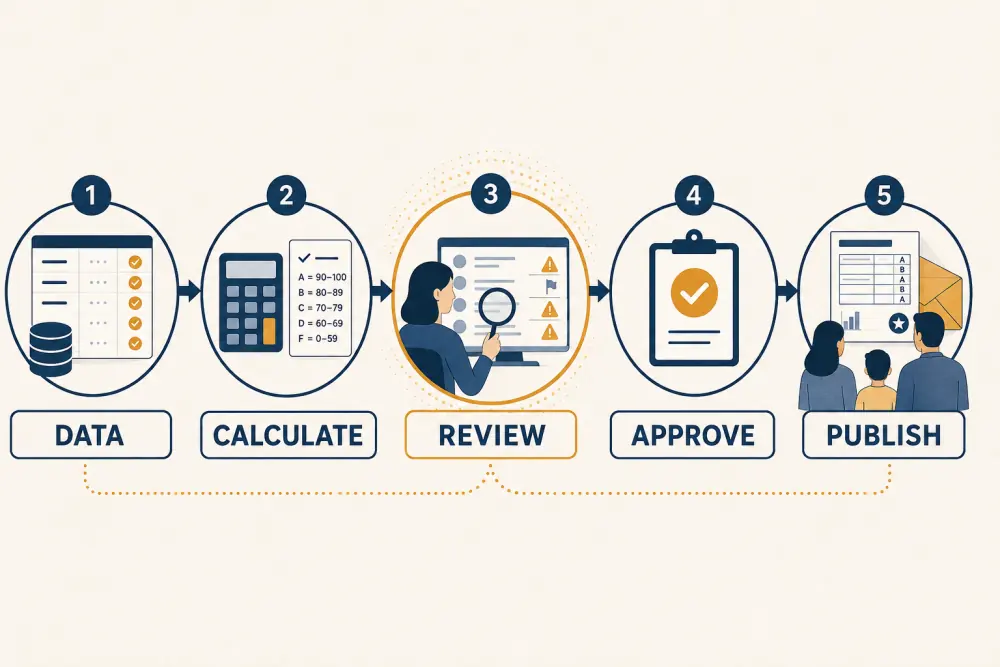
- Data: collect complete, authorised marks and required student information.
- Calculate: apply approved totals, weightage, grades, and rounding rules.
- Review: surface missing values, exceptions, and unusual outcomes.
- Approve: give authorised academic roles a final controlled sign-off.
- Publish: release the approved version to the correct family or student.
Do not collapse these into one “generate” button. Each stage protects a different kind of accuracy.
Establish authoritative source data
Marks should flow from the approved assessment record rather than copies emailed between teachers. Student names, identifiers, class, subjects, and attendance should come from current academic records.
Set mark-entry deadlines and explicit states for absent, exempt, withheld, and not submitted. A blank cell must not be silently treated as zero. Show teachers what remains incomplete before the review window closes.
Configure and test calculation rules
Document maximum marks, component weightage, best-of rules, grade boundaries, rounding, optional subjects, promotion logic, and comment requirements. Keep policy language and system configuration aligned.
Test representative cases before every major reporting cycle: a learner exactly on a grade boundary, an absent component, a transfer joining mid-term, an exempt subject, and a corrected mark. Compare expected and calculated results. Save the test cases so policy changes can be checked again.
Review exceptions instead of every cell
A good assessment system can direct attention to missing marks, values outside range, unexpected grade changes, inconsistent subject enrolment, and results changed after initial review.
Teachers should confirm their subjects. Class or grade leaders can review learner-level completeness. An authorised academic administrator can resolve cross-subject and policy exceptions. This layered review is more dependable than asking one person to inspect every spreadsheet row.
Keep correction history
After review begins, changes should require a reason. After approval, changes may need stronger authorisation and a replacement version. Retain who changed the record, when, why, and whether the family had already received an earlier report.
Avoid editing a generated PDF directly. Correct the source record, recalculate, approve, and generate the new report so every output agrees.
Design the report for understanding
Use consistent subject names, terms, grade legends, and attendance labels. Make it clear whether a number is a mark, percentage, grade point, or weighted total. Comments should help the learner understand progress and next steps rather than repeat the grade.
Preview long names, multilingual text, optional subjects, empty comments, and page breaks. Visual errors can obscure accurate data.
Publish through controlled access
Release reports only after final approval and at a communicated time. A parent portal can provide each family with the correct report without exposing a class list or relying on manually addressed attachments.
Define a route and deadline for correction requests. Record whether the query concerns source marks, calculation policy, student information, or report presentation so the right team can respond.
Review the cycle
After publication, count missing-mark chases, calculation defects, reopened approvals, replacement reports, and parent queries. These measures show where the process needs improvement before the next term.
Report-card checklist
- Student, subject, assessment, and mark records have clear owners.
- Blank, absent, exempt, and withheld states are distinct.
- Calculation rules match approved academic policy.
- Boundary and exception cases are tested.
- Review queues identify missing and unusual records.
- Corrections keep reason and history.
- Final approval is role-based and visible.
- Reports are previewed with realistic edge cases.
- Publication protects each learner’s privacy.
- Post-cycle issues become improvements for the next term.
Scholva connects source marks, academic rules, approval, report generation, and family access in one auditable flow. Request a demonstration with a sample grading policy.
Related reading: Manage the complete school examination cycle and Topic-level assessment analytics for reteaching.