
Most admission conversations happen in the school’s best week: corridors swept, notice boards current, a senior teacher free to walk you around, every question answered as rehearsed. None of that is dishonest. It is the wrong sample.
The useful questions are the ones a school answers with a specific fact rather than a principle: a name, a date, a number of periods, a document you can read. Here is the framework I would carry into a visit, so that each hour of asking gives you something you can compare between two schools.
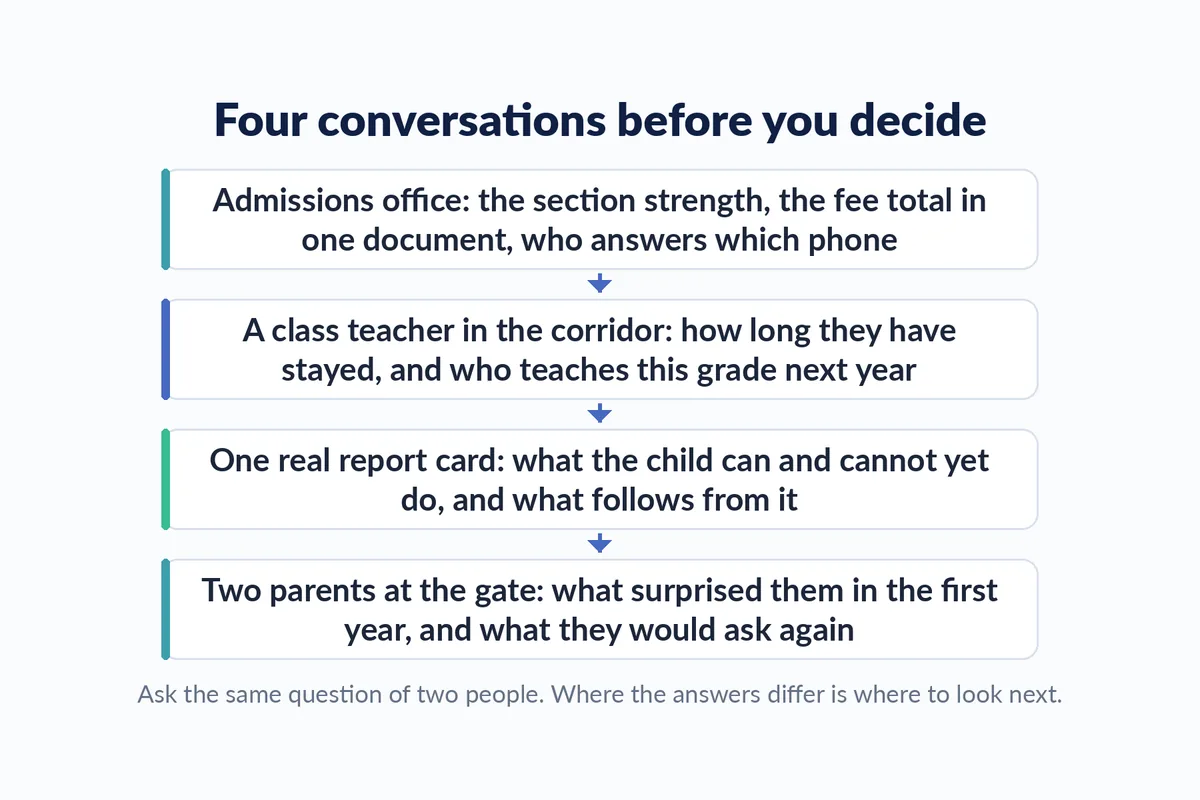
Four conversations, each answerable with a specific fact rather than a principle, and each worth repeating with a second person.
Ask about teachers, not about teaching philosophy
Every school will tell you that its teachers are caring and qualified. Ask instead how many left at the end of the last two academic years, and in which subjects those vacancies fell. A school that keeps the number can tell you. One that cannot is also telling you something.
Then narrow it. Who taught this grade last year, and who will teach it next year? How long has the current class teacher been here? If she joined in June, ask whom she replaced and why that person left. Three follow-ups usually settle it: what happens to a class when a teacher leaves in November, whether the replacement is permanent or temporary, and whether the senior grades have subject teachers for the whole year.
The cheapest version of this question goes to a teacher rather than the admissions office, in the corridor or at the staff room door, in the ten minutes after a class. “How long have you been here?” is not impertinent, and three or four answers tell you whether the place holds people.
Class size is a number plus a set of arrangements
The ratio in the brochure is an average across the school. What affects your child is the strength of the specific section she would join, and how that section changes during the year.
Ask for three figures: the section strength in your child’s grade, the largest section in that grade, and whether sections are rebalanced after the first term. Ask how many periods a week the class teacher actually spends with the class, rather than how many the timetable allots. Then ask what happens when a teacher is absent: whether a substitution is arranged, whether the class is merged with another, or whether the period is simply free. The third answer is common.
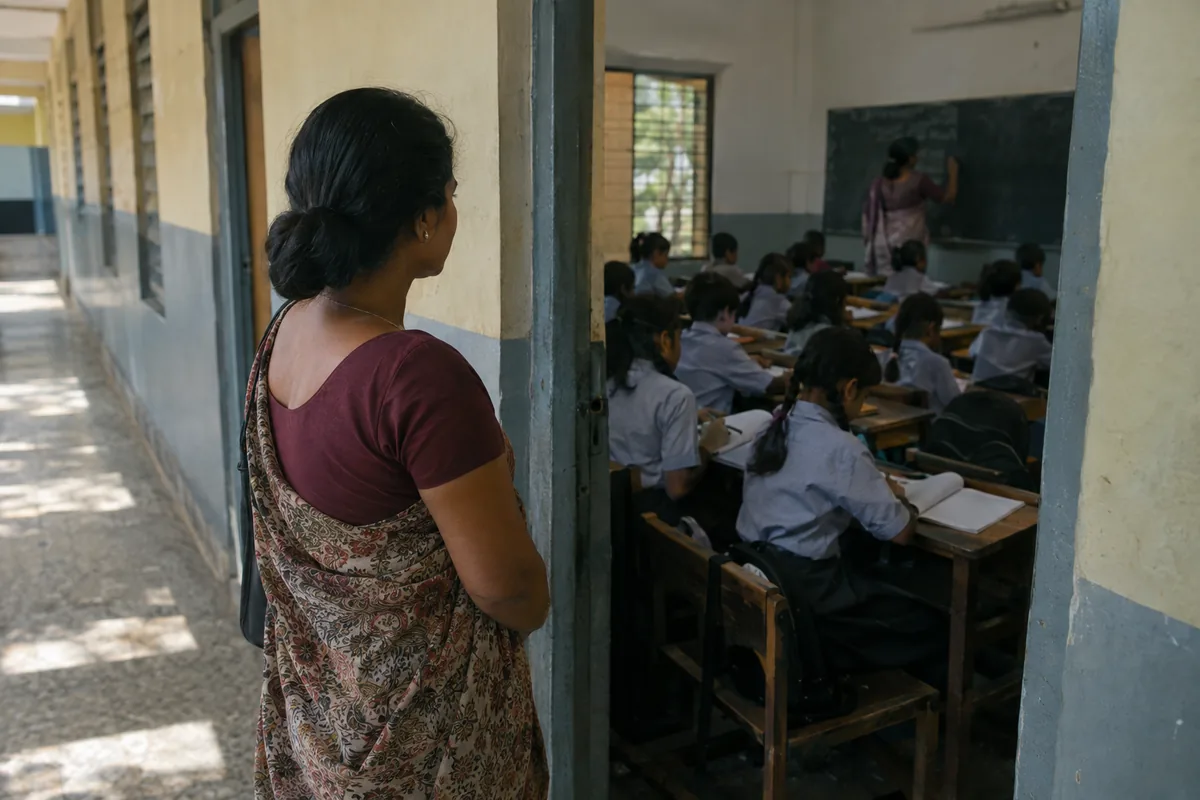
Standing at the door for five minutes shows the section strength, the spacing between rows and whether the back of the room can hear, none of which appears in a brochure.
Look at the room itself when you visit: how many desks it holds, how much space is left between the rows, whether the last bench can hear, and whether the back has light and a working fan.
Ask as well what the school offers a child who is already ahead, not only one who is behind.
Assessment: read one real report card
Ask the school to walk you through a report card from last term, with the name removed.
Read it for three things. Whether it says what the child can and cannot yet do, in words, not only a rank or a percentage. Whether it says what to work on next. And whether anything follows from it: a remedial group, a conversation with the subject teacher, a plan with a date attached. The way a school writes about a weak term is the clearest evidence of how it thinks about children.
Then ask how a parent learns that a child is slipping, and how early. The honest answers describe a schedule: a short test every few weeks, a note home when a mark falls below a threshold, a parent-teacher slot that exists whether or not there is a problem. The weaker answer is that parents can check the portal, which is true of every school that owns one and says nothing about who notices. For the parent’s half of that conversation, reading a report card without panicking is the companion piece, and the questions that follow belong in a parent-teacher meeting.
Communication is a test you can run before you enrol
Ask for three documents and read them rather than discussing them: a circular sent to parents last month, the fee notice for the current year, and the message a parent receives when a child is unwell. The first shows the school’s real tone. The second shows whether costs are stated once or arrive in instalments. The third shows whether anyone has thought about the moment parents are most anxious.
Then ask who answers. Which number a parent calls for an academic question, which for transport, which for fees, and during what hours. What happens to a message sent at nine at night, and whether class messages come through one official channel or a group run by a parent volunteer.
The question most schools have not been asked is the important one: what happens when the school gets something wrong? A fee charged twice, a bus that does not arrive, a mark entered against the wrong child. Schools with an answer describe a route and a person. Schools without one describe their intentions.
Visit on an ordinary day, twice if you can
Go on a working day, mid-morning, and ask to stand at the back of one class for five minutes. Watch whether the children are working, whether the teacher is teaching or managing, and whether anyone looks up at you.
Walk the parts of the campus the tour skips: the toilets, the drinking water, the sick room, the ground at break, the gate at dismissal. Ask how a child is handed over, who is permitted to collect, and what the school does when the person at the gate is not recognised.
Outside the gate, talk to two parents who are waiting, not the ones the school introduces you to. Ask what surprised them in the first year and what they would ask if they were choosing again.
The fee conversation, in full
Ask for the whole year in one document: tuition, admission or registration charges, examination fees, transport by route, books and uniform where the school supplies them, activity and laboratory charges, and any refundable deposit. Then ask what is not included in it.
Some states require recognised private schools to display their fee structure and their rules for revising it, and what is required differs from state to state. Rather than rely on a summary, check what your state’s education department currently publishes, then ask the school for the same information in writing. Current as of October 2026, that order is the reliable one: the requirement first, the school’s document second.
Ask about withdrawal: whether the deposit is returned, how much notice is required, and how the transfer certificate and the child’s records are issued. Its quality still tells you how the school treats families who leave.
A framework to carry in
- How many teachers left in the last two academic years, and which subjects did they teach?
- Who will teach this grade next year, and how long has the class teacher been here?
- What is the strength of the section my child would join, and what happens when a teacher is absent?
- Can I read one real report card, and how early does the school tell a parent that a child is slipping?
- What does the school offer a child who is already ahead?
- Which number do I call, and who answers it after hours?
- What is the total cost of the year in one document, and what is left out of it?
- How are records and the transfer certificate issued if we leave?
- What did this school change after last year’s complaints?
If you also sit on a school committee, those are also the questions a school should answer from its own records without a chase: staff lists with joining dates, section strengths, an assessment history for each child, a fee structure that reconciles to what was collected. Scholva keeps them in one place, and a demonstration shows it against a school’s own data.
None of this requires expertise. It requires asking the same question of two people, and noticing when the answers differ.
Related reading: Choosing an education board, a practical guide and understanding the Indian schooling system.