School leaders often hear about a problem after it has become urgent: repeated absence has affected learning, unpaid fees have accumulated, assessment gaps have widened, or a transport issue has frustrated families for weeks. The necessary signals may already exist, but remain separated across registers and departments.
An early-warning practice connects a small number of meaningful signals to a defined human response. It should help, not label or punish.
Connect signals to early action
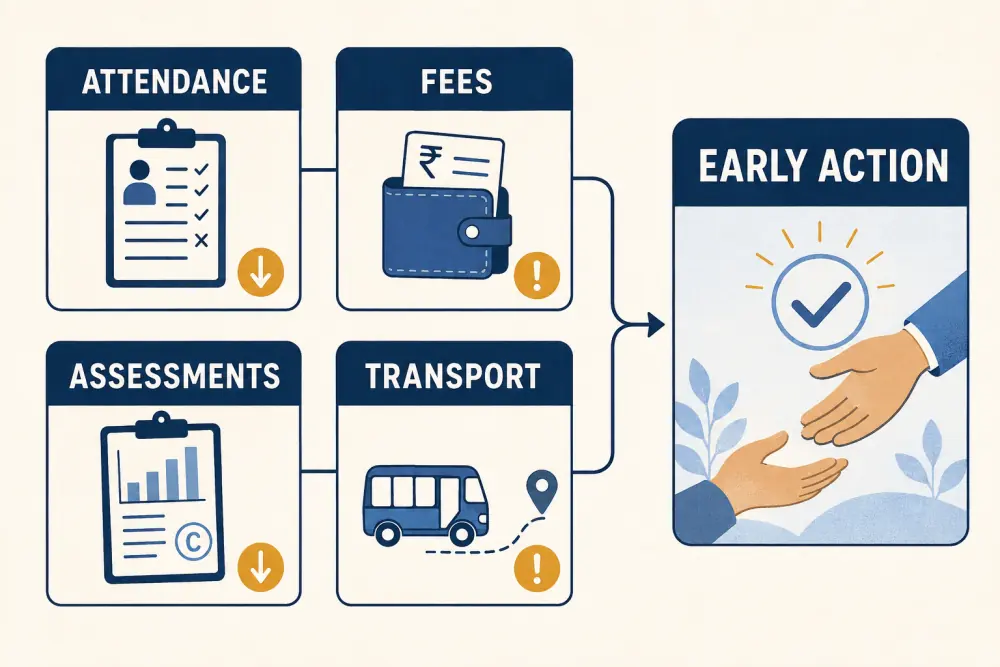
Four operational areas provide a useful starting point:
- Attendance: repeated absence, a sudden change in pattern, or frequent late arrival.
- Fees: an unexpected missed instalment, unresolved payment mismatch, or repeated promise-to-pay date.
- Assessments: declining performance, missing work, or a topic-level gap across a class.
- Transport: recurring delays, missed boarding events, or repeated route exceptions.
None of these proves a cause. Each is a prompt for an authorised person to check context and decide whether support is needed.
Choose thresholds carefully
Avoid creating dozens of alerts simply because the system can. Begin with conditions that are easy to explain and connected to a useful response. For example, a school might review three absences within a defined period, an assessment result missing after the entry deadline, or a route delay repeated several times in a week.
Test thresholds against historical patterns if reliable data is available. A signal that flags half the school will be ignored; one that only appears after a crisis is too late. Review thresholds by age group, academic calendar, and local context rather than assuming one rule fits every institution.
Define ownership before creating an alert
Every signal needs an owner, response time, and closure state. Attendance concerns may go first to a class teacher or year coordinator. Fee exceptions belong with an authorised finance role. Assessment patterns need academic review. Transport exceptions require the transport team.
The owner should be able to record that the signal was reviewed, what action was taken, and whether further follow-up is required. Otherwise, dashboards become lists of unresolved warnings.
Bring context together responsibly
Connected school analytics can reveal patterns across operations, but access should remain role-based. A teacher may need academic and attendance context without seeing family financial details. A transport coordinator does not need assessment history.
Use the minimum information needed for each decision. When cross-functional review is genuinely necessary, define who may convene it and how sensitive notes are handled.
Keep people in the decision
An alert is not a verdict. Absence can reflect illness, a family event, transport disruption, or an incorrectly recorded register. A fee delay can arise from a mismatched payment rather than non-payment. A low result may indicate a poorly understood topic, an inaccessible assessment, or missing marks.
Contact should begin with curiosity and dignity. The school’s response script can guide staff to verify the record, listen to context, agree on an action, and document only what is necessary.
Use class and operational patterns too
Early warning is not only about individual students. If many learners struggle with the same topic, the response may be reteaching rather than individual intervention. If one route is regularly late, the timetable or stop sequence may need adjustment. If payment mismatches cluster around one channel, reconciliation needs attention.
Looking at both individual and aggregate patterns prevents the school from placing every problem on a learner or family.
Build a short review rhythm
A weekly review can be enough for most non-urgent signals. Prepare a concise exception list showing new, in-review, actioned, and unresolved items. Keep emergency safety processes separate; they should not wait for a dashboard meeting.
Monthly, leaders can review signal volume, response times, false alarms, repeated cases, and outcomes. Remove alerts that do not lead to useful action and refine unclear thresholds.
Responsible early-warning checklist
- Each signal has a clear purpose and explainable threshold.
- An accountable role reviews it within a defined time.
- Access reveals only the context that role needs.
- Staff verify the underlying record before contacting a family.
- The response begins with support rather than punishment.
- Individual and group patterns are both considered.
- Alerts have reviewed, actioned, and closed states.
- Sensitive notes follow retention and access rules.
- Thresholds and false alarms are reviewed regularly.
Scholva can connect academic, fee, assessment, and transport information into role-appropriate views, helping leaders notice what needs attention without turning every variation into an alarm. Request a demonstration to design a small, responsible set of signals for your school.
Related reading: The complete guide to choosing school ERP software in India and A principal’s daily school dashboard.