
Colleges and universities issue marksheets, degrees, diplomas, transcripts and consolidated statements for decades. Long after a cohort has dispersed, employers, other universities, licensing bodies, visa authorities and the graduates themselves come back asking for proof. The record has to still exist, still be readable, and still be checkable against something the institution controls.
The hard part is that “keep everything” is no longer a neutral default. Indian institutions now work under a data protection regime that expects personal data to be erased once the purpose is served, and a records room full of legacy scans is a liability before it is an asset. A retention schedule is how both duties get satisfied at the same time.
Two records, not one
Most institutions treat “the marksheet” as a single object. It is really two things with very different lifetimes.
The award record is the institution’s own statement about a person: the programme, the academic period, the results approved by the competent body, the award classification, the date, and the identifier of the certificate or marksheet. It is the thing you will be asked to confirm in twenty years, and it should be retained for as long as the institution exists and awards qualifications.
The underlying assessment evidence is the material that justified the award: answer scripts, internal assessment sheets, practical and viva marks, evaluation summaries, moderation and re-evaluation correspondence. It matters intensely for a short period, because of re-checking, re-evaluation and result disputes, and then its value drops sharply. Keeping it indefinitely multiplies the number of documents that can leak or be misused without improving the institution’s ability to confirm a qualification.
Once those two are separated, most retention arguments resolve themselves.
Define record classes before you define periods
A retention schedule built around file names will not survive contact with a real records room. Build it around classes of records, each with an accountable owner:
- Award and qualification records: degree, diploma, marksheet, transcript, award register entries.
- Assessment evidence: answer scripts, internal marks, evaluation records, moderation notes.
- Admission and eligibility records: applications, prior qualification documents, eligibility certificates, admission approvals.
- Identity and verification documents: identity proofs, photographs, category and income certificates, migration records.
- Student lifecycle records: registration, progression and promotion decisions, transfers, withdrawals, conduct and disciplinary proceedings.
- Financial and benefit records: fee ledgers, receipts, scholarships, refunds, concessions.
- Grievance and legal records: complaints, appeals, litigation files, statutory notices.
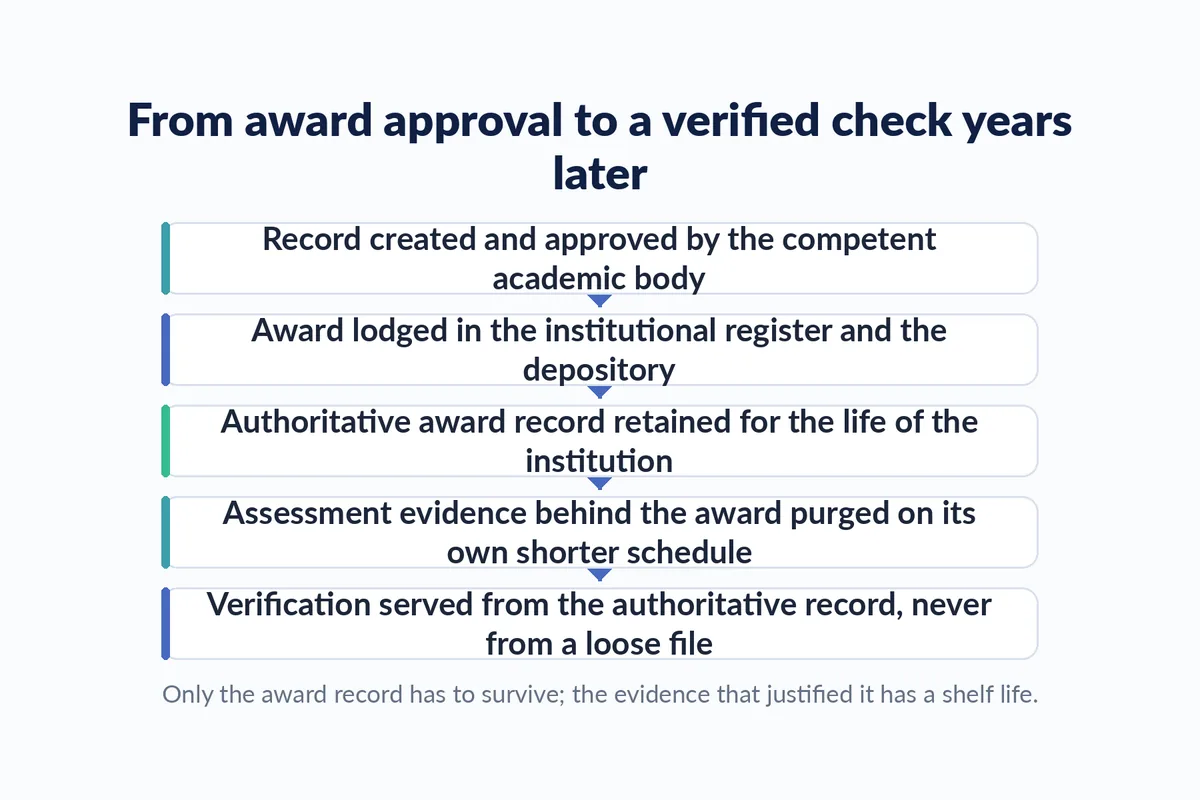
The award record is the one artefact that has to outlive every system change; the evidence behind it does not.
For each class, write four things: what is retained, the trigger that starts the clock (issue date, end of academic year, date of withdrawal, date of final disposal), the retention period, and the disposal method. Anything with an active grievance, appeal or legal proceeding goes on hold and leaves the schedule until the matter closes.
What the data protection framework adds
Current as of 14 October 2026, the Digital Personal Data Protection Act, 2023 and the Digital Personal Data Protection Rules, 2025, notified as G.S.R. 846(E) dated 13 November 2025, set the outer frame. Three provisions matter directly to a records office.
The Act’s general obligation sits in section 8(7): a Data Fiduciary must erase personal data upon the Data Principal withdrawing consent, or as soon as it is reasonable to assume the specified purpose is no longer being served, unless retention is necessary for compliance with another law in force. Section 12(3) gives the Data Principal a right to request erasure, and the institution must act on it unless retention is necessary for the specified purpose or for compliance with law. For an institution, both of those exceptions do real work: your own statute or act, the regulator directions that apply to you, limitation periods for disputes, and the genuine need to answer verification requests are legitimate grounds for holding an award record.
Rule 6(1)(e) of the 2025 Rules requires logs and personal data to be retained for one year as a security safeguard, so that unauthorised access can be detected, investigated and prevented from recurring. Rule 8 adds timed erasure for the classes of Data Fiduciaries listed in the Third Schedule, and for the State-use purposes in the Seventh Schedule it sets a minimum of one year of retention for personal data, associated traffic data and logs before erasure. Rule 8(2) also requires the Data Principal to be told at least forty-eight hours before a scheduled erasure, which is a sensible pattern to copy even where the rule does not bind you.
Two cautions. First, most of these obligations, including the security and breach provisions in Rules 6 and 7, come into force eighteen months after publication under Rule 1(4), so plan for around mid-2027 rather than assuming the regime is fully operative today. Second, the educational-institution relief in the Fourth Schedule, which switches off parts of section 9, is narrow: it covers tracking and behavioural monitoring for the institution’s own educational activities or for the safety of children enrolled with it, and nothing else. It is not a general exemption for student data.
Choose formats that will still open
A verified scan that cannot be opened is not a record. Three format decisions carry most of the weight.
Store the authoritative digital copy in a preservation-oriented format, such as PDF/A for documents, rather than in whatever the scanner or the ERP happened to produce that year. Keep the originally generated file as well where a regulator or an awarding body requires it.
Keep the evidence that a document is genuine with the document itself. That means the approval trail, the checksum or digital signature record, and the identifier of the register entry, stored together rather than in three different systems.
Index by person and by award, not by file. A records store with a hundred thousand correct scans and no reliable index is functionally the same as no records store at all.

Physical registers and their digital indexes have to be kept in step, or a record that exists cannot be found.
Make the award verifiable without sending the file
The practical failure mode is rarely a missing certificate. It is a certificate nobody can confirm. Files can be copied, altered after the fact, or forwarded well beyond the person who was entitled to see them.
The National Academic Depository, the Government of India’s depository for academic awards, is the reference point here. Institutions lodge awards there, students reach their own documents through DigiLocker, and a verifier route exists for third parties, with awards held in the system treated as legally valid digital records. Where an award is lodged, a verification request can be answered by pointing at the depository instead of emailing a PDF.
Where the institution still issues its own documents, any downloadable file should carry a link back to a live status check, so that a copy made last year cannot outlive a correction made last month. Our guide to digital certificate verification covers that workflow, and the vendor security checklist covers what to ask the systems that hold these records.
Retention checklist
- Name one accountable owner for the retention schedule.
- Separate the permanent award record from the purgeable assessment evidence.
- Define record classes, retention triggers and disposal methods in writing.
- Apply a hold rule for active disputes, appeals and investigations.
- Keep approval trails, checksums and register identifiers with the record.
- Store authoritative copies in preservation formats, behind an index that outlives the software.
- Lodge awards so a third party can verify them without a phone call.
- Log who accessed or exported record sets, and keep those logs for at least a year.
- Re-test one ten-year-old record every year: open it, find it, verify it.
Retention is a design problem, not a storage problem. Institutions that decide early which record is the institution’s word about a person, and treat everything else as evidence with a shelf life, find that verification gets faster and the data footprint gets smaller at the same time.
Scholva holds award records, assessment evidence and verification status in one system of record, with role-scoped access and an audit history, so a retention decision can be applied to a whole class of records instead of to individual folders. To see how that works across semesters, programmes and campuses, request a demonstration or review Scholva’s security information.
Related reading: Digital certificates and alumni qualification verification and Role-based access protects school data.