
Graduates regularly need to prove a qualification to employers, universities, licensing bodies, and government services. Paper certificates remain important in many contexts, but manual verification can be slow and vulnerable to altered documents or misdirected requests.
A digital workflow can make authentic records easier to share and verify - if identity, privacy, corrections, and status are designed from the beginning.
Design the full trust flow
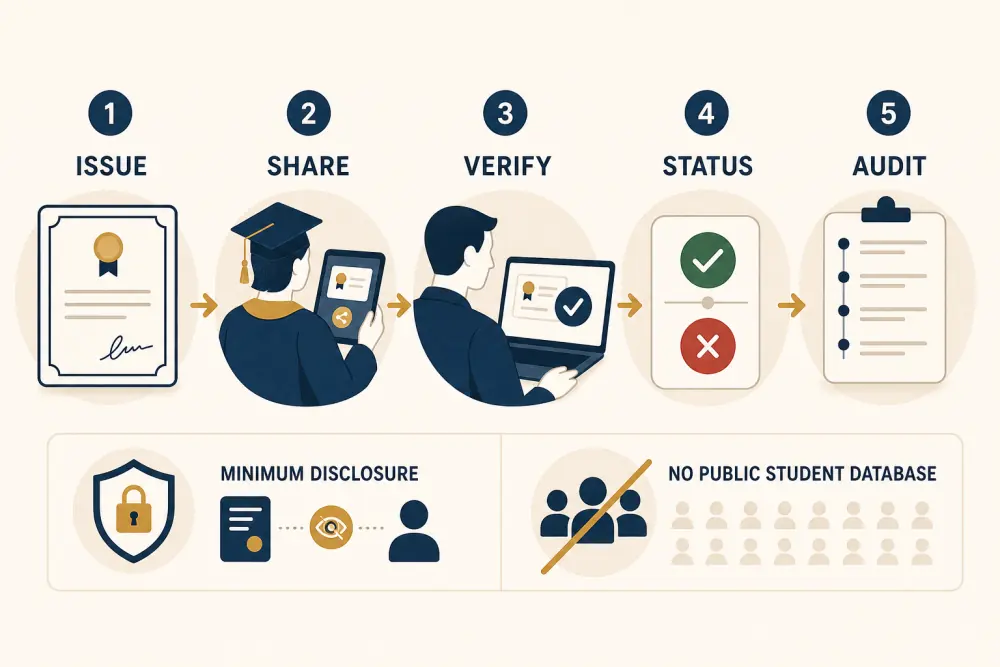
The institution issues an approved credential. The graduate shares a controlled verification route. The verifier sees only the information needed and checks its current status. Important events are auditable. Each step needs an accountable owner.
Establish the authoritative record
Before generating certificates, confirm which system and officers are authoritative for programme completion, identity, name presentation, award classification, dates, and certificate number. Define approval stages and how late mark changes or administrative corrections reach the record.
Do not generate credentials directly from an unreviewed spreadsheet export. Reconcile a sample against approved results and existing certificates, then investigate every exception.
Verify the recipient
Provide graduates with a secure account or identity-checking process. Account recovery deserves special care because alumni often lose access to institutional email addresses and change phone numbers.
Recovery should not rely on information that is easy to discover publicly. High-risk changes may require reviewed evidence and an audit trail. Staff should never ask a graduate to send credentials or identity documents through informal messaging channels.
Share the minimum necessary information
A verification page should reveal only what the purpose requires - for example, the graduate’s name, institution, qualification, award date, and whether the credential is valid. Avoid exposing date of birth, full student identifier, address, marks, or unrelated academic history.
Use an unguessable, time-limited, or graduate-controlled verification route where appropriate. A public directory searchable by name can expose education history without the person’s knowledge and is not required for effective verification.
Explain to the graduate what a verifier will see before they share it.
Show current status clearly
Verification should distinguish valid, corrected or superseded, revoked, expired where relevant, and unable-to-verify states. It should not show a revoked credential as though it never existed, and it should not reveal a sensitive reason unnecessarily.
Define who can change status, what approval is required, how the graduate is notified, and how an appeal or correction is handled. Preserve links from a replaced credential to its approved successor without making both appear current.
Make the page difficult to misrepresent
Use transport security, a stable institutional domain, signed or otherwise tamper-evident data where the architecture supports it, and a prominent current-status check. A downloadable file should point back to live verification because files can be copied after their status changes.
QR codes are convenient, not proof by themselves. They must lead to a trusted domain and a valid record. A sophisticated ledger is not automatically necessary; operational control, access, recovery, and governance usually determine whether the service is trustworthy.
Apply the vendor questions in our school data-security checklist to hosting, keys, logs, support access, backups, and incident response.
Keep an appropriate audit trail
Record issuance, approval, correction, status changes, and administrative access. Decide whether and how verification events are logged, with privacy and proportionality in mind. Avoid collecting more about the verifier than the service needs.
Audit logs should support investigation without becoming an unrestricted secondary database. Limit access and retention.
Roll out in controlled stages
Start with one programme or graduating cohort. Test name variants, legacy records, duplicate student identities, accessibility, mobile use, slow connections, printing, expired links, corrections, and support requests.
Publish guidance for graduates and verifiers. Maintain a staffed exception route for old awards or organisations that require formal letters.
Verification checklist
- Identify the authoritative academic record and approvers.
- Reconcile source data before issuing credentials.
- Secure graduate access and account recovery.
- Reveal only the minimum verification fields.
- Make valid, corrected, and revoked status unambiguous.
- Link downloadable credentials to a live trusted check.
- Audit issuance and administrative changes.
- Provide correction, appeal, and legacy-record routes.
- Pilot accessibility, mobile use, and exceptional cases.
Scholva can connect alumni records with controlled institutional workflows. To examine how verification fits your policies and existing records, request a demonstration.
Related reading: How to build an active alumni network and How role-based access protects school data.