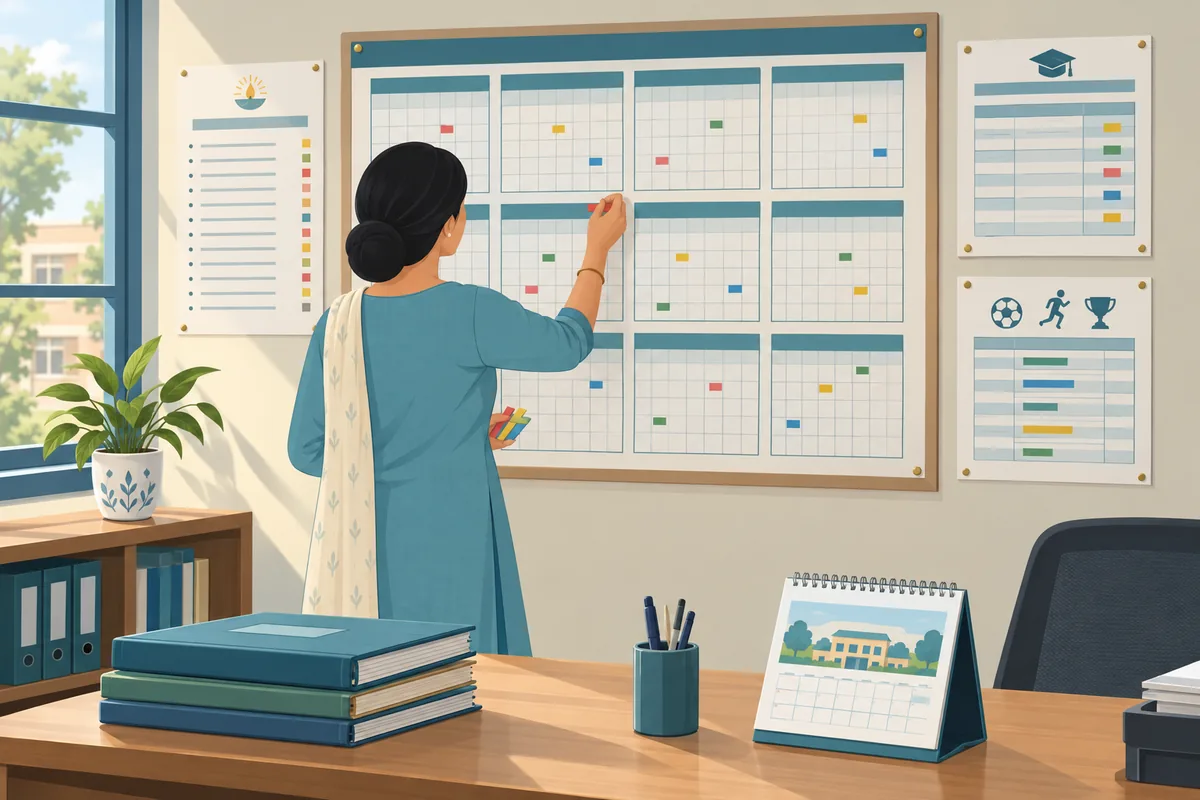
Every school publishes an academic calendar. Fewer schools publish one that is still trusted in November.
The failure is rarely a missing event. It is a calendar built as a wish-list of dates rather than as a model of real constraints — examination windows, festivals and public holidays, board examination dates, sports seasons, and the plain reality of staff leave. When the first two of those collide, the calendar is quietly abandoned and the school starts communicating through reminders and word of mouth instead.
A calendar that survives term one is built the other way round: fix what cannot move, layer what can, and leave room for the week that goes wrong.
Start from the dates you do not control
The first entries on the calendar should be the ones the school cannot negotiate.
Board examination dates sit at the top of that list. CBSE, CISCE and each state board publish their own examination schedules and conduct instructions, and they update them during the season; the school’s internal examinations have to be arranged around those fixed points rather than in competition with them. Download the current published schedule, note the date you checked it, and treat that saved copy as the source the whole calendar is built from — not a date someone remembers from a circular.
Public holidays are the second fixed layer, and here the source matters more than the pattern. State government holiday lists are revised through the year, and a list circulated in April is not necessarily the list that applies in December. Confirm the current list from the state education department or the state government’s own notification, and record the reference date on the calendar rather than carrying over last year’s version.
Everything else — the annual day, the sports meet, the staff workshop, the parent-teacher meetings — is negotiable, and should be placed only after the fixed dates are on the board.
Build the year in layers
A calendar written as one long list of events hides its own conflicts. Build it in three layers instead.
The first layer is immovable: board examination windows, state and national holidays, and any date fixed by an external authority. The second is structural: the term structure, internal assessment and examination cycles, and the sequence of teaching weeks those require. The third is discretionary: events, celebrations, competitions, excursions, and staff development days.
The value of the layering is that it tells you where a change is cheap. Moving a discretionary event is a diary change. Moving an assessment cycle pushes teaching weeks and creates follow-on work in every department. Layering makes that difference visible before the year begins, when the trade-off is still free. The article on managing the complete school examination cycle sets out the assessment side of that structure end to end.
Check the calendar at both ends
Two date sets change without the school’s involvement, and both deserve a verification step rather than an assumption.
At the examination end, re-verify the board’s published date sheet before every major communication, and keep one owner for the master version. If a paper moves, the internal timetable, the invigilation roster, the transport plan and the family notice all have to move with it — the countdown described in the article on board exam season operations is that same discipline applied to a shorter window.
At the holiday end, check the state list against the school’s own published calendar before each term, and note the reference date you used. Where a holiday is announced at short notice, having a written change process — not just a new date — is what stops the calendar from fragmenting into half a dozen unofficial versions.
Model staff leave reality
Most calendars are built for a school where every teacher is present every day. Real terms are not like that.
Before finalising, look at the leave patterns of the previous year: the months with the most approved leave, the festivals around which staff travel, the periods already crowded with examinations and events. Then decide honestly what the calendar can absorb. A short week carrying an external examination and a staff development day holds three separate pressures inside the same five days.
This matters most for the staff whose absence has no easy substitute — the subject teacher who is the only one qualified to run a practical, the coordinator who holds the examination process together. Where the calendar compresses, name the reserve cover in advance, using the same logic as managing teacher absence without breaking the timetable.
Leave slack where the year is thinnest
A calendar with no empty space is a calendar that breaks the first time something goes wrong — and something will. A storm, an unscheduled holiday, a building repair, an examination that moves.
Deliberately keep a small number of unfilled days at the points of highest pressure: after a long sequence of events, before examination weeks, and at the end of a term that is already carrying a lot. Unfilled does not mean unused; it means not yet committed. Those days are what let a school absorb a disruption without cancelling teaching or squeezing a department into overtime.
The same principle applies to the days immediately after a major event. Schools routinely schedule the next thing on the first available day, then spend the following week catching up. Leaving the gap is cheaper than the catch-up.
Publish one calendar and one change process
Multiple working versions of a calendar are how a school ends up with three different dates for the same event. Decide where the authoritative calendar lives, who owns it, and when it is published — typically before the term begins, with the version and date visible to staff and families.
Then define what happens when a date changes. A change should record what moved, why, the effective date, who approved it, and which audiences need to know. Update the single source first, not the message. A calendar is only as useful as the version people are actually looking at, which is the same discipline as keeping one official channel for school communication.
A term-one calendar review
The calendar does not have to be perfect in April; it has to be reviewed. At the end of term one, spend an hour on four questions:
- Which fixed dates moved, and how far in advance did the school know?
- Where did the plan and the term actually diverge most?
- Which weeks turned out to be overloaded?
- What would you place differently next year, and what would you leave alone?
Term-one calendar checklist
- Board examination dates and conduct instructions are downloaded, dated and re-verified.
- The current state holiday list is confirmed from the official source, with a reference date.
- Immovable, structural and discretionary dates are separated into layers.
- Internal assessment and examination cycles are fitted around fixed external dates.
- Staff leave patterns from the previous year informed the busiest periods.
- Reserve cover is named for staff whose absence has no substitute.
- Unfilled slack days are kept at the points of highest pressure.
- One authoritative calendar is published, with a version and an owner.
- A written change process covers what moved, why, who approved it and who is informed.
- A short end-of-term review feeds the next year’s calendar.
A calendar that survives term one is not the most detailed one. It is the one built on the constraints the school actually has, verified against the sources that own those dates, and reviewed while the year is still running. Scholva keeps the academic calendar, examination planning, staff cover and academic records in one place so a published date stays a date. You can request a demonstration with a sample term from your school.
Related reading: A principal’s daily school dashboard and How to build a conflict-free school timetable.