
Schools need fee structures that reflect grade levels, programmes, transport choices, optional services, admission timing, instalments, and approved concessions. Flexibility becomes risky when every exception is maintained in a separate spreadsheet or depends on one staff member’s memory.
The goal is controlled variation: families can receive the right plan while finance teams retain consistent rules, approvals, and reporting.
Model the parts of a fee plan
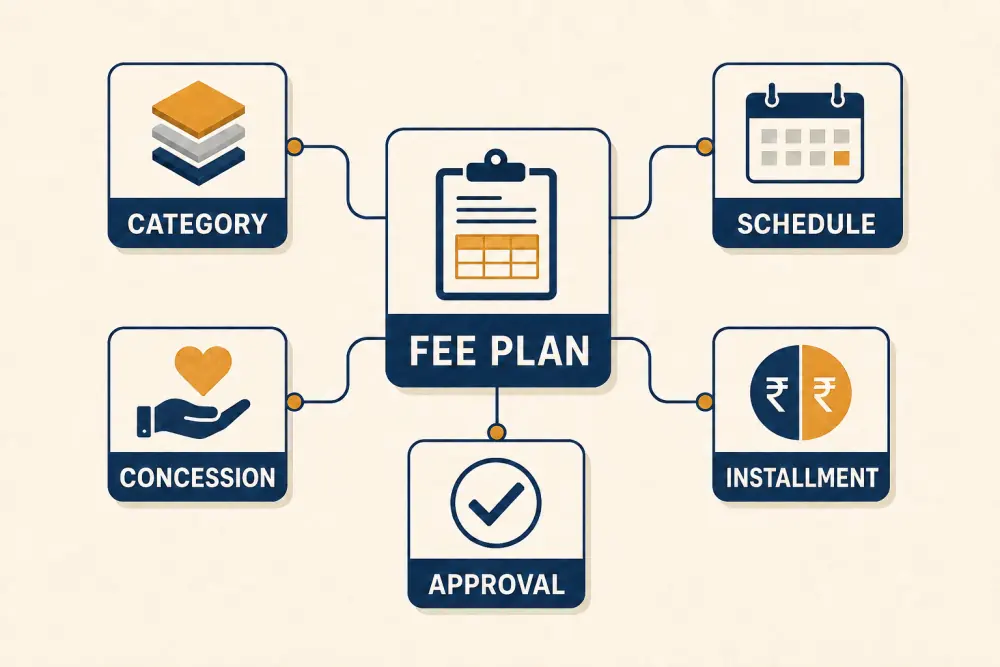
A useful fee plan separates five concepts:
- Category: what the charge is for, such as tuition, transport, activity, or examination.
- Schedule: when the amount becomes due.
- Instalment: how an approved total is divided across dates.
- Concession: a transparent adjustment based on an institution-defined policy.
- Approval: who may create, change, waive, or refund a charge.
Keeping these parts distinct makes plans easier to explain and change without editing hundreds of individual records.
Standardise category names
Agree on names and accounting mappings before configuration. Avoid near-duplicates such as “transport fee,” “bus fee,” and “transport charges” unless they genuinely represent different items. Record whether a category is mandatory, optional, refundable, recurring, or linked to a service.
Finance and administration teams should review the catalogue together. Software can enforce configured rules, but the institution should confirm how categories align with its approved policies and applicable requirements.
Build reusable plan templates
Create templates for common groups - perhaps by campus, grade, programme, or academic session - then assign the appropriate plan to each student. A template should define categories, amounts, due dates, and standard instalments.
Do not create a new template for every family. Genuine individual adjustments belong in a controlled concession or exception layer so the standard plan remains understandable.
Make concessions explicit
Define concession types, eligibility evidence, approvers, effective period, and whether the adjustment applies to one category or the whole plan. Use a fixed amount or percentage according to policy, and test rounding.
Limit access to sensitive reasons. General teachers do not need a family’s financial details. Reports can show approved concession totals without exposing private notes broadly.
Manage instalments and mid-year changes
An instalment plan should preserve the approved total, show each due date, and make partial payments visible. If a learner joins mid-year or changes a service, define whether charges are prorated, begin from a future date, or require manual approval.
Use effective dates. Editing a plan without them can unintentionally change past invoices or make receipts difficult to reconcile.
Control changes after collection begins
Once a charge has payments against it, changes need extra care. Decide how the school handles corrections, reversals, refunds, credit balances, and transfers between siblings or categories. Keep a reason and approval trail rather than deleting the original transaction.
A connected fees platform should distinguish plan configuration from everyday collection and from authorised corrections.
Explain the plan to families
Before assigning a new fee structure, preview how it will appear to parents. Show the amount due now, later instalments, concessions where appropriate, payments, receipts, and contact route for questions. Use the same category names in notices, the parent portal, and finance reports.
Clear presentation reduces calls and prevents a correct internal calculation from becoming a confusing family experience.
Test before publishing
Create representative cases: a standard learner, sibling concession, transport opt-in, mid-year admission, partial payment, late change, and approved refund. Verify allocations, due totals, portal display, receipts, and reporting.
Ask someone who did not configure the rules to explain each test case. If they cannot, the structure may be too complex to operate safely.
Fee-structure checklist
- Categories have unique, approved meanings.
- Reusable templates cover common student groups.
- Instalments preserve the correct total and dates.
- Concessions have types, evidence, duration, and approvers.
- Sensitive reasons have restricted access.
- Mid-year changes use explicit effective dates.
- Corrections, refunds, and reversals keep history.
- Parent and finance views use consistent terminology.
- Edge cases are tested before assignment.
- Policies and configurations are reviewed each session.
Flexible fees should make policy easier to apply, not create hidden exceptions. Scholva can connect plan design, collection, receipts, reconciliation, and parent visibility. Request a demonstration with a sample of your current structures.
Related reading: Improve school fee collection without chasing parents and Automatic payment reconciliation for school accounting.