
A college applicant can interact with admissions, an academic department, finance, examinations, accommodation, transport, the library, and student support. If every office creates its own version of the person, the learner spends time repeating information and staff struggle to see the full journey.
Connected operations begin with shared definitions and carefully controlled transitions - not a single unrestricted database.
Design around the student lifecycle
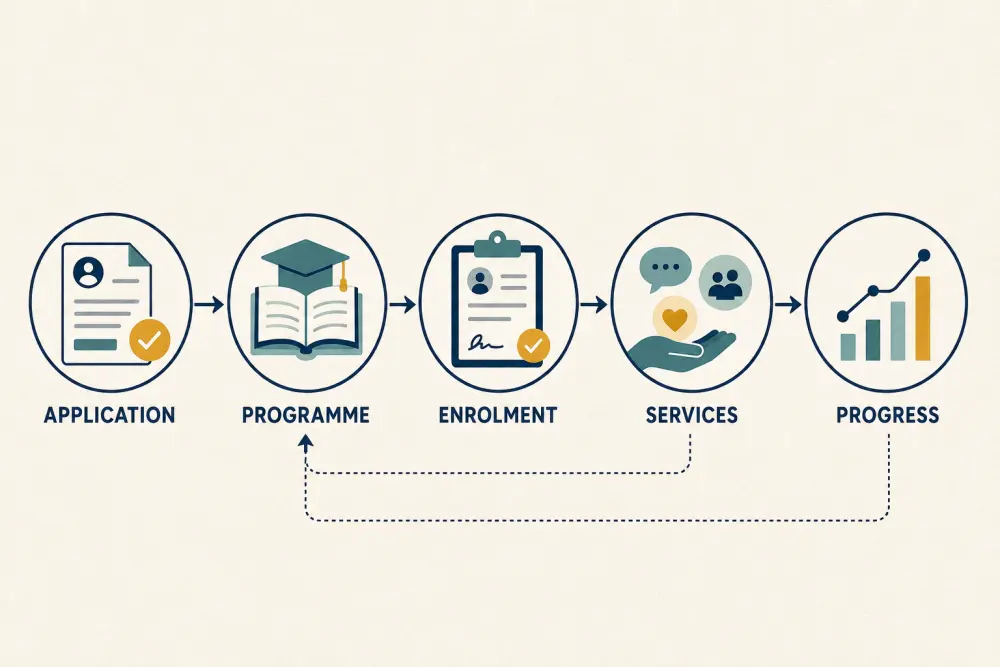
The primary flow moves from application to programme, enrolment, services, and academic progress. Feedback also matters: recurring support needs or progression patterns can inform programme planning, but only after appropriate review and without reducing a student to a score.
Make the programme structure authoritative
Define institution, campus, school or faculty, department, programme, version, academic period, course or module, credit rules, and delivery pattern. Assign an accountable owner to each definition and an effective date to changes.
Programme versions are important. A curriculum change for new entrants should not silently rewrite requirements for existing cohorts. The student record must show which approved rules apply.
Move applications forward without copying them
Capture identity, contact information, prior education, programme choices, required documents, and consent once. Use stage changes for review, offer, acceptance, and enrolment, with owners and reasons for decisions.
Only reviewed information should enter the official student record. Retain the relationship to the application so authorised staff can trace the decision, while keeping internal admissions notes away from people who do not need them.
Duplicate detection needs a human review route. Similar names are not proof that two applicants are the same person.
Treat enrolment as a controlled transition
Acceptance does not automatically mean every service is active. Define prerequisites such as approved documents, deposit or funding status where applicable, programme confirmation, and registration steps. Record conditional cases clearly.
At enrolment, create the learner’s institutional identity, programme relationship, academic period, and appropriate portal access. Do not grant broad system access from a single status field without checks.
Connect services to current eligibility
Library, accommodation, transport, advising, student clubs, certificates, and other services may depend on campus, programme, period, residence, or individual approval. Use the shared student record to reduce repeat entry, while giving each team only the information it needs.
A librarian does not need admissions deliberations. A transport coordinator does not need marks. Good integration passes the minimum useful data and returns an operational status.
Student requests should have a category, owner, status, expected response, and escalation route. Self-service can handle routine information, but sensitive or unusual cases need a person.
Join academic progress carefully
Connect registration, attendance where used, assessments, credits, progression decisions, and published results. Changes require an audit trail and the institution’s approval model.
Dashboards can reveal missing registrations, unposted results, or patterns that merit attention. They should not make automated high-stakes decisions from partial data. Staff should examine the underlying record and speak with the student where appropriate.
The same caution applies to early-warning signals: indicators support triage, not judgement.
Close the loop at completion
Define completion checks, outstanding obligations, final approval, award status, transcript or certificate workflow, alumni transition, and record retention. Corrected results must flow through to the authoritative record before a credential is updated.
Graduates should be able to maintain suitable contact and share a controlled qualification check. See our guide to digital certificate verification.
Give students a coherent experience
The portal should explain current programme information, registered courses, results after publication, authorised fees and receipts, service requests, notices, and next steps. Use clear ownership: when something is wrong, students need to know which team can correct it.
Design for mobile access, accessibility, varied connectivity, and account recovery. Offer assisted service for people who cannot complete a process digitally.
Implement by journey
Choose one programme and map the complete route from application to an active term. Agree identifiers, status meanings, owners, access scopes, and exception paths. Migrate active records, reconcile totals with each office, and test real scenarios such as a programme change, document correction, deferred entry, repeated course, and withdrawn student.
Connected-college checklist
- Version the programme and curriculum structure.
- Promote reviewed application data into the student record.
- Define enrolment prerequisites and conditional states.
- Share only minimum service data by role.
- Track student requests with ownership and escalation.
- Keep academic changes approved and auditable.
- Provide human review for risk indicators and exceptions.
- Connect completion, credentials, and alumni transition.
- Pilot one programme and reconcile every hand-off.
Scholva’s academics, portals, and analytics can be reviewed as parts of this lifecycle. Request a demonstration to walk through a representative student journey.
Related reading: How to build an active alumni network and Migrating from registers and Excel.
For a related perspective, see The Admissions Enquiry Funnel: Where Prospective Families Actually Drop Off.