
Every coaching institute has two or three weeks a year when the front office stops behaving like an office. Enquiries arrive faster than anyone can answer them, batches fill in an order nobody planned, and the first class begins before the last admission has been properly recorded.
The reflex is to hire: a temporary counsellor, another person at the counter, someone to type. Hiring is the most expensive way to answer a problem that is mostly about where work waits for a person, and staff taken on for two weeks leave behind records only they can read.
Three shortages that look like one
Counter time is a person at a desk taking details and answering the same eight questions. Decision time is someone senior enough to confirm a batch, approve a concession, or accept a pending document. Record time is the minutes spent typing one family’s details into a register, a spreadsheet, a fee book and a messaging group.
The first two need people at particular hours. The third is a design problem, and it consumes the staff you already have.
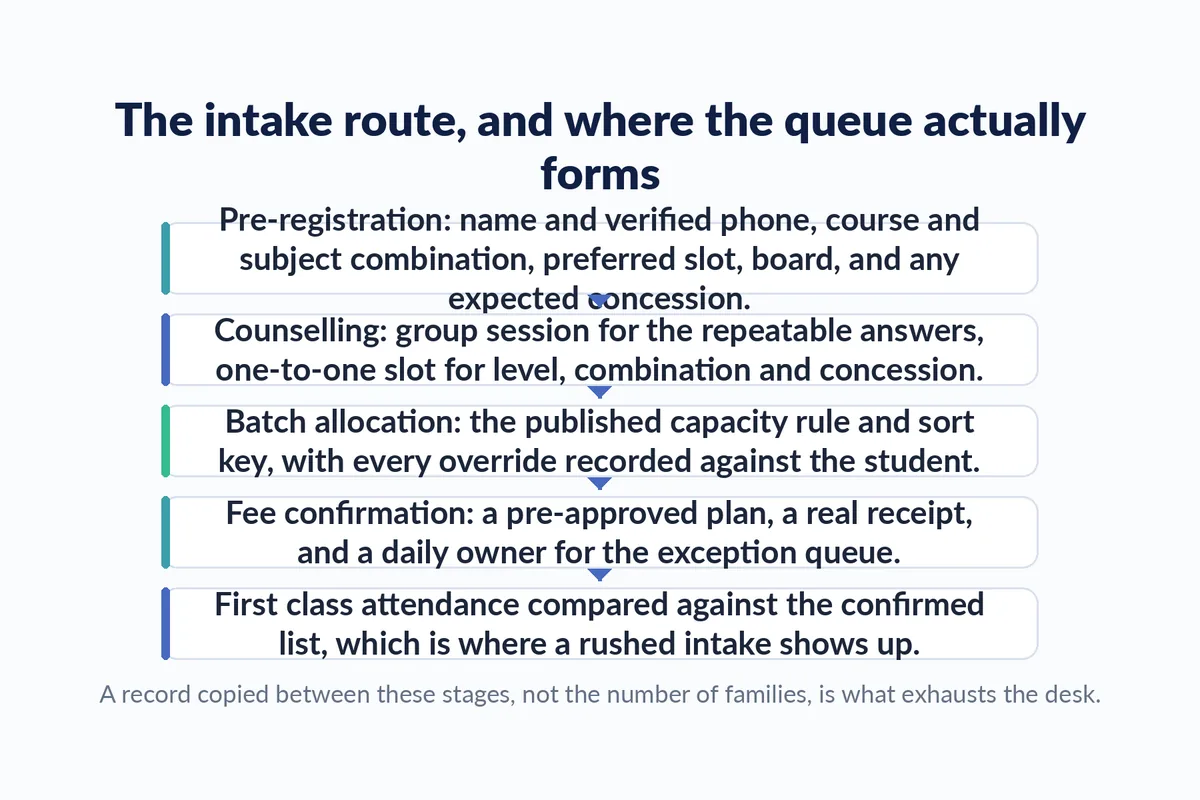
Five stages carry a family from enquiry to first class, and the counter queue is usually a symptom of records being rebuilt between them.
Pre-registration turns a crowd into a list
Pre-registration is not a booking, and should not be described as one. It is a short, free or nominal step that converts an anonymous enquiry into a known person with a subject combination and a preferred timing, so that the counter on day one is confirming a record rather than discovering one.
Ask for very little: the student’s name and a verified phone number, the course and subject combination, a preferred slot, the school or college attended with its board, and the current level if a placement test is used. Add one question: does the family expect to ask about a concession? That field is the one institutes leave out, and it is why a fifteen minute conversation becomes forty minutes with the wrong person across the table.
Pre-registration also gives you what a queue cannot: a forecast. Names sorted by course and slot show which batches will overflow while there is still time to publish a second one, and that is the difference between announcing an extra batch and apologising for a full one.
Say plainly what it promises. A held seat is a commitment; a place in the queue is not, and whichever it is belongs on the confirmation the family receives.
Write the batch rule before the season writes it for you
Under pressure, batch allocation drifts towards whoever is loudest at the counter. The fix is unglamorous: decide the rule in advance and put it where staff can see it.
Agree the capacity of each batch in numbers, not impressions, and the sort key that decides who goes where: a placement test, the previous term’s result, or the order of confirmed payment. Agree which exceptions the front desk may settle alone, and how a mid-season batch change is recorded, because a student who moves section in week two must not lose the attendance history that justifies it.
Overrides are fine. Unrecorded overrides are not: they are what makes two families believe the same rule produced different outcomes, and that belief costs more at the counter than an extra batch would have.
Protect the counselling hour
Counselling is the step that cannot be compressed by software or by speed. A family deciding on a two year course commitment is not a transaction, and a rushed conversation produces a badly matched batch that returns as an early dropout.
What can be compressed is repetition. Course structure, timings, the assessment calendar and the fee plan are identical for every family in a course, so they belong in a group session of twenty, held twice a day during the peak. One-to-one time is then reserved for the real decisions: level, subject combination, concession, and the timing that fits around school.

These fifteen minutes are the part of intake that cannot be accelerated, so the repeatable answers belong in a group session and this time belongs to the real decisions.
Book counselling by slot rather than by arrival. A slot gives a family a time to return with documents and gives the counsellor a list to work through instead of a room of people competing for attention. State the time limit at the start; most families accept fifteen minutes if they are told.
Keep the counsellor out of status work: if “is my form complete” and “which batch am I in” can be answered at the front desk, the senior person stays free for the conversations that need judgement.
Take the payment without stopping the queue
Payment is the slowest step, not because families are unwilling but because the most things can go wrong at once: an instalment plan needing approval, a transfer that has not settled, a concession discussed but never recorded.
Settle the policy before the season: which payment methods the counter accepts, which instalment splits are pre-approved and which need sign-off, what a family receives as proof on the day, and what counts as confirmed. A screenshot of a transfer is not a receipt, and marking a seat confirmed on one is how two students end up in the same seat.
Keep an exception queue for payments without a reference or for the wrong amount, and give it a daily owner: an exception left overnight becomes a phone call from a parent and a discount demanded in the fourth week.
Move people before you hire them
Before adding headcount, look at the day rather than the week. Most institutes have a morning lull in teaching and an evening crush at the counter. Faculty who teach only in the evening can cover the morning desk if they are trained for it, and a desk that handles a fee confirmation and a batch allocation removes the handoff that produces most of the record time. One person who can verify a document, record a payment and place a student in a batch is worth three who each own one step and pass the family along.
Watch the intake daily while it is happening
Weekly reports are useless during the surge, because the week is over before the report exists. Track three numbers each evening: pre-registrations that became a counselling slot, counselling slots actually attended, and confirmations that produced a first class attendance.
The step where the count drops is the step to staff tomorrow. Plentiful pre-registrations with thin attendance means scheduling, not weak demand. Strong attendance with weak confirmations means fee policy or document expectations. Each is a different fix, and none is solved by hiring another counsellor.
The fortnight after the peak decides the year
The damage from a rushed intake appears after the queue has gone: seats confirmed twice, batches that clash with school timings, concessions promised verbally and never recorded, refunds nobody can trace. Give it a reconciliation week: compare the confirmed list against first class attendance and call the gaps, because a no-show is often a family told something at the counter that the record does not say.
A short list for the season
- Open pre-registration early, ask for few fields, verify the phone number once.
- Publish the batch rule, the sort key and who may override it.
- Book counselling by slot, time-box it, and keep one-to-one time for real decisions.
- Pre-approve instalment plans and define what counts as a confirmed payment.
- Cross-train the desk so one person can close a family’s whole admission.
- Count three numbers every evening and staff the weakest step.
- Reconcile confirmations, attendance and payments the fortnight after the peak.
None of this requires a larger team. It requires the intake to be described once, as a sequence with owners, before the season arrives, and each record to be created once where it is first known. That is the principle that keeps batches, attendance and fees working through the year, and the complete management workflow for coaching institutes sets out how the rest of the loop fits behind it. If intake runs on paper registers and a messaging group, The Hidden Cost of Administrative Handoffs in Education explains why the copying, not the paperwork, is the expensive part.
A peak handled with rules, slots and one record reads to a family as an organised institute. A peak handled by adding people reads as a busy one.