
Every student who asks about a college course gets more answers than they asked for. An uncle recommends the course his neighbour’s son took. A senior says the syllabus is impossible and the teachers never turn up. A coaching centre lists the courses its own students have gone on to. A short video explains, in under a minute, why one degree is finished and another is the future.
These answers contradict each other, and the usual conclusion is that nobody knows anything. Most of the advice is sincere, and almost all of it is true about the person giving it. The difficulty is that it arrives in the same confident tone, with no label saying what it is evidence of.
What follows is a way of sorting it. Not a way of finding the one correct course, because there rarely is one, but a way of getting answers you can check instead of reassurance you have to trust.
Most advice is a report about the person giving it
Ask what each source can actually see, and the contradictions stop being confusing.
Family sees the money and the risk. What they usually cannot see is the syllabus, the assessment pattern, or who teaches the first year.
Seniors are the closest thing to a witness, and the most misread. They saw one cohort, on one campus, under the regulations in force when they joined. A senior’s account of a course is a report from a moving object.
Coaching centres know their own results, which is information about the students they taught rather than about the course. It also favours the courses that feed the entrance examinations they prepare students for.
Social media rewards what holds attention. A confident claim about a whole field travels further than an accurate one about a single institution, so what surfaces most is the most assertable.
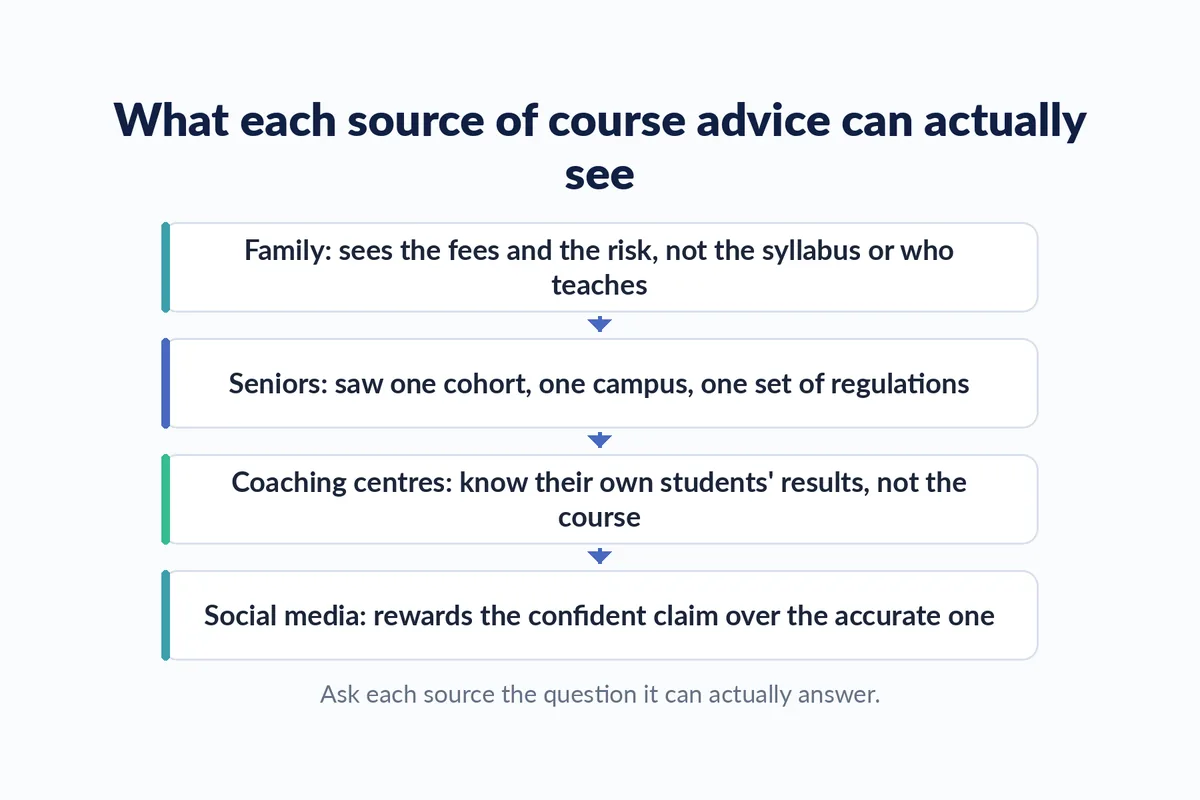
The sources are not equally wrong: each one is reliable about a narrow question and unreliable outside it, which is why their answers conflict.
Each source is reliable about a narrow question and unreliable outside it. The useful move is to stop asking whether a course is good, a question all four will answer, and start asking each source the one question it can actually answer.
Three tests for any piece of advice
- Proximity. Has this person seen the thing itself, at close range, for long enough to know what a normal week looks like?
- Recency. Was it true recently? A course structure from five years ago is a historical document, however confidently it is described.
- Checkability. Can the claim be traced to something published: a regulation, a syllabus, a scheme of examination, a fee notification?
Advice that fails all three is not necessarily wrong. It is simply not something you can decide on, and it should not outweigh a document you have read yourself.
Ask about the course, not the college
A course is a set of papers, taught by particular people, assessed in a particular way. All of that is answerable, and it tells you more than any ranking.
- What does the first year actually contain? Ask for the list of papers, not the name of the programme. A degree called Business Administration can be mostly accounting at one institution and mostly economics at another.
- What does a normal week look like? Teaching hours, whether attendance is recorded, whether practicals and tutorials are compulsory. Compare that week with the one you are willing to live for three years.
- How is each paper assessed? The split between internal assessment and the end-semester examination is published in the scheme of examination, and it decides what kind of student succeeds there.
- Who teaches the first year? This is where institutions differ most and say least. Ask plainly, and notice whether the answer names departments and experience or slides away.
- What happens when a paper is failed? Every institution has a rule: supplementary examinations, backlog attempts, a limit on how many attempts are allowed. Most students learn it in the worst possible month. Ask now, while it is still a hypothetical.
- What can be changed, and by when? Whether you can shift a section, drop an elective or change the whole course in the first weeks, and the deadline for doing it.
Ask about the institution in the language it has to answer in
Institutions are required to publish certain things, and a question phrased against those obligations gets a better answer than a question about quality.
- Is this course approved, and by whom? A degree should sit with a recognised university, and professional programmes carry their own regulator. The authority to check with is the regulator’s own published list, not a brochure.
- Is the institution accredited, and for what? Accreditation applies to an institution and often to specific programmes, and it is renewed on a cycle. Ask for the current status and check it where it is published.
- What is the full cost, including the parts not in the headline fee? Examination fees, hostel and mess charges, transport, caution deposits, and whether the fee is revised during the course.
- What are the attendance, hostel and transport rules in writing? These shape daily life, and they usually exist in a student handbook before you arrive.
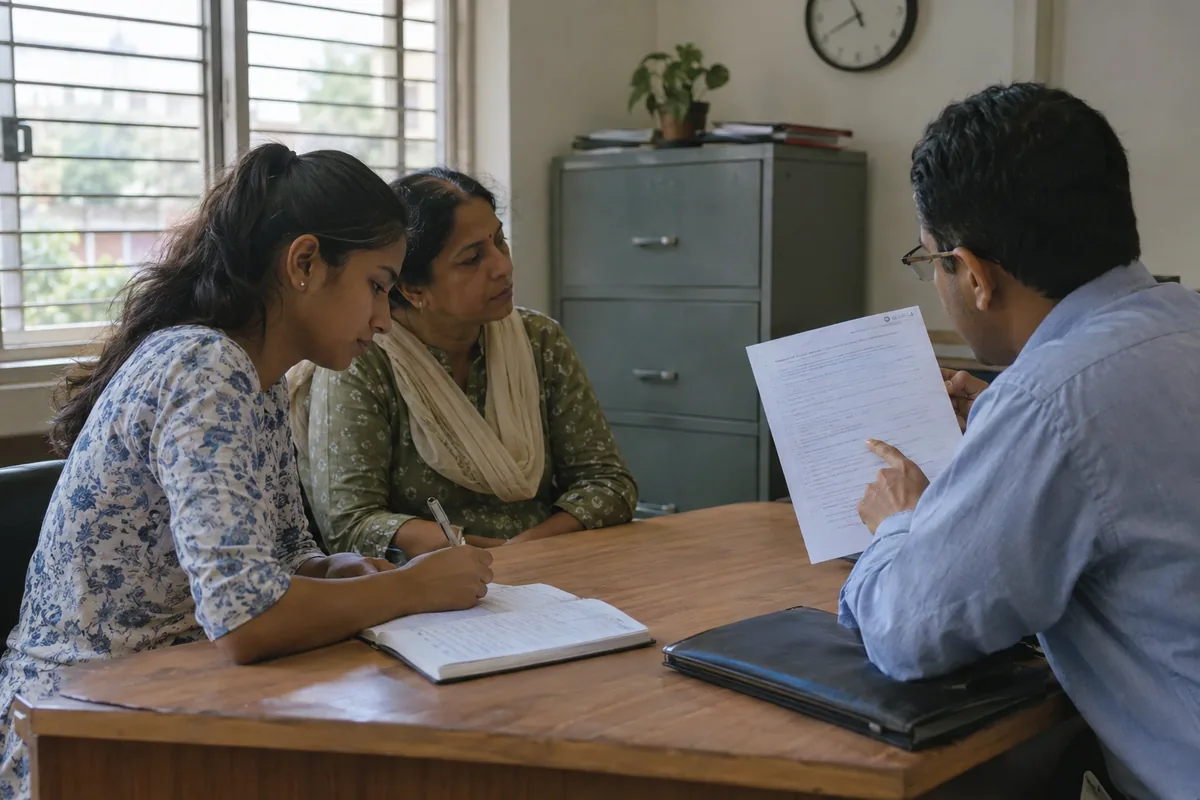
Questions phrased against documents an institution must publish, such as the scheme of examination or the fee notification, get specific answers instead of a sales pitch.
A brochure describes a place at its best, and a regulation describes it as it must operate. You want the second.
Read the documents, not the brochure
Four documents are worth the effort, and most students never open any of them.
- The course structure or scheme of studies. Which papers, in what order, with what credits.
- The scheme of examination. How each paper is assessed, and what weight the internal component carries.
- The academic regulations or student handbook. Progression, attendance, backlog rules, discipline.
- The fee notification for the current year.
Read the section on failure first. It is the part nobody volunteers, and it decides how a bad semester will actually feel.
What a placement claim can and cannot tell you
Placement figures are the most quoted and least examined claims around any course. You do not need to audit them. Ask three questions, and listen to how precise the answer is: which graduating batch is the figure about, how many students were in it, and what counts as placed, an offer in hand, a joining letter, or a named recruiter for your specific course.
An institution that answers with a batch, a denominator, a definition and a couple of named recruiters is telling you something. One that answers with a number and no denominator is telling you something too.
What a good answer sounds like
Good answers are specific, slightly boring, and often come with a limit attached. You will hear documents named, pages pointed at, sentences that begin with a condition. A good answer sometimes ends with an invitation to check the regulation because the person may be out of date, and that is the most honest sentence in the conversation.
Answers worth distrusting: ones that arrive before your question has finished, ones about the field rather than your course, ones that treat a doubt as a loyalty test. Anyone who replies to a question about assessment by asking you not to worry about all that has told you something about the next three years.
Decide on a written record, and hold it lightly
Write one paragraph: what you chose, the two or three facts that decided it, and what you would need to see to change your mind. In a year it will be the only honest record of what you knew at the time, and far more useful than trying to remember why you liked a campus.
Courses are consequential and less permanent than they feel. The point of all this questioning is not to find a choice you will never regret. It is to make a choice you can explain, from evidence you gathered yourself.
If you are still a year or two away from this decision, the earlier one matters more: A Student’s Guide to Choosing a Stream After Class 10 sets out how subject combinations open and close routes. And when the first results arrive and do not match your plan, Reading Your Own Marks: How to Work Out What Actually Went Wrong is the next thing to read.