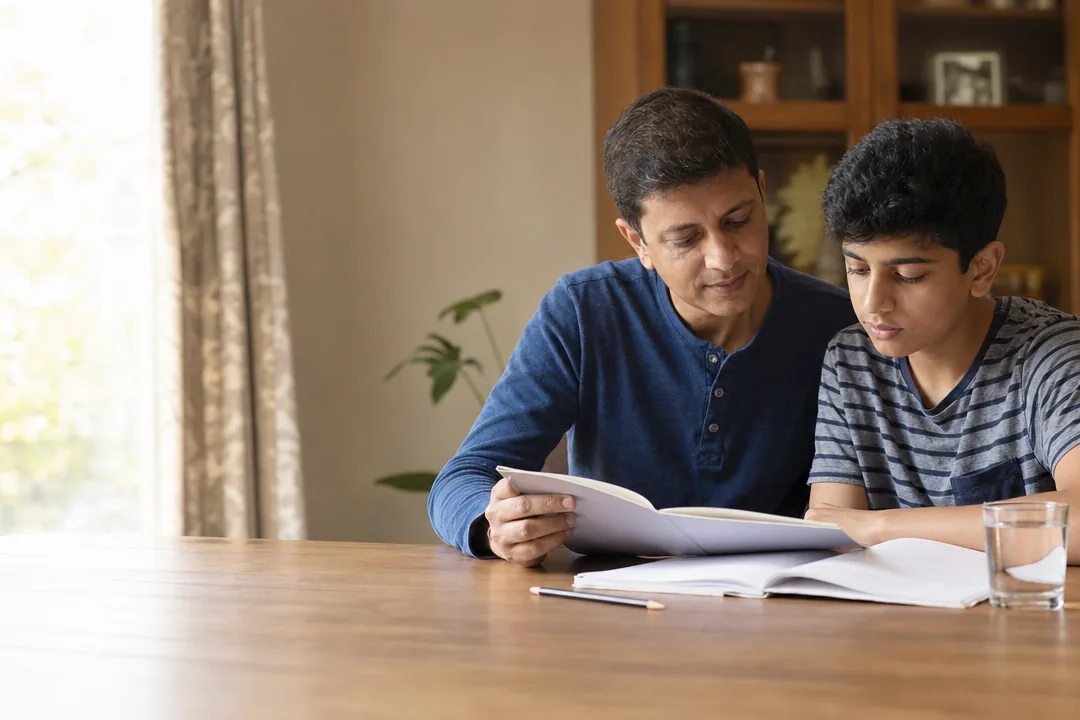
A CBSE Class 9 year used to feel like a waiting room: the same subjects, the same tests, the board exam still two years away. From this session that is no longer quite true. CBSE has begun running Class IX on the scheme of studies recommended in the National Curriculum Framework for School Education (NCFSE) 2023, and several of those recommendations touch your child directly.
Here is what changed, what did not, and what is worth asking your school. Everything below is current as of 28 September 2026 and drawn from CBSE’s own documents — the Secondary Curriculum 2026-27 for Classes IX–X and Circular Acad-14/2026 dated 1 April 2026. Policy moves, so treat the CBSE Academic portal as the authority over any summary, including this one.
What CBSE actually changed this session
Circular Acad-14/2026 confirmed that CBSE is implementing the NCFSE 2023 scheme of studies in Class IX from this academic session; the Class IX–X curriculum was released on 2 April 2026. The same circular asked heads of institutions to hold special parent-teacher meetings explaining the changes. Four of them matter most at home:
- The three-language formula is now enforced in Class IX. The third language (R3) became compulsory in Class VI and Class IX from 2026-27.
- Mathematics and Science are offered at two levels — Standard and Advanced.
- The 20 internal marks have a defined structure, not a general impression.
- New curricular areas appear on the timetable, including an interdisciplinary subject, alongside Art, Physical Education and Vocational Education as assessed areas.
Class IX is still a school examination
“NCF changes” is often read as board exams arriving early. They have not. Class IX still ends with an annual examination conducted by the school: 80 marks for that examination and 20 marks for internal assessment in major subjects — the same split as Class X, where the 80-mark paper is set by the board. To be declared successful in a subject, a student must secure at least 33% separately in the external and internal components.
One real difference this year: grading in Class IX is absolute, not positional. The Class IX scale runs from A1 (91–100 marks) downwards, so a grade depends only on your child’s own marks. In Class X the board grades on a nine-point scale by rank order, so a grade depends partly on how the cohort performs. A Class 9 result is a statement about your child, not about the competition.
The third language, and what “transitional” means
R3 is assessed entirely by the school; there is no separate board examination in the third language at Class X. But successful completion of R3 is mandatory for the award of the CBSE Class X certificate, and the marksheet will reflect the outcome distinctly. A student who has not qualified in R3 can still appear in the board examination in other subjects, with the school reassessing R3 before the board examination concludes.
Students entering Class IX in 2026-27 are in a transitional phase: they study Class VI level R3 textbooks prescribed by NCERT or CBSE, plus one local literary text. Two of the three languages studied must be native to India, and for a student who has not studied any native Indian language in Classes VI to VIII, a native Indian language at R3 is compulsory. Schools were directed to update their R3 offering on the OASIS portal by 30 June 2026. Case-by-case exemptions exist for children with special needs under the RPwD Act, 2016, and for students arriving from foreign boards who have not previously studied a native Indian language.
Mathematics and Science at two levels
Both subjects are now offered at Standard and Advanced levels in Class IX. Everyone studies the same core content and sits a common final examination of 80 marks and three hours. Students who opt in to the Advanced level also take a 25-mark, one-hour paper built entirely from higher-order questions on additional content. Scoring 50% or more there earns a line on the marksheet — the document’s tentative wording is “The Advanced Level has been successfully cleared” — but those marks are not added to the aggregate or total. Below the threshold, no reference to the Advanced level appears at all.
The choice is genuinely optional: a student may take neither, one, or both. The older Mathematics Basic/Standard split is discontinued from 2026-27, though students already in Class X this year continue under the previous scheme. The Advanced paper rewards depth and comfort with unfamiliar problems and carries no aggregate benefit, so it is not worth deciding in September on the strength of one test.
The 20 internal marks now have a structure
Internal assessment is defined as four components, each carrying 25% of the internal total: three periodic assessments per subject, of which the average of the best two counts; multiple assessment through presentations, discussions, quizzes, experiments, projects, fieldwork and reflective tasks against rubrics shared in advance; a portfolio of the student’s own work; and subject enrichment activities.
The curriculum states that the best performance across the prescribed components shall be considered when awarding the final internal credit, and that internal assessment should feed the Holistic Progress Card that NCFSE 2023 envisages as the school-family reporting document. Internal marks are therefore less a single teacher’s impression and more a record your child can influence repeatedly.
What arrives later, and what outlasts this year
“Individual in Society” is introduced as an interdisciplinary area in Class IX from 2026-27, and “Environmental Education” in Class X in 2027-28 — both as and when NCERT textbooks become available. Computational Thinking and AI have started for Classes III to VIII this session; for Classes IX to XII they are scheduled for 2027-28.
Two structural decisions will outlast the year. Classes IX and X constitute a composite course, and the curriculum says students should take in Class IX only those subjects they intend to continue in Class X — a subject set aside now is not simply picked up again later. Separately, the Class X board examination has moved to two phases, a main examination and a second optional attempt for improvement, with the better performance considered. That scheme ran for the first time for the 2026 Class X examinations. Advanced-level papers are scheduled to reach Class X in 2027-28, the year your Class 9 child sits the board examination; the mechanics will be published in CBSE circulars closer to the time.
If you are still working out how your school’s board, assessment and reporting choices fit together, two existing pieces are a useful companion: how to choose the right education board and an overview of the Indian schooling system and the NEP 2020 overhaul.
Questions worth asking at the next parent-teacher meeting
- Which languages is my child studying at R1, R2 and R3 levels, and is the school’s R3 offering recorded on OASIS?
- Who teaches the third language, and how many periods a week does it get?
- Is Advanced-level Mathematics or Science being offered, and what will the school base its advice to us on?
- What are the four internal assessment components in each subject, and how will we see the portfolio?
- When does “Individual in Society” start, and how will it be assessed?
- What does the school’s Holistic Progress Card report, and when does it reach families?
The short version
Class IX under the 2026-27 curriculum is still a school examination with an 80-plus-20 structure. The change is in what the curriculum asks for and how it is measured, not in who conducts the final paper. The three-language requirement is now real, Mathematics and Science carry an optional Advanced paper that adds recognition rather than marks, and internal assessment has four named components you can ask about specifically.
Ask a handful of precise questions at the next meeting, and leave the rest alone for a term. The point of these changes, on the board’s own framing, is to reduce dependence on memorisation — a goal that is easier to support at home if you are not adding pressure of your own.