
Behaviour records should help a school understand what happened, respond consistently, and support a student. They should not become a permanent collection of labels.
A useful process combines clear expectations with professional judgement. It gives teachers a quick way to record meaningful events, helps pastoral teams see context, and makes follow-up visible to the people responsible for it.
Start with a support cycle
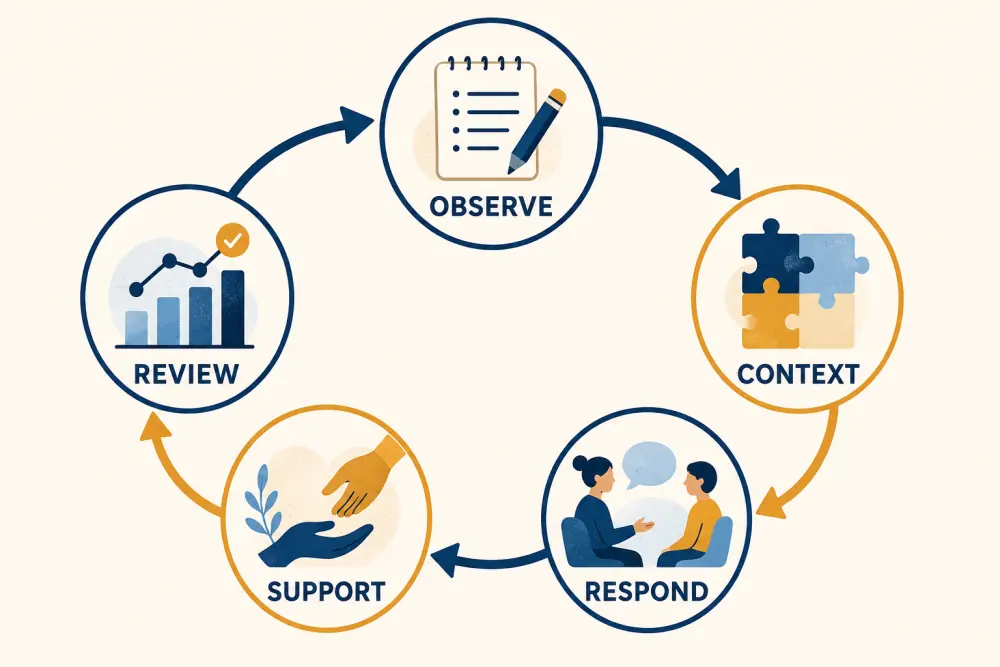
The cycle matters more than the incident count. Record an observation, capture relevant context, choose a proportionate response, arrange support, and review whether the response helped. A record without follow-up is administration, not a student-support system.
Define what should be recorded
Agree on a small set of event types and positive behaviours that are meaningful across the school. Include examples so staff interpret categories consistently. Distinguish an observable fact - “left the classroom for eight minutes after a disagreement” - from a judgement such as “disrespectful student.”
Keep free-text notes concise and relevant. Do not invite speculation about a child or family. Sensitive safeguarding concerns should follow the school’s dedicated safeguarding procedure, with access restricted to authorised staff.
Positive recognition belongs in the process too. Recording only problems creates a distorted picture and can make ordinary mistakes look like a student’s identity.
Capture context without making excuses
Useful context can include the lesson, location, time, people involved, preceding event, immediate response, and the student’s perspective. It helps staff identify patterns: a recurring transition problem may need a timetable or supervision change rather than repeated individual sanctions.
Context does not remove accountability. It improves the chance that the response addresses the cause as well as the visible event.
Make response and ownership explicit
Every event that needs action should have an owner, next step, and review date. Low-level classroom events may remain with the teacher. Repetition, wellbeing concerns, or serious incidents may require a year leader, counsellor, or school leader.
Set clear thresholds for escalation, but retain a route for staff to escalate unusual circumstances. Automatic severity scores should not replace professional review.
A connected platform can notify the responsible team without broadcasting the record. Explore how Scholva supports student management while keeping role boundaries clear.
Communicate with families thoughtfully
Decide which events require guardian contact, who communicates, and what information is appropriate. A short factual message with the action and next conversation is usually more useful than an unexplained category or points total.
Do not surprise families with a long history at the end of a term. Equally, avoid sending instant automated alerts for every minor correction; they can remove context and damage trust. Provide a named contact and an opportunity for dialogue.
Check for fairness
Review patterns across classes, year groups, event types, locations, and - where lawful and appropriate - student groups. The purpose is to find differences that need investigation, not to declare causation from a dashboard.
Ask whether expectations are applied consistently, some environments generate more incidents, or particular students receive different consequences for comparable behaviour. Sample the underlying notes before acting on totals. Train reviewers to recognise bias.
Never publish individual behaviour rankings or use public leaderboards. Restrict access, set retention rules, record corrections, and provide an appropriate route to challenge inaccurate information.
Measure whether support works
Useful measures include completed follow-ups, repeat-event trends, time to support, restorative actions completed, student or family feedback, and patterns by setting. Falling reports are not automatically proof of improvement; staff may simply be recording less.
Review data alongside attendance, wellbeing conversations, classroom observation, and staff insight. Attendance workflows can provide context, but correlation should never be treated as a diagnosis.
Implementation checklist
- Define observable categories and positive behaviours.
- Publish examples, escalation rules, and safeguarding boundaries.
- Record context, the immediate response, owner, and review date.
- Limit visibility by role and legitimate need.
- Give students and families an appropriate voice.
- Audit consistency, bias, corrections, and overdue follow-up.
- Remove records according to a documented retention policy.
- Evaluate support outcomes, not just incident totals.
A positive process turns records into coordinated care. If you want to map this workflow to your pastoral responsibilities, request a Scholva demonstration.
Related reading: How role-based access protects school data and Responsible gamification for student engagement.
For a related perspective, see Signs Your Child Is Struggling Before the Marks Show It.
For a related perspective, see Reading Your Own Attendance Data Properly.
For a related perspective, see Preparing for Board Exams Without Burning Out.
For a related perspective, see Handling Sensitive Student Records: A Practical Access Review.