
An alumni network becomes active when former students receive value, find meaningful ways to contribute, and trust how the institution uses their information. A contact database is necessary, but it is not the community.
Build a repeatable engagement cycle
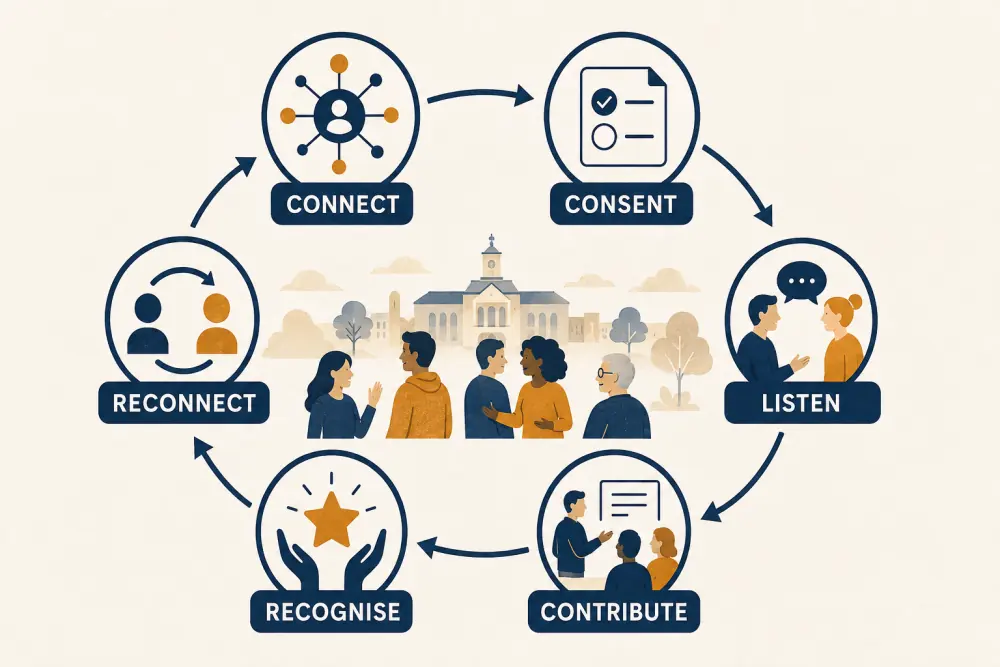
Connect with alumni, record their communication choices, listen to their interests, offer suitable opportunities, recognise contributions, and reconnect. Repetition turns occasional outreach into a durable programme.
Start before students leave
During the final year, explain the alumni community, the kinds of communication it offers, and how graduates can update their details. Ask for appropriate consent rather than assuming a former student wants lifelong marketing.
Separate the academic record from engagement preferences. The institution may need to retain some records for legitimate purposes, but that does not automatically authorise every newsletter or fundraising message.
Provide a clear way to change channels, frequency, topics, and consent later.
Create a trustworthy core record
Choose a small set of useful fields: identity match, graduation year, programme or house where relevant, verified contact route, location at an appropriate level, interests, volunteering preferences, and consent history. Record when information was confirmed.
Avoid collecting sensitive career, salary, family, or demographic details merely because they might be useful someday. Define who can export data, how corrections work, and how long inactive engagement data is kept.
Duplicate profiles are common when names, email addresses, or phone numbers change. Use a reviewed merge process so one alumnus does not receive repeated invitations or lose their history.
Listen before designing programmes
Survey a representative group and hold short conversations across graduation years. Recent graduates may want career guidance; established professionals may value networking or mentoring; older alumni may prefer reunions, archives, or opportunities to support current students.
Do not let the most visible group define the programme for everyone. Offer different formats, times, languages, and levels of commitment.
Offer more than fundraising
An active network can support mentoring, career talks, internships, reunions, local chapters, clubs, curriculum insight, archives, volunteering, and peer introductions. Make the benefit and expected commitment clear for each opportunity.
For mentoring, define boundaries, matching criteria, safeguarding expectations, meeting channels, and escalation. Do not share a student’s direct contact details without the required permission and controls.
Donations may be part of the programme, but every interaction should not lead to an ask. Trust grows when the institution also celebrates alumni, shares useful opportunities, and reports the impact of contributions.
Make events part of the record
Capture invitations, responses, attendance, volunteer roles, and follow-up in one workflow. This helps the team avoid conflicting messages and learn which formats serve different groups.
After an event, share a concise recap and next step. Ask what was useful and invite participants to update preferences. Photographs and attendee lists require an explicit, respectful publication policy.
Recognise contribution responsibly
Recognition should reflect the contributor’s preference. Some people welcome a public profile; others prefer private thanks. Confirm names, roles, and permission before publishing. Avoid implying that financial contribution is the only valuable form of participation.
Measure relationship health
Track reachable records, preference completion, response by cohort, repeat participation, mentoring completion, volunteer diversity, event usefulness, and corrections or opt-outs. Email opens alone do not describe a community, and large follower counts do not prove meaningful involvement.
Review who is missing. If activity is concentrated in one city, profession, gender, or graduation period, investigate access and programme design before increasing message volume.
Alumni programme checklist
- Explain the network and request appropriate consent.
- Keep contact details, preferences, and consent current.
- Offer clear correction and opt-out routes.
- Listen across generations and locations.
- Provide mentoring, learning, service, and social opportunities.
- Apply safeguarding and privacy rules to introductions.
- Record events and follow-up in one place.
- Recognise different types of contribution.
- Evaluate repeat participation, inclusion, and value.
Scholva’s alumni management can help institutions organise records and engagement while keeping the human relationship central. Request a demonstration to map your alumni lifecycle.
Related reading: Digital certificates and qualification verification and Connecting college admissions, programmes, and student services.