
Receiving a payment does not complete the fee process. The school must identify the payer, match the amount to the correct student and charge, issue or confirm a receipt, and post the result without creating duplicates. When references are inconsistent, staff can spend hours comparing bank exports, messages, and fee ledgers.
Automatic reconciliation handles strong matches quickly and sends uncertainty to a human review queue.
Understand the matching flow
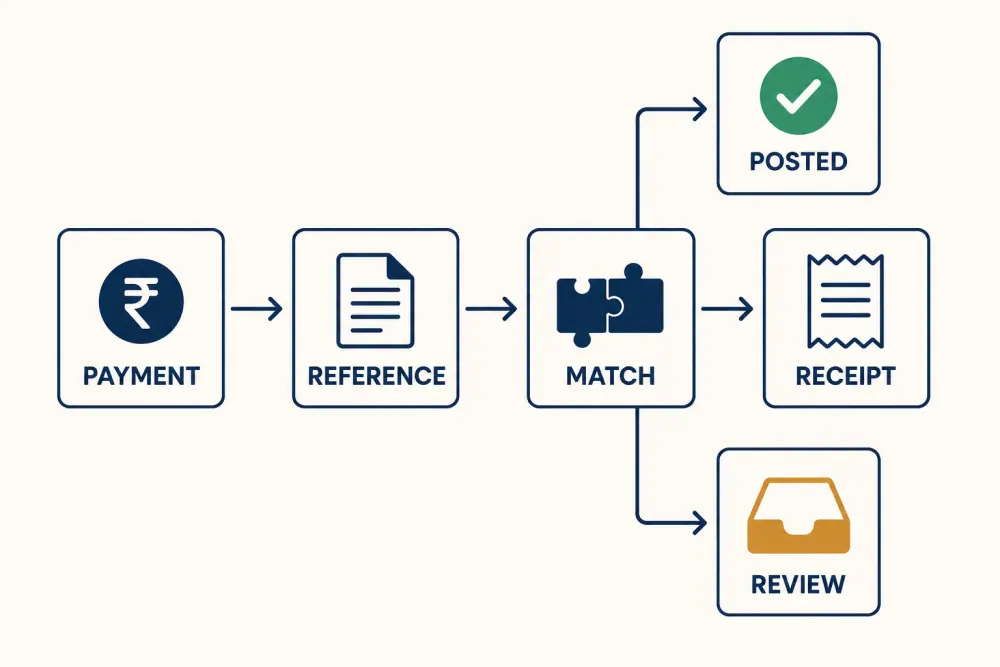
A typical flow contains payment, reference, match, receipt, and posting stages. If the evidence is incomplete or conflicting, the item should move to review instead of being forced onto the nearest record.
The safest automation is confidence-based: exact unique references and expected amounts may post automatically; reused, missing, partial, or conflicting references need a person.
Improve payment references
Give each student, invoice, or fee request a stable reference according to the school’s payment channels. Communicate it clearly through official notices and the parent portal. Where supported, prefilled payment links can reduce typing errors.
Do not rely only on payer name. Bank account names may differ from student or guardian names, siblings can share a payer, and abbreviations are inconsistent.
Define matching rules
Write rules in order of strength. An exact unused transaction identifier is stronger than matching only amount and date. A unique student reference plus expected amount may be strong; the same amount paid by several families is not.
Set tolerances deliberately and review them with the finance team. The software should explain why a transaction matched so staff can audit and correct the process.
Build a useful exception queue
Common exceptions include missing references, duplicate feeds, partial or combined payments, overpayment, payment for siblings, reversals, chargebacks, late bank settlement, and offline receipts. Categorise them so the right action is clear.
Assign ownership and ageing. An unmatched transaction should not sit indefinitely while the parent receives overdue reminders. The finance team needs to see items that affect current communication.
Prevent duplicate receipts
Use payment-provider or bank transaction identifiers to detect duplicates. A repeated import should be idempotent: it should recognise the existing transaction instead of posting it again.
Issue the receipt only after the school’s configured confirmation point. If a transaction later reverses, preserve the original event and record the reversal rather than deleting history.
Reconcile totals independently
Even strong item-level matching needs control totals. Compare the count and value of incoming transactions, matched items, exceptions, posted receipts, reversals, and settlement amounts for the period.
A school fees system can organise this workflow, but the institution should align exports and postings with its own accounting policies and professional advice. Software configuration is not a substitute for statutory or accounting review.
Connect reconciliation to communication
Once a confirmed payment is posted, parent balances and reminders should use the updated position. If a payment is under review, give staff a way to pause inappropriate escalation while preserving the original due record.
Avoid telling a family that a payment is confirmed before the institution’s process supports that statement. Clear states - received, under review, posted, reversed - are better than one ambiguous “paid” flag.
Monitor the system
Track automatic-match rate, exception age, duplicate attempts, manual overrides, reversals, and time from settlement to receipt. Review recurring failure causes. If missing references drive most exceptions, improve the payment request rather than adding finance staff.
Periodically sample automatic matches as well as exceptions. Quiet errors in the “successful” path can be more damaging than visible unmatched items.
Reconciliation checklist
- Payment channels provide stable identifiers where possible.
- Families receive the correct reference and approved instructions.
- Matching rules are ordered by evidence strength.
- Ambiguous items go to human review.
- Repeated imports cannot create duplicate postings.
- Partial, combined, sibling, reversal, and offline cases are defined.
- Control totals reconcile source, exceptions, and posted records.
- Receipts and parent balances use confirmed states.
- Overrides and corrections retain reason and history.
- Automatic matches are sampled and rules reviewed.
Reconciliation automation is valuable because it narrows manual work to genuine exceptions while keeping the finance team in control. Scholva can connect payment matching, fee records, receipts, and parent visibility. Request a demonstration using anonymised examples from your current process.
Related reading: Design flexible school fee structures and Improve fee collection without chasing parents.