
College admissions do not spread themselves across a year. They compress. The state’s common entrance counselling publishes its round schedule, the merit list appears, allotments are released, candidates arrive with a folder of certificates, and a fee deadline decides who actually enrols. Four decisions that belong to four different offices land in the same fortnight, and each one depends on the one before it.
The paperwork is not what makes this hard. What makes it hard is that the same candidate is described in four places at once: the counselling authority’s allotment list, the department’s intake sheet, the accounts register, and a spreadsheet maintained by whoever was at the desk that day.
The season is short, the record has to last
Everything created during these weeks is read again for years. The enrolment number issued now becomes the attendance record, the examination registration, the scholarship claim and, later, the data an accreditation visit asks to see. An error made in a hurry in June is not a June problem.
Treating the season as a records problem rather than a stamina problem is the whole argument of this article. Extra staff at the counter help with volume. They do not help when a candidate’s category was recorded one way at verification and another way at fee payment, because the second version came from memory.
One applicant, one record
Begin with the unit of work. It is not the seat, the fee or the document. It is the applicant, and there should be exactly one record per applicant that every office reads and only the owning desk edits.
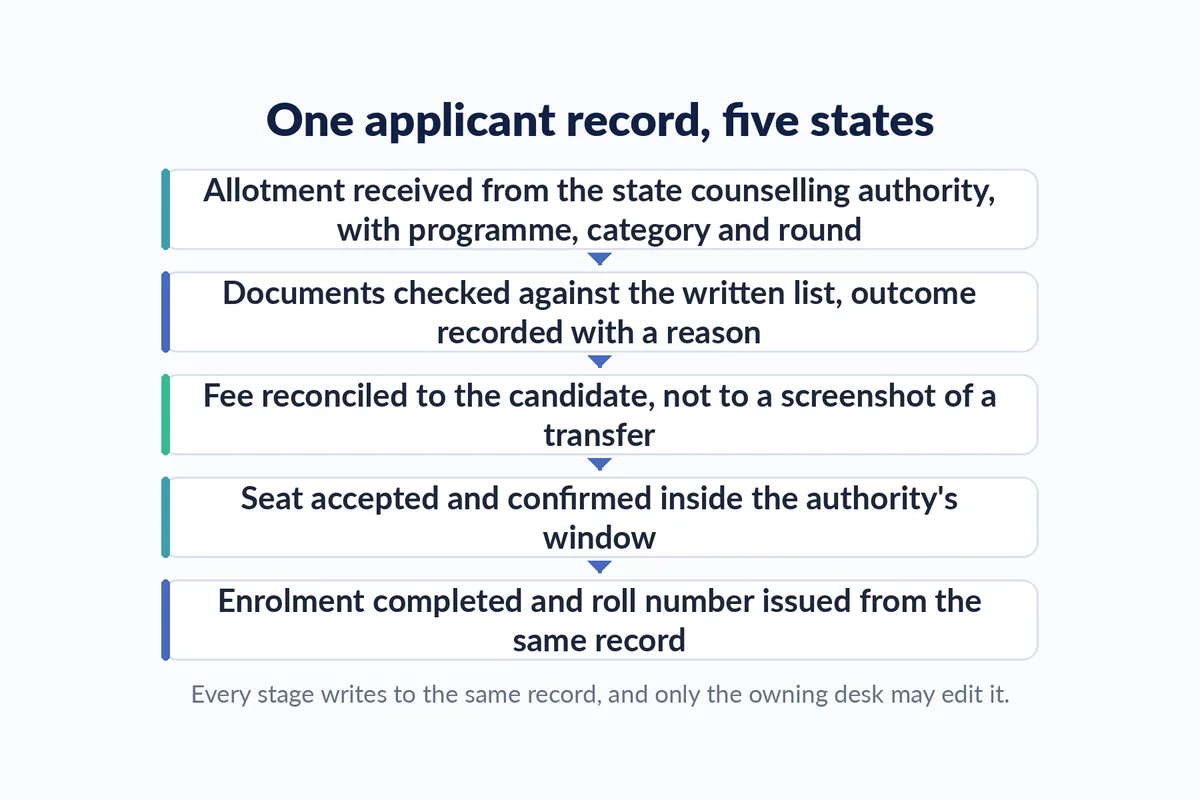
Five states carry a candidate from the counselling authority’s allotment list to a roll number, and each one is a field on the same record rather than a new file.
The record carries identity, contact, the programme and category applied for, the rank and round from the counselling authority, the documents seen, the fee status, and finally the enrolment number. Each stage adds to that record instead of starting a new one, so “where is this candidate” has a single answer at any hour of the day.
Pick any applicant and ask the admissions clerk, the accounts assistant and the head of department how many seats are confirmed in that programme. If the three answers differ, the institution has three admissions processes.
Merit lists and category quotas belong to the state
The counselling authority owns the merit list, the category and quota rules, the round structure and the deadlines. None of that should be re-derived inside the college. Import the published allotment data and reconcile it against your approved intake: programme, sanctioned strength, category and quota split, and the round in which each allotment was made.
Never maintain a parallel merit position in a spreadsheet. The moment your list and the authority’s list disagree, you have created a dispute you cannot win. And do not carry last year’s dates forward: schedules, the number of rounds and the rules for upgrading are revised between years, so the only safe source is the authority’s current published schedule, checked before each round opens.
Document verification is a checklist, not a conversation
Verification is the slowest step of the season and the one most often run from memory. A candidate sits down, an experienced clerk looks at a folder, and the outcome is a nod, a shake of the head, or “bring the original later”. None of those three outcomes is a record.
Write the checklist down. It has two parts, and they should not be mixed: what the counselling authority requires before it will confirm an admission, and what the college asks for on top of that for its own file. The first part comes from the authority’s current brochure and should be quoted from it, not remembered. The second part is your policy, and if it is not written, it is not a policy, it is the mood of the person at the desk.

Verification produces one of four outcomes, so the folder on the table should end the conversation with a status on the record rather than a nod.
The outcomes are finite and each one deserves a field on the record: verified, provisional pending a named document, rejected with a reason, or not yet seen. A provisional admission without a date by which the document must arrive is an admission that will fail quietly, usually in the week the examination form is due.
Allotted, accepted, paid and enrolled are four different things
Most admissions confusion comes from collapsing four states into one word, “admitted”. A candidate is allotted a seat by the authority, accepts it within the authority’s window, pays the institution’s fee, and then completes enrolment on campus. Each state has a different owner, a different deadline and a different way of failing.
When the record holds those four states separately, two useful things happen. A seat that has been allotted but not accepted can be released in time for the next round instead of being discovered as empty in September. And the count of confirmed students stops being an estimate.
Fee deadlines do not negotiate
Fee collection during admissions is not really a finance task. It is a reconciliation task, and it fails on exceptions: a transfer with no reference number, an amount that matches a different programme’s fee, a concession discussed at the counter but never approved.
Decide the accepted payment channels before the first round, decide who may approve an instalment arrangement, and define what counts as confirmation. A screenshot of a transfer is not a receipt, and marking a seat confirmed on one is how two candidates end up against the same seat. Keep a single exception queue for payments that do not reconcile, with one owner and a daily review.
The phone is not a status system
Count the calls an admissions office receives in a peak week and most of them ask one of four questions: is my document accepted, is my seat confirmed, how much do I still owe, and when does my class start. Every one of those is a read of data the institution already holds.
A candidate-facing status view answers them from the record instead of from a clerk’s memory of yesterday, which improves accuracy as much as it saves time. Opened to departments, the same view ends the internal version of the call: how many seats are left in this programme, and how many of them are actually paid for.
Reconcile before the season is declared over
The damage from a rushed intake shows up after the queue has gone: a candidate allotted in two institutions, a seat confirmed twice in the same programme, a cancellation never processed, a refund nobody can trace.
Give the fortnight after the last round to reconciliation. Compare the enrolled list against first attendance and the paid list against the enrolled list. Call the gaps rather than writing them off: most are a candidate who was told something at a counter that the record does not say.
A short list for the week before the round opens
- Confirm the current counselling schedule from the authority itself, not from last year’s file.
- Import the approved intake by programme, category and quota, and reconcile it to the allotment data.
- Write the document checklist in two columns, authority requirement and institutional requirement.
- Name the four states on the record: allotted, accepted, paid, enrolled.
- Decide who may approve an instalment, a concession and a provisional admission.
- Publish a status view for candidates before the first deadline, not after it.
- Book the reconciliation fortnight before anyone goes on leave.
None of this needs a bigger team. It needs the season described once, in advance, as a sequence of states with an owner for each, and each fact recorded once at the point where it is first known. An institution that can answer “where is this candidate” without a phone call has already solved most of its admissions season, and the same discipline is what makes a single source of truth across multiple campuses work when intake is spread over more than one site. If the reporting side is the next question, the practical analytics use cases for schools, colleges and coaching institutes show what becomes possible once those records are complete.
A peak handled with one record per applicant reads to a family as a college that knows who they are. A peak handled with four spreadsheets reads as a college that will lose their certificate.