
Every study plan works in week one. The notebook is new, the evenings are still empty of the backlog the plan exists to clear, and nothing has yet collided with a test that moved, a tuition class that shifted, or an evening when you came home too tired to open anything.
Then the second week arrives, and with it a normal week. Most plans do not survive it. The conclusion most students draw is that they lack discipline. That is rarely what happened. The plan was built on an assumption about time that a normal week quietly disproves.
Week one is not evidence
A timetable is a claim about the future: that on Tuesday at seven you will be able to do the hardest thing on your list. Week one is a weak test of that claim, because week one has no backlog and no interruptions. The test that matters is the ordinary week, the one with a class that ran late, a test you did not plan for, and a family evening you did not want to miss.
The mistake is planning hours instead of energy
Take two students with the same three free hours. One has them from six in the morning, after a full night’s sleep, before the house is awake. The other has them from nine at night, after school, a commute and dinner. On paper the resource is identical. In the body it is not.
Free hours are not usable hours either. An hour between school and dinner, with a bus, a change of clothes and a younger sibling in the room, may hold twenty minutes of real work. The plan counted sixty. Nothing was dishonest; the plan simply counted the clock instead of the person.
This is why plans built from available hours collapse the moment an hour is not available. A plan built from energy patterns bends instead, because it was designed around something that repeats.
Audit two real weeks before you plan one
Two weeks, not one. Try to catch one ordinary week and one with something in it.
Each evening, write four things: what you actually studied, when, for how long, and how it went. Two words are enough for the last one. Sharp. Flat. Restless. Good for the first half only.
Then read the fortnight for three patterns.
- The windows where work came easily. Almost everyone has one, and often two. This is the raw material of the whole plan.
- The windows where you sat for an hour and produced two lines. Those are not for new chapters. They are for tidying notes, checking tomorrow’s classes, or nothing at all.
- The interruptions, and whether they can move. A phone, a shared room, a television, a neighbour.
Two questions matter more than the times on the page: where you were sitting, and where your phone was. A window that only works at the kitchen table with the phone in another room is a window with conditions, and the conditions belong in the plan.

Two weeks of evenings written down beats a plan built from memory, because the pattern you are looking for is only visible when the days sit next to each other.
Match the work to the window
Sort each week’s work into three kinds, then place them by the state they need rather than by the subject they belong to.
- New material needs your best window, the one where you read something once and understand it. This is the work that disappears when it is pushed to the last hour of the day.
- Practice and revision need a moderately tired but focused head. A second-best window is fine, and a timed paper is better here than reading.
- Admin means organising notes, checking what is due tomorrow, adding to a formula sheet, filling a gap you noticed last week. It fits almost anywhere, including the windows where nothing else works.
Most plans that fail put new material at night because that is where the hours were. The hours were there. The head was not.
Build the plan in five moves
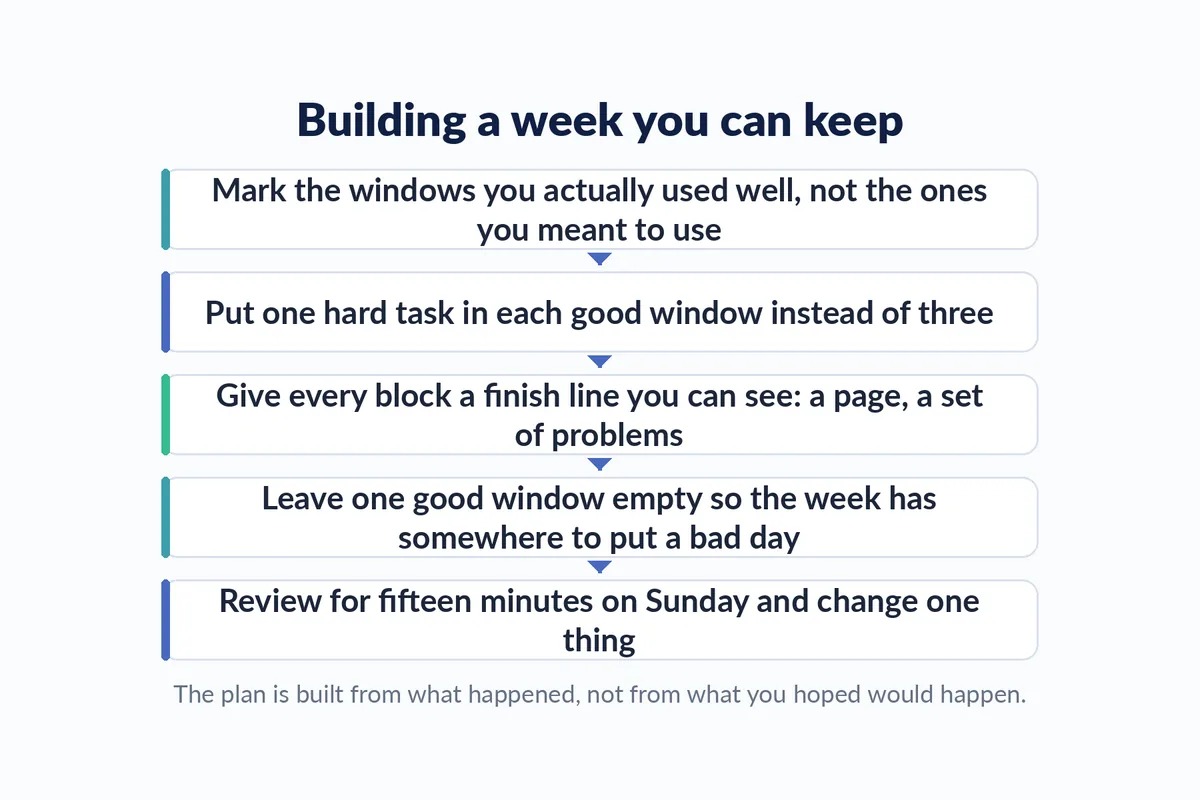
The order carries the method: the windows come first, the tasks fit into them, and the empty slot is what makes the difference between a plan that bends and one that breaks.
- Mark the windows you actually used well. Not the ones you wish you used. Two or three reliable windows is enough to build on.
- Put one hard task in each good window. One. A window that holds three subjects holds none of them properly.
- Give every block a finish line. A page number, a set of problems, a heading in your notes. Something you can look at and say it is done.
- Leave one good window empty. Not as a reward, as structure. The week needs somewhere to put the thing that went wrong.
- Set the review before you need it. Fifteen minutes on Sunday, written into the week like any other block.
Write tasks, not hours
“Physics, two hours” cannot be started, only endured. “Chapter 6, problems 1 to 12, then check the answers” can be started, finished and measured, and it tells you when to stop.
A block with no finish line expands until it meets bedtime, and a student who ends every evening past the point of absorbing anything learns to associate study with being tired.
Plan the week, not the day
Days go wrong. Weeks rarely do.
A daily plan that misses Tuesday evening feels broken, and a plan that feels broken gets abandoned by Thursday. A weekly plan moves Tuesday’s block to Thursday and keeps going.
Keep it on one page, somewhere you see it without opening anything.
When it breaks, move it, do not double it
The first missed block is a test of the plan, not of you.
Move the block. Do not add it to the next evening, because stacked blocks are how a timetable turns into a punishment and then into an abandoned timetable. If two blocks go in the same week, cut one rather than compressing both. Compressing removes the finish line, and the finish line was the part that made the block startable.
If the same subject is dropped every week, that is information rather than failure. Either the window you gave it is wrong, or the block you wrote for it is too big to begin.
The minimum that keeps a bad week alive
On a day when nothing is going to happen, do the smallest real unit of one subject. Five problems. One derivation. One paragraph of a summary. Twenty minutes.
The point is not the content. The point is that tomorrow the plan is still something you are following rather than something you have stopped.
Add one person to this: a classmate, a sibling, a parent, who asks on a fixed day. Not what you scored. Whether the block happened.
Review it on a Sunday, in fifteen minutes
Three lines. What happened. What did not. What you will move.
Then change one thing, not five. A plan rebuilt from scratch every week never gets tested, because it is always a different plan.
Three weeks of this and you will know whether the timetable is honest. If the same blocks keep being dropped, the plan is wrong. Change the plan rather than your opinion of yourself. If your evidence is a set of marks rather than a set of evenings, Reading Your Own Marks: How to Work Out What Actually Went Wrong shows how to sort the lost marks into something you can act on.
What survives week one
A timetable you actually follow is smaller than the one you would like. It sits in the windows you already use, it is written as tasks with endings, it has room in it for the week to go wrong, and it is reviewed by a person who is willing to move a block instead of defending it.
That is a low standard, and it is the one that holds. The ambitious version is easy to write on a Sunday and hard to keep by Wednesday, and the habit worth having is the ordinary week, repeated.
If the year ahead contains a board examination, Preparing for Board Exams Without Burning Out covers how the same weekly structure changes as the paper gets closer, including what to protect in the last six weeks.