
Marketing is the easiest part of a coaching institute to measure and the easiest place to spend money. Enquiries, walk-ins, the cost of a lead: all of it is countable and all of it turns into a report at the end of the month, so it gets reviewed in a meeting while the thing that decides the year sits in a register nobody opens until a fee falls due.
The constraint is not demand. It is how many of the students who enrolled in June are still in the room in November, and whether anyone noticed in week four, when they first began not to be.
The seat is lost long before the fee reminder
In many institutes the only systematic contact with a struggling family is the fee reminder, which is the wrong instrument for three reasons.
It arrives late. A family that is drifting usually stops attending before it stops paying, so the reminder reaches the parents after the student has already decided.
It arrives at the wrong family. Plenty of students with perfect fee records are on their way out; those parents are not withholding money, they simply do not know she has not attended the evening batch in eleven days.
And it arrives with the wrong tone. A message about an overdue instalment tells a worried parent that the institute’s first interest is money, and whatever the office says next is heard through that.
Attendance is the earlier signal, and the institute already holds it for every student, every week.
Attendance has a pattern, not just a percentage
A monthly attendance percentage is the least useful number in the system. It flattens a student who attended every session until the twelfth into the same figure as one who missed every Tuesday for a month.
Read the pattern instead, and three shapes are worth naming.
A repeating weekday or slot. Missing the Saturday test series, or the 6 a.m. batch on Mondays, is usually a fact about that family’s week, not a discipline problem.
A change from the student’s own baseline. The comparison that matters is a student against their own last four weeks, not the batch average. Dropping from near full attendance to seventy percent is a move, even where seventy percent is respectable elsewhere.
Explained against unexplained absence. An absence the office was told about, and recorded with a reason, is information. An absence nobody can account for is the one that repeats.
Read batches, not individuals
One student’s attendance is noisy. A batch’s attendance is a verdict on the institute’s own arrangements, and it separates a phone call from a timetable change.
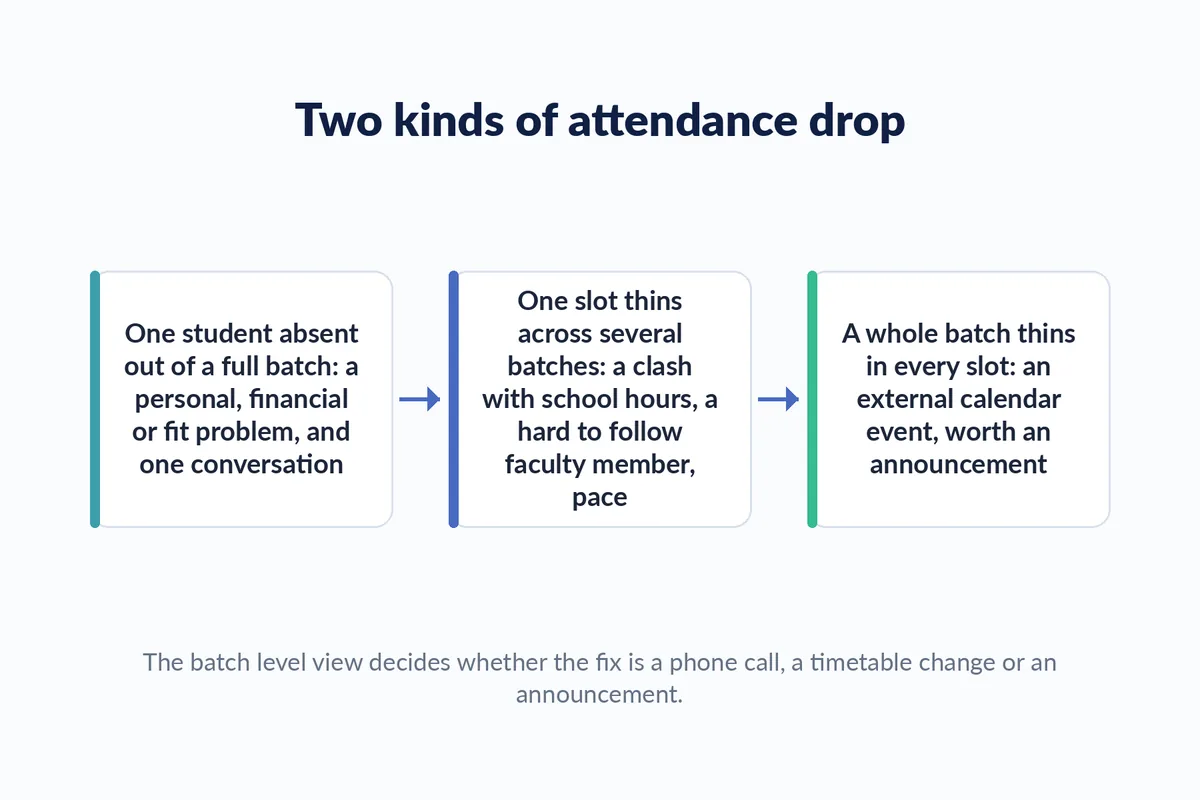
Reading the drop at batch level rather than student level is what tells a director whether the fix is one phone call, a different slot, or a calendar announcement.
A batch that thins in one slot has a slot problem: a clash with school or college hours, a faculty member the room finds hard to follow, a syllabus moving faster than the room can absorb. Ringing forty parents produces forty apologies and no attendance; moving the slot or slowing the pace refills the room.
A batch that thins across every slot has an external cause, such as board practicals or a festival month: worth an announcement, not a rescue plan.
A single student who stops coming out of a mostly full batch is the case a register cannot explain alone, and where one conversation beats any report.
Test data says whether the absence is costing marks
Attendance says a student is not there; it does not say what that costs. Pair the two and one absence figure leads to two conversations.
Two students, both at seventy percent. The first holds rank in the weekly test and may be studying elsewhere, so the conversation is about what the fee is buying and whether this batch fits. The second has slipped two grades in three weeks, and that conversation is about rescue: the missing chapters, the backlog, what the family can support at home.
The reverse case matters as much: marks falling for two cycles while attendance holds near full usually means the teaching has moved past the student, or something at home has changed.
The weekly hour, and what to do in it
None of this needs a dashboard. It needs an hour, on the same day each week, with the same questions, worked through batch by batch.

The weekly call is the step that turns a flag into a reason, and the reason is what decides whether the student needs a timetable change, a rescue plan or nothing at all.
Start on Monday with last week’s attendance for every batch, set against that batch’s own four week average rather than a target. Flag three things and nothing else: two consecutive unexplained absences, attendance fallen visibly from a student’s own baseline, and test scores that dropped in two cycles while attendance held.
Each flag needs a name against it before the meeting ends, someone who teaches that student rather than the front desk. The person who takes the class knows who works night shifts, who has a board practical, and who has stopped answering calls.
The call is not a warning. Ask what has changed, record the answer in the same field every week so reasons can be counted later, and agree one small next step with the family. Most such calls end with a fact the office did not have.
Close the loop on Friday: which flags were called, which reasons came back, who is still unexplained. A flag raised and never closed teaches the staff that flags are decoration.
The thresholds that give attendance teeth
Attendance has a hard edge too. Boards and universities set their own minimum attendance requirements for eligibility to sit an examination, and an institute preparing students for those examinations inherits the consequence. Those rules differ by board, university and year, so the numbers belong on the board’s or university’s own circular, current as of the date you check, not in an article.
What the institute controls is whether a student learns of the risk in week three or in the fortnight before the exam, when nothing can be repaired. A weekly view that flags the students nearest whatever threshold applies turns an eligibility crisis into a conversation about a timetable, and decides whether the register survives being questioned at all.
A register worth reading
Most attendance data is a compliance artefact for four ordinary reasons: the month is marked at the end of it, everyone is present because the room looked full, presence is recorded at the gate rather than in the class, and past entries can be edited by anyone.
Two decisions fix most of it. Capture attendance per session, in the session, by the person teaching it, and route corrections through a named person with a timestamp, so a later change shows up as a change. A register with those properties can carry a conversation with a parent; one without them cannot, and the office knows it, which is why nobody uses it.
The Monday list
- Batch attendance last week against each batch’s own four week average.
- Students with two consecutive unexplained absences.
- Students whose test scores fell in two cycles while attendance held.
- Students nearest the eligibility threshold that applies to their board or university.
- Flags from last week that are still open.
One page, one owner for each line, a reason written down for every call. That is the whole system, and it fits into an hour.
Retention is not marketing wearing a different hat
A marketing spend answers one question: how many families enquired. Attendance and test data answer the other: how many who came stayed, and what the ones who left needed in the week before they decided. The first number does not compound. The second does, because a seat held into a second year costs nothing to acquire, and a reputation for noticing a struggling student travels further than any hoarding.
Scholva keeps session level attendance, test results and fee history on one student record, so the Monday list is a view rather than an exercise in copying between registers. For the intake side of the same problem, see Coaching Institute Intake: Managing the Seasonal Surge. If the register is still being filled in at the end of the month, Reading Your Own Attendance Data Properly is where to start.
A coaching institute rarely loses students to a competitor’s advertisement. It loses them in the gap between the day they stopped coming and the day someone noticed.